In all things, there abides either life or death; in every action we perform, we perform either life or death; in the words that we say or write, we validate either life or death; in the ways that we think and in the ideologies to which we cling, we are either struggling up the bright and rough mountain or sliding down into the dark pit, into a centre that cannot hold. I understand that such an absolute conception of the world is outmoded and no longer fashionable and I grant that there may in fact seem to be, in certain cases and under certain circumstances, shades of grey in our perception of the world, times when it is not clear if we are choosing life or death. But the world itself is not grey; it is not nearly as polymorphous, ambivalent and relative as we, grasping for self-satisfying justifications, so often try to convince ourselves that it must be. Life or death. Good or evil. This is the nature of the world and this is the nature of people. These are not mere philosophical considerations; they are not abstractions or moral hypotheticals; they are not metaphors or tropes -- you, me, everyone: we are either choosing life of we are choosing death. And recognizing which is which is not nearly as difficult or complicated as it often seems. Life corrects; death permits. Life builds; death dissolves. Life searches for truth; death denies its existence. Life faces reality; death ignores it. Life speaks for the voiceless and abandoned; death consumes them before they can speak. Life recognizes evil and calls it such; death lies and says that evil does not exist. Life, because it does not deny the existence of evil, defines the boundaries of freedom; death, because it fears definition, sets fire to every bounding line and declares that there are no limits. Life is self-affirming; death is self-immolating. Life loves; death hates. Life lives; death dies. Life is eternal; death, like grass, whithers and vanishes.
Thursday, September 18, 2008
A Matter of Life and Death
Whenever the time comes to write anything about politics I feel sliding sickliness wash over me and a nearly overwhelming sense of apathy and depression opens up around me and plunges me into a dark cloud fraught with dragons and reptiles of the mind. It's not that I don't understand what is happening in the world, or that I don't recognize the shapes, spirits, and forces that are guiding it and dragging it down dark well-trodden paths, it's that all the things that I see twisting and turning in the winds and over the lands of once great nations, all the white-washed rhetoric, all the thinly veiled deceit, all the posturing and moral dissolution, only seems to confirm and validate within me my desire to step out, kick the dust from my shoes, kick the very world to pieces, and simply walk away. World be damned, I want no part of you. And yet I am, reluctantly at times, still a part of this world -- a sort of resident alien -- and so can only ignore it to my own peril, can only detach myself so much before my detachment becomes itself not an act of self-preservation but an act of sabotage and irresponsibility. So, with both Canada and the United States dancing on the razor's edge, two very different hells to find on either side, I feel compelled to add my own voice to the already over-loaded and terrifying cacophonous roaring din that is North American democracy.

Wednesday, September 17, 2008
In Memorium :: David Foster Wallace
David Foster Wallace -- novelist, essayist, cultural critic -- died on September 12, 2008 from an apparent suicide. I've read his first novel, The Broom of the System, and some of his essays; I haven't yet read Infinite Jest but have had every intention of doing so for a while now, and that intention that has only been lent some urgency. I can't say that I know much about him; I can't say that I'm an expert on his work; but I can say that he offered me some bright, shining insights into the nature of language and culture and so I thank him for that. The highest praise that I can give an author is that he's caused me to think more clearly about myself. Here, then, are two passages from his essay "E Unibus Pluram: Television and U.S. Fiction," from his collection of essays, A Supposedly Fun Thing I'll Never Do Again; I found these quotes to be especially illuminating and relevant to my own thought. Enjoy.
And make no mistake: irony tyrranizes us. The reason why our pervasive cultural irony is at once so powerful and so unsatisfying is that an ironist is impossible to pin down. All U.S. irony is based on the implicit "I don't really mean what I'm saying." So what does irony as a cultural norm mean to say? That it's impossible to mean what you say? That maybe it's too bad it's impossible, but wake up and smell the coffee already? Most likely, I think, today's irony ends up saying: "How totally banal of you to ask what I really mean."
So then how have irony, irreverence, and rebellion come to be not liberating but enfeebling in the culture today's avant-garde tried to write about? One clue's to be found in the fact that irony is still around, bigger than ever after 30 long years of the dominant mode of hip expression. It's not a rhetorical mode that wears well. As [Lewis] Hyde puts it, "Irony has only emergency use. Carried over time, it is the voice of the trapped who have come to enjoy the cage." This is because irony, entertaining as it is, serves an almost exculsively negative funtion. It's crtical and destructive, a ground-clearing. Surely this is the way our postmodern fathers saw it. But irony's singularly unuseful when it comes to constructing anything to replace the hypocrisies it debunks. This is why Hyde seems right about persistent irony being tiresome. It is unmeaty. Even gifted ironists work best in sound bites. I find gifted ironists sort of wickedly funny to listen to at parties, but I always walk away feeling like I've had several radical surgical procedures. And as for actually driving cross-country with a gifted ironist, ot sitting through a 300-page novel full of nothing but trendy sardonic exhaustion, one ends up feeling not only empty but somehow... opressed.
Saturday, September 13, 2008
Reflections on the Revolution in France (excerpt)
It's election time again, both in Canada and the United States, and that has me once again reflecting on the nature of democracy and freedom. Here's an excerpt from Edmund Burke's famous book. Enjoy.
When I see the spirit of liberty in action, I see a strong principle at work; and this, for a while, is all I can possibly know of it. The wild gas, the fixed air is plainly broke loose: but we ought to suspend our judgment until the first effervescence is a little subsided, till the liquor is cleared, and until we can see something deeper than the agitation of a troubled and frothy surface. I must be tolerably sure, before I venture publicly to congratulate men upon a blessing, that they have really received one. Flattery corrupts both the receiver and the giver; and adulation is not of more service to the people than to kings. I should therefore suspend my congratulations on the new liberty of France, until I was informed how it had been combined with government; with public force; with the discipline and obedience of armies; with the collection of an effective and well-distributed revenue; with morality and religion; with the solidity of property; with peace and order; with civil and social manners. All these (in their way) are good things too; and, without them, liberty is not a benefit whilst it lasts, and is not likely to continue long. The effect of liberty to individuals is, that they may do what they please: We ought to see what it will please them to do, before we risque congratulations, which may be soon turned to complaints. Prudence would dictate this in the case of separate insulated private men; but liberty, when men act in bodies, is power. Considerate people before they declare themselves will observe the use which is made of power; and particularly of so trying a thing as new power in new persons, of whose principles, tempers, and dispositions, they have little or no experience, and in situations where those who appear the most stirring in the scene may possibly not be the real movers.
Burke, Edmund. Reflections on the Revolution in France. Edited by J.C.D. Clark. Stanford, CA: Stanford University Press, 2001. 151-2.
Wednesday, September 3, 2008
Review :: L'Armée des ombres (1969)
 It is only recently, over the last year or so, that I've become familiar with la nouvelle vogue -- the French New Wave -- and specifically with the filmmakers Jean-Luc Godard and Jean-Pierre Melville. My baptism into New Wave films came, fittingly enough, with Godard's whirlwind A bout le souffle (Breathless), but while that film certainly secured a position of extreme importance and excitement for the New Wave in my own mind it was not until I came to the movies of Melville that the movement became for me something more than just an aesthetic innovation. The films of Godard, films such as A bout le souffle or Bande a part, are fascinating and exhilarating but I find that their iconoclasm and almost reckless sense of innovation in a way almost impede their ability to simply tell good stories. In Godard, aesthetics and narrative become fused and yet slightly desynchronized, as if the two, blended as they are, are never quite able to connect in a satisfying way. Take Breathless for example: the jazzy re-invention of noir and gangster sensibilities inside an accelerating and at first rather disorienting editing style almost becomes a story unto itself and threatens to overwhelm, through sheer aesthetic force, any concerns either Godard or we may have for the film's actual narrative. One of the effects of this, at least on me, is the formation of a slight gap between viewer and film. I feel distanced from the screen, from the characters and their emotions, from the immediacy of the story. With Melville, however, though the aesthetic once again becomes an absolutely integral part of the films' substance it never threatens to overwhelm them in the same way. Perhaps it is his more subdued, meticulous and more than a little foreboding aesthetic, or perhaps it is simply his more organized and much less frantic sense of pace, but I find Melville, much more so than Godard, to be in complete command of his own aesthetic and so better suited to simply tell a story.
L'Armée des ombres (Army of Shadows) is Jean-Pierre Melville's film about the French Resistance during World War II. Sombre, pessimistic, and filled with a sense of inescapable and predestined resolution, L'Armée is by turns both heartless and sympathetic, both convinced and morally ambivalent. With blue and gray eyes (the film's dominant colour palette) it looks deeply into the moral ambiguity of both war and resistance -- and into the actions that both seem to demand -- but it seems to always refuse us the opportunity either to disengage entirely or identify completely with its characters and their actions. Though the narrative often picks up the stories of other resistance member's as well, L'Armée primarily follows Philippe Gerbier (Lino Ventura), a high-ranking member of the French Resistance. Unlike the grand war films -- the storm the beach, rescue the prisoners, defeat the enemy type of films -- L'Armée is a very subdued affair, muted in tone and scope, and muted, one might say, in its depiction of the heroic figure. The film's characters are not the young and the reckless soldiers and freedom fighter idealists that often accompany war films; they are hardened, professional, dedicated and appear both worn out and morally tired. Melville's resistance members have more in common with the type of characters we would normally associate with crime or gangster films -- like Melville's own Le Cercle Rouge (1970) -- rather than with war films: they are cool, aloof and detached; they go about their business in silent resignation, poised for sacrifice. In not glamourizing his subject, Melville humanizes it.
When Steven Spielberg was trying to create a sense of moral fatigue in Saving Private Ryan he was only faintly approximating what Melville is able to accomplish in L'Armée des ombres almost thirty years earlier. But while Spielberg allowed Ryan to slide across the line from moral fatigue to thinly veiled nihilism and into a faint disgust for its subject, Melville never lets L'Armée slump into such a relaxed posture. The resistance may be facing a hopeless battle, and they may know it, but neither they nor the film ever suggest that this is a pointless battle. The moral question that haunts the film is not "should we fight?" but "how should we fight?" which seems to me to be a much more relevant question, both in terms of WWII and present conflicts. So often war films -- especially those of the high-brow variety -- contemptuously dismiss the necessity of war, as if WWII could have been avoided if we all had developed of more liberal understanding of the world; so often war films -- especially those of low-brow variety -- blindly grope about for an often false binary structure and an easy rhetoric of good versus evil. L'Armée des ombres, more mature than either of those types of films, navigates between the two without really compromising either. It's a rather remarkable fusion of pessimism and conviction. One might call it realism, I suppose. I call it strong filmmaking.
Sunday, August 31, 2008
Review :: Brand Upon the Brain!
 Navigating the fragility of memory and the potentially deadly traps of reminiscence, saturated with regrets and guilt, twisting together disparate film elements and genres with nearly iconoclastic zeal, haunted and haunting, irreverent, horrific, inspired, wildly funny and more than a little disturbing -- Canadian art house auteur Guy Maddin's Brand Upon the Brain! (2006) is a seemingly semi-autobiographical meditation upon many things, chiefly familial relationship, love, childhood, and the inescapable and suffocating grip of the past. In the film, Guy Maddin (not played by Guy Maddin) returns to desolate little island in order to repaint the lighthouse, his childhood home and site of the orphanage that his tyrannical mother and mad scientist father had run. Though the lighthouse is falling apart, the good and dutiful son Guy will paint it, twice, in what very quickly becomes an obvious attempt to whitewash the trauma of his childhood. However, as William Faulkner wrote, "The past is not dead. In fact, it's not even past," and soon, despite his best efforts, Guy's past launches itself at both him and the screen in a dreamy and nightmarish whirl of phantasmagoria and Freudian anxiety.
Brand Upon the Brain! is ostensibly a silent film, complete with title cards and narration. It is black and white, frantically shot on rough and grainy super 8, and hypnotically edited. The film was originally designed to be a "cinematic experience," more a piece of performance art than a conventional theatrical film. It debuted at the Toronto Film Festival with live musical accompaniment and several live foley artists; in the festival circuit it has been narrated live by Maddin himself, Eli Wallach, Isabella Rossellini and Crispen Glover, amongst others. For this fantastical and metaphorical trip down memory lane, Maddin harvests nearly every genre imaginable, from melodrama to horror, fantasy to science-fiction, erotic thriller and teen detective story. Vampires, secret teen lesbians, Lord of the Flies-style savages and the re-animated dead become the principal characters on the stage of Guy's memory. And yet, as Maddin continually mashes up genres and themes and as he overlaps motifs and elements, a surprisingly coherent film emerges. The film never feels forced or disjointed; it all makes a type of emotional and resonant sense. In this sense, Maddin is very much a Canadian counterpart to David Lynch; however, unlike the often off-puttingly esoteric nature of the Lynch's narratives, even a casual film goer, were he able to withstand the unabashed art house sensibility of the film's style and storytelling, would easily be able to understand the broad sweeps of Brand Upon the Brain! Its touchstones and themes -- such as first love, maternal attachment, the ambivalence and ambiguity of adolescence -- are broad and universal enough that, though the film appears to be deeply personal it is immediately identifiable.
While it's clear that Brand Upon the Brain! is firmly couched within a metaphoric sensibility, it's difficult and probably deliberately impossible to firmly identify where biography breaks off and where fantastic and perhaps slightly indulgent metaphor takes over. Both metaphor and myth are, I think, a very appropriate vehicle for self-revelation and Maddin deftly uses both here. However, if I were to lodge one protest against the film it would be that it almost feels dishonest. By using his own name as the name of his protagonist, Maddin establishes an autobiographical tone that the film's more outrageous elements almost immediately challenge and call into question and you begin to suspect that autobiography is not on Maddin's agenda after all. The relationship between Guy and his mother, for instance, seems designed to inflame, and perhaps poke fun at, Freudian anxieties rather then legitimately explore deep-seated emotional or psychological issues. In fact, throughout most of the film I think it is more likely that Maddin has his tongue in his cheek rather than his head on the couch. It is perhaps best to think of the film not as an exploration of Maddin's past (of course, for all I know about Maddin's childhood, it may well be just that) but rather an exploration of the past in general, it's impact and import, and its highly subjective nature. Guy becomes not so much a director's surrogate as an audience's and that, when executed as expertly as here, is a thrilling experience of which to be a part.
Every time I think that the limits of film have been bounded and set, I find someone like Maddin who brazenly over-steps the bounds and pushes the medium in directions I hadn't expected. Brand Upon the Brain! isn't a perfect film and it certainly isn't for everyone. In fact, chances are that unless you count yourself amongst the pretentious cinematic elite you probably haven't even heard of the film. It is, however, an exuberant, thrilling and rather marvelous little film full of whimsy, menace, sentimentality and sudden and bright splashes of affection. Brand Upon the Brain! is the first Guy Maddin film that I've seen -- an embarrassing admission for a Canadian critic, I know. After seeing it, however, I can say that I am indeed very eager to catch up on some of his other films such as The Saddest Music in the World and My Winnipeg. Guy Maddin's vision in Brand Upon the Brain! is compelling and unique and worth the time of anyone who loves film.

Saturday, August 23, 2008
Braid
Other than a ranting, and in retrospect slightly hypocritical, diversion about Grand Theft Auto IV and the media circus that surrounded that game's launch, I've steered clear of any real gaming discussions or reviews on Rivers. Though I'm a rather enthusiastic gamer, I've always thought that gaming doesn't deserve much critical attention or serious thought. For the most part, gaming is diversionary -- it's entertaining but it's hardly what I'd call art. Braid, however, demanded my full attention. It even demanding that I rethink my position on games as art.

Braid is a unassuming little game. In an obvious homage to Super Mario Bros, our protagonist, Tim, is searching for the Princess. However, this Princess is not the helpless damsel in distress and Tim is not the stalwart hero we probably expect him to be. Tim has made mistakes. Big ones. It's his fault that he lost the Princess. He lost her not because he made a deal with the wrong people, not because he had enemies, not because he was involved in some diabolical scheme, and not because it's convenient to the game's plot; in fact, it's not because of any of the usually tropes and narrative conventions that get recycled game after game in an industry even more creatively stagnated than Hollywood. Tim lost the Princess because he walked out at the wrong moment. Braid is the story of Tim, an average man, trying to say sorry to his girlfriend. Or at least, that's what the story appears to be about. The game starts as one thing and ends up as another, however; or rather, the game does end where it starts but picks up and develops several other overlapping narratives that could be the same story from another perspective or could simply be thematically guided excursions into related territory. Braid's themes and plots begins to overlap, conflict and eventually collapse in upon itself in a type of narrative singularity. It's a bit dizzying. You might expect this sort of literary maturity in a novel or a particularly good film but you probably would not expect it from a video game. Braid tells us that we should expect it from now on.
At it's core, Braid is a platform puzzle game. Like any good platform protagonist, Tim can run, jump, drop down on enemies, bounce off them, grab keys, unlock doors, all the platforming usuals we've come to expect. Braid's distinguishing gameplay mechanic, however, is that Tim can manipulate time. If he falls to his death, fails to solve a puzzle, or sets up his strategy poorly, he can simply rewind time, go back to the beginning, and start anew. Different objects in the game's worlds react differently, however; some will obey Tim's temporal dictates, others will not. Knowing what object will do what at a given moment and under a given condition is crucial to solving these puzzles. However, as interesting a gameplay mechanic as this is (and believe me, it's pretty damn interesting... and fun), it is not Braid's true genius. It's true genius is the meta levels upon which it operates. The game is not what it appears to be. Here, in Braid, gaming grows up.
Braid rethinks the medium entirely and manipulates it in ways that are, as far as I can tell, wholly new. It is possible, I suppose, to see it only as a simple platformer and dismiss it as nothing more than an interesting excursion into an almost antiquated gaming formula. It is likewise possible to think of Hamlet only as a play or The Starry Night only as a painting. Braid's deceptively simple appearance overlays a deeply self-aware and reflective game experience. Braid's gameplay itself is, in fact, a metaphor. The entire game is a type of dream, a digital manifestation of Tim's psychic quest to undo the damage he has done. All the game's major elements reflect this interior focus. The tripped and Monet-esque dripping wet-paint art direction as an image of dream quest or of a desire for an altered reality; the platformer puzzles as a representation of an underlying assumption that every problem -- even emotional and relational ones -- is a riddle easily solved by manipulating its elements; the core mechanic, the ability to rewind time to effect a more desirable outcome, as a expression of the fundamental wish of the guilty to go back and do things right: the game is operating on all these levels and it's operating on all of them beautifully, with a subtle hand and a quiet affirmation. Braid is as transcendent a gaming experience as is perhaps possible on the medium.
In the last little while, we've seen glimpses of what gaming could be. Games like Ken Levine's Bioshock, which combined a deeply satisfying FPS experience with a 1940s art deco sensibility and a surprisingly thoughtful philosophical mediation, and Valve's Portal, which is one of the only truly original and innovative games to come out in years, have elevated the medium beyond it's simple escapist heritage to something approaching art. Braid is another of these elevating games. It is as important a game as we're likely to see for a long time. Though the medium, or perhaps the nature of the industry controlling much of the medium, is not normally predisposed to the creation of art -- and by art I generally mean a product of imagination that offers anything from a full interpretation to a small comment on the human condition -- it seems as if truly artistic efforts can succeed on the medium after all.
Braid is available on the Xbox Live Arcade. I believe it is right now exclusive to that platform but as far as I'm concerned this game should be released on every platform possible. It deserves to be played.

Tim is off on a search to rescue the Princess. She has been snatched by a horrible and evil monster.Braid is about the sorrow of lost love, about time travel and bittersweet forgiveness, and it's about the inescapable conclusions towards which most of us hurtle along. Deeply personal, surprisingly metaphysical, steeped in a keen sense of lose, and capable of evoking previously unknown levels of intimacy for a game, independent developer Jonathan Blow's first major release trumps years of big-budget game development in a single, unexpected burst of creativity. Like last year's Portal, Braid proves that the truly important developments in gaming are coming from the small releases, from unexpected places, in unexpected forms. While high-profile studios such as Bungie, Blizzard and Rockstar are constantly looking for ways to milk every last dollar from their respective franchises, Jonathan Blow has released a game with more emotion, more innovation and more genuine artistry than most of last year's releases combined.
This happened because Tim made a mistake.
Braid is a unassuming little game. In an obvious homage to Super Mario Bros, our protagonist, Tim, is searching for the Princess. However, this Princess is not the helpless damsel in distress and Tim is not the stalwart hero we probably expect him to be. Tim has made mistakes. Big ones. It's his fault that he lost the Princess. He lost her not because he made a deal with the wrong people, not because he had enemies, not because he was involved in some diabolical scheme, and not because it's convenient to the game's plot; in fact, it's not because of any of the usually tropes and narrative conventions that get recycled game after game in an industry even more creatively stagnated than Hollywood. Tim lost the Princess because he walked out at the wrong moment. Braid is the story of Tim, an average man, trying to say sorry to his girlfriend. Or at least, that's what the story appears to be about. The game starts as one thing and ends up as another, however; or rather, the game does end where it starts but picks up and develops several other overlapping narratives that could be the same story from another perspective or could simply be thematically guided excursions into related territory. Braid's themes and plots begins to overlap, conflict and eventually collapse in upon itself in a type of narrative singularity. It's a bit dizzying. You might expect this sort of literary maturity in a novel or a particularly good film but you probably would not expect it from a video game. Braid tells us that we should expect it from now on.
At it's core, Braid is a platform puzzle game. Like any good platform protagonist, Tim can run, jump, drop down on enemies, bounce off them, grab keys, unlock doors, all the platforming usuals we've come to expect. Braid's distinguishing gameplay mechanic, however, is that Tim can manipulate time. If he falls to his death, fails to solve a puzzle, or sets up his strategy poorly, he can simply rewind time, go back to the beginning, and start anew. Different objects in the game's worlds react differently, however; some will obey Tim's temporal dictates, others will not. Knowing what object will do what at a given moment and under a given condition is crucial to solving these puzzles. However, as interesting a gameplay mechanic as this is (and believe me, it's pretty damn interesting... and fun), it is not Braid's true genius. It's true genius is the meta levels upon which it operates. The game is not what it appears to be. Here, in Braid, gaming grows up.
Braid rethinks the medium entirely and manipulates it in ways that are, as far as I can tell, wholly new. It is possible, I suppose, to see it only as a simple platformer and dismiss it as nothing more than an interesting excursion into an almost antiquated gaming formula. It is likewise possible to think of Hamlet only as a play or The Starry Night only as a painting. Braid's deceptively simple appearance overlays a deeply self-aware and reflective game experience. Braid's gameplay itself is, in fact, a metaphor. The entire game is a type of dream, a digital manifestation of Tim's psychic quest to undo the damage he has done. All the game's major elements reflect this interior focus. The tripped and Monet-esque dripping wet-paint art direction as an image of dream quest or of a desire for an altered reality; the platformer puzzles as a representation of an underlying assumption that every problem -- even emotional and relational ones -- is a riddle easily solved by manipulating its elements; the core mechanic, the ability to rewind time to effect a more desirable outcome, as a expression of the fundamental wish of the guilty to go back and do things right: the game is operating on all these levels and it's operating on all of them beautifully, with a subtle hand and a quiet affirmation. Braid is as transcendent a gaming experience as is perhaps possible on the medium.
In the last little while, we've seen glimpses of what gaming could be. Games like Ken Levine's Bioshock, which combined a deeply satisfying FPS experience with a 1940s art deco sensibility and a surprisingly thoughtful philosophical mediation, and Valve's Portal, which is one of the only truly original and innovative games to come out in years, have elevated the medium beyond it's simple escapist heritage to something approaching art. Braid is another of these elevating games. It is as important a game as we're likely to see for a long time. Though the medium, or perhaps the nature of the industry controlling much of the medium, is not normally predisposed to the creation of art -- and by art I generally mean a product of imagination that offers anything from a full interpretation to a small comment on the human condition -- it seems as if truly artistic efforts can succeed on the medium after all.
Braid is available on the Xbox Live Arcade. I believe it is right now exclusive to that platform but as far as I'm concerned this game should be released on every platform possible. It deserves to be played.
Wednesday, August 20, 2008
On Klaus Kinski
Last night I watched Mein Liebster Feind, Werner Herzog's documentary/tribute to his friend, the explosive, volatile and absolutely mesmerizing German actor Klaus Kinski, whom Herzog had worked with, and fought with, on five of his most famous movies, including Aguirre: The Wrath of God and the now legendary Fitzcarraldo. Perhaps because in Herzog's films he always plays a character who is either teetering on the edge of madness or who has whole-heartedly plunged into it I've always just assumed that Kinski himself was a sort of a madman. A genius, but a thoroughly diabolical one. And apparently, I was right. Kinski was mad: egomaniacal, conflicted and perhaps a shade delusional. Prone to raving fits and explosive, violent outbursts, Kinski was not so much an actor to be directed as one to be wrestled with. He could rant for hours, foaming at the mouth, over the smallest of artistic differences; he could become physically violent, lashing out at actors and extras he thought were performing poorly; he would, as a matter of course, threaten to walk off a project entirely. Herzog apparently had to actually threaten to shoot him in order to keep Kinski from walking out during the filming of Aguirre. But Kinski could also be an extremely courteous and gentle man, capable of moments of truly sublime beauty. Here are some videos of Kinski that I find simply fascinating. Unfortunately, the first two are in German but Kinski's real grandeur is his face and emotional volatility, which translates without subtitles just fine. The first one is a famous clip from Kinski's "Jesus Tour," a one man show in which he interprets Jesus and the Gospels as the ravings of a lunatic. This is perhaps not as blasphemous as it sounds; most of what Kinski is doing is establishment subversion rather than heresy. Still, some members of the audience didn't appreciate Kinski's take on Scripture. The second one is an interview he gave in 1971 that spiraled into him raving at the reporter. It's a long clip. Kinski starts to get extremely agitated at about the 6:00, if you don't want to watch the whole thing. The third is the final scene of Herzog's Mein Liebster Feind and shows the other, more gentle side of Kinski. Enjoy.
Tuesday, July 22, 2008
"Musée des Beaux Arts" by W.H. Auden
 About suffering they were never wrong,
The Old Masters; how well, they understood
Its human position; how it takes place
While someone else is eating or opening a window or just walking dully along;
How, when the aged are reverently, passionately waiting
For the miraculous birth, there always must be
Children who did not specially want it to happen, skating
On a pond at the edge of the wood:
They never forget
That even the dreadful martyrdom must run its course
Anyhow in a corner, some untidy spot
Where the dogs go on with their doggy life and the torturer's horse
Scratches its innocent behind on a tree.
In Breughel's Icarus, for instance: how everything turns away
Quite leisurely from the disaster; the ploughman may
Have heard the splash, the forsaken cry,
But for him it was not an important failure; the sun shone
As it had on the white legs disappearing into the green
Water; and the expensive delicate ship that must have seen
Something amazing, a boy falling out of the sky,
Had somewhere to get to and sailed calmly on.
Painting: Landscape with the Fall of Icarus by Pieter Breughel.
Monday, July 21, 2008
Review :: The Dark Knight
Here it is, my altogether too long review of Christopher Nolan's The Dark Knight.
I suppose it remains to be seen whether or not Christopher Nolan's The Dark Knight will go down in history as the great piece of cinema that everyone is clearly calling it at the moment. Time, after all, has a funny way of making us all look bad and in serious need of better judgment. But, that being said, as far as I can tell there absolutely is no reason why it should not go down as one of the single greatest superhero movies of all time, if not the greatest. I normally do not trust the hyperbole and media hype surrounding a film, especially when it surrounds a big-budget superhero movie, so I went into a screening of The Dark Knight deliberately skeptical and demanding that Nolan and company work hard to convince. They did not disappoint. Nolan, Bale and Ledger were up to the challenge, it seems, because convince me they did. They fully convinced me. In fact, I haven't been so convinced of a movie's greatness since I stumbled out of my first screening of There Will Be Blood last year. It's that good. Believe the hype, believe the hyperbole: The Dark Knight is not only perhaps the most perfectly conceived and executed comic-book movie of all time but it is also, as far as I'm concerned, a legitimate contender for best picture of the year so far.

I suppose it remains to be seen whether or not Christopher Nolan's The Dark Knight will go down in history as the great piece of cinema that everyone is clearly calling it at the moment. Time, after all, has a funny way of making us all look bad and in serious need of better judgment. But, that being said, as far as I can tell there absolutely is no reason why it should not go down as one of the single greatest superhero movies of all time, if not the greatest. I normally do not trust the hyperbole and media hype surrounding a film, especially when it surrounds a big-budget superhero movie, so I went into a screening of The Dark Knight deliberately skeptical and demanding that Nolan and company work hard to convince. They did not disappoint. Nolan, Bale and Ledger were up to the challenge, it seems, because convince me they did. They fully convinced me. In fact, I haven't been so convinced of a movie's greatness since I stumbled out of my first screening of There Will Be Blood last year. It's that good. Believe the hype, believe the hyperbole: The Dark Knight is not only perhaps the most perfectly conceived and executed comic-book movie of all time but it is also, as far as I'm concerned, a legitimate contender for best picture of the year so far.

In the wake of the events of Batman Begins, Bruce Wayne (Christian Bale) continues his vigilante crusade against Gotham's criminal element. His determination to bring order out of chaos has led to a safer city and he is now even able to consider retirement: with people like the idealistic Harvey Dent (Aaron Eckhart), Gotham's new District Attorney, stepping up and bringing down the mobster element, the Batman can perhaps forever hang up his cape and mask and pursue the more normal, domestic pleasures of life. At just the moment when it seems as if Batman and his loose partnership with the Gotham police force's Lt. Gordon (Gary Oldman) may have won the war on crime, however, a wild card is thrown into the mix: a disfigured, painted, lip-smacking angel of chaos, the Joker (Heath Ledger). Unlike any of the mobsters or villains Batman has faced before, the Joker does not want anything other than to revel in the complete collapse of order. He does not want power, he does not want money. All he wants, as Alfred tells Bruce Wayne, is to see the world burn. Can a villain such as this - one who represents not so much a type of criminal but a type of metaphysical flaw - even be defeated? If it can, can it be defeated by a rational mind or is this, as the Joker maniacally declares, a battle between freaks?
It is this sort of philosophical pondering that elevates The Dark Knight above its so-called peers. Despite it's own comic-book origins, and despite the Batman franchise's questionable cinematic pedigree (Batman Begins excepted, of course) The Dark Knight is piece of serious filmmaking. Unlike the experience of other superhero efforts - Spider-Man, for instance, or this summer's own over-praised Iron Man - in which you are constantly reminded that, yes indeed, this is a comic-book fantasy, The Dark Knight broods within a simmering pool of plausibility. I'm not saying that it is without its implausible moments but that it does not ever fall back upon the tired and conventional tropes of the genre. If I may make a perhaps slightly blasphemous cinematic comparison, The Dark Knight does for the comic-book movie what Stanley Kubrick's The Shining did for horror: by completely transcending the obvious limitations of the genre, the movie establishes itself as something greater than the genre even permits. The Dark Knight is not only a great comic-book movie, it is a great movie.
 Even though it's his show, the Bruce Wayne/Batman character actually takes a step back from centre stage in The Dark Knight and Christian Bale, who proved in Batman Begins that nobody else should ever play Batman, takes a similar step back in his performance, allowing the stories of others to be told. Many of the themes that dominated Batman Begins return in The Dark Knight but are this time located in other characters. It's as if each character, from Gary Oldman's resolute Lt. Gordon to Aaron Eckhart's idealistic Harvey Dent and yes even to Heath Ledger's demonic Joker, have become thematic extensions of Batman himself and seem to represent individual aspects of Bruce Wayne's personality. Bale, who really is given the least glamourous role of the major characters, and whose character doesn't really have as strong an arc as either the Gordon or Dent characters, never once tries to one-up his co-stars but always delivers a perfectly taut and controlled performance, as we've come to expect from him. His co-stars, in turn, rise to the challenge: Oldman is fantastic and Eckhart is, for the most part, quite good, though his performance does get a little cartoony towards the end, which is one of my only criticisms of the film.
And then there is Heath Ledger. Watching Ledger descend into the Joker is like watching Daniel Day-Lewis become Bill the Butcher in Gangs of New York; it's like watching Javier Bardem incarnate evil as Anton Chigurh in No Country for Old Men; it's like watching Darth Vader, Freddy Krueger or Jack Torrence leave their mark on cinema; it's as irrefutable and iconic a performance as anything else that has ever come out of Hollywood. With all respect to Cesar Romero, Jack Nicholson, Mark Hamill and anyone else who's ever taken a stab at the character over the years, Heath Ledger is the Joker. And yet, as insane as the role is, the Joker himself, as conceived of by Nolan and Ledger, is not merely a homicidal lunatic. He is chaos. Devouring, insatiable chaos. And he is beautiful and terrible to behold
That's all I have to say about The Dark Knight. I could get into a couple of minor criticisms: a few moments, most of which revolve around a particular character in the film's last act, are still a little too comic-booky for my taste and seem almost stylistically incongruous with the rest of the film; not all the performances are great - Maggie Gyllenhaal is straight up boring and Morgan Freeman is... well, he's just Morgan Freeman; and if anything there seems to be almost an over-abundance of plot. But I won't get into those. They hardly matter in the face of everything else that the film is doing. The Dark Knight is a masterpiece. There, I've said it. Hyperbole be damned, it's a masterpiece. If you haven't seen it yet, go; if you aren't planning on seeing it, go anyway; if you've seen it and don't agree with me, stop going to the theatre because you obviously aren't there to watch great movies.
experto crede: best film of the year so far, and this from a guy who on principle hates almost all comic-book movies (except Hellboy).
 Even though it's his show, the Bruce Wayne/Batman character actually takes a step back from centre stage in The Dark Knight and Christian Bale, who proved in Batman Begins that nobody else should ever play Batman, takes a similar step back in his performance, allowing the stories of others to be told. Many of the themes that dominated Batman Begins return in The Dark Knight but are this time located in other characters. It's as if each character, from Gary Oldman's resolute Lt. Gordon to Aaron Eckhart's idealistic Harvey Dent and yes even to Heath Ledger's demonic Joker, have become thematic extensions of Batman himself and seem to represent individual aspects of Bruce Wayne's personality. Bale, who really is given the least glamourous role of the major characters, and whose character doesn't really have as strong an arc as either the Gordon or Dent characters, never once tries to one-up his co-stars but always delivers a perfectly taut and controlled performance, as we've come to expect from him. His co-stars, in turn, rise to the challenge: Oldman is fantastic and Eckhart is, for the most part, quite good, though his performance does get a little cartoony towards the end, which is one of my only criticisms of the film.
And then there is Heath Ledger. Watching Ledger descend into the Joker is like watching Daniel Day-Lewis become Bill the Butcher in Gangs of New York; it's like watching Javier Bardem incarnate evil as Anton Chigurh in No Country for Old Men; it's like watching Darth Vader, Freddy Krueger or Jack Torrence leave their mark on cinema; it's as irrefutable and iconic a performance as anything else that has ever come out of Hollywood. With all respect to Cesar Romero, Jack Nicholson, Mark Hamill and anyone else who's ever taken a stab at the character over the years, Heath Ledger is the Joker. And yet, as insane as the role is, the Joker himself, as conceived of by Nolan and Ledger, is not merely a homicidal lunatic. He is chaos. Devouring, insatiable chaos. And he is beautiful and terrible to behold
That's all I have to say about The Dark Knight. I could get into a couple of minor criticisms: a few moments, most of which revolve around a particular character in the film's last act, are still a little too comic-booky for my taste and seem almost stylistically incongruous with the rest of the film; not all the performances are great - Maggie Gyllenhaal is straight up boring and Morgan Freeman is... well, he's just Morgan Freeman; and if anything there seems to be almost an over-abundance of plot. But I won't get into those. They hardly matter in the face of everything else that the film is doing. The Dark Knight is a masterpiece. There, I've said it. Hyperbole be damned, it's a masterpiece. If you haven't seen it yet, go; if you aren't planning on seeing it, go anyway; if you've seen it and don't agree with me, stop going to the theatre because you obviously aren't there to watch great movies.
experto crede: best film of the year so far, and this from a guy who on principle hates almost all comic-book movies (except Hellboy).
Wednesday, July 16, 2008
Dr. Horrible's Sing-Along Blog
There is awesome and there is awesome... and then there is Dr. Horrible's Sing-Along Blog. I haven't always been the biggest Joss Whedon fan, not since the Buffy days anyway, but this, I gotta say, is something else. I mean really something else. No more words... go check it out.

UPDATE: Dr. Horrible's Sing-Along Blog is, sadly, no longer available as free, streaming video. It has vanished into the ethereal night. However, do not panic, gentle reader, for it is still available on iTunes and will be released on DVD shortly.
UPDATE: Dr. Horrible's Sing-Along Blog is, sadly, no longer available as free, streaming video. It has vanished into the ethereal night. However, do not panic, gentle reader, for it is still available on iTunes and will be released on DVD shortly.
The Politics of Satire
The cover of the latest issue of The New Yorker's has stirred up the shit. It is quite possible to be just a little too clever, it seems, especially in the murky, hyper-literal waters of today's political scene. The cartoon in question, which depicts Barack Obama as a Muslim (presumable of the extremist persuasion) and his wife as a Black Panther-esque radical as they fist bump in the oval office while the American flag burns under the a portrait of Osama bin Laden, is high satire; it is supremely ironic, smirking not only at the contents of the cartoon but, more importantly, at those who would in fact create such a cartoon or be persuaded by it. Here is the cartoon, titled The Politics of Fear, in all its glory:
 Of course, most people - Republican and Democrat alike - entirely missed the point of the cartoon. In such a depressingly ignorant and unthinking time as this, a time in which such scientific and altogether non-racially biased terms as black hole can lead to hurt feelings, heated arguments and apologies amongst adults, the irony of depicting a presidential candidate as a Muslim extremist - the very point of which is to mock the very idea that such a notion could exist! - is likely going to rub a lot of people the wrong way. (Note: Okay, I used a word I hate. "Ignorant." Terms such as "ignorant" and "unthinking" are often used these days as agenda-driven political buzzwords, as euphemisms used to denigrate the intelligence of those who do not believe the same things you do. I don't use the word this way. I mean it literally. When I say our historical time is unthinking and ignorant, I don't mean that it rejects what I believe, I mean that it is, quite literally, unintelligent and incapable of higher thought, regardless of what ideological direction those thoughts may take. If you cannot understand satire, or if you think that every phrase or term that includes the word "black" is racially biased, you have no business pretending to be an adult). That an alarmingly small amount of North American people today lack the hermeneutical ability to discern satire from sincerity is not The New Yorker's fault.
The New Yorker knew what it was doing when it ran the cartoon, likely knew that the majority of people who saw the cartoon would, especially as a first reaction, misread the cartoon and, in the parlance of out time, unleash a shit-storm of invective, denials, fury and hate, all of which they very predictably did, thank you very much. It is distressing that these are the types of people leading the free-world, people who cannot even read a cartoon, people who can't see the joke, people capable only of the most elementary and literal of thought. I do not necessarily applaud The New Yorker for their cartoon, nor do I agree with their take on the rhetoric surrounding Barack Obama or the need to denigrate people uneasy about Obama's political ties and agenda. I can see what the cartoon is, however; I can see the satire, which is more than most people do. As a piece of political propaganda, the cartoon is rather uninteresting; however, as a gauge for measuring North American literacy (and don't be fooled, the ability to recognize satire is a literacy issue), the cartoon may reveal a little too much about the intellectual short-comings of North American politicians.
 Of course, most people - Republican and Democrat alike - entirely missed the point of the cartoon. In such a depressingly ignorant and unthinking time as this, a time in which such scientific and altogether non-racially biased terms as black hole can lead to hurt feelings, heated arguments and apologies amongst adults, the irony of depicting a presidential candidate as a Muslim extremist - the very point of which is to mock the very idea that such a notion could exist! - is likely going to rub a lot of people the wrong way. (Note: Okay, I used a word I hate. "Ignorant." Terms such as "ignorant" and "unthinking" are often used these days as agenda-driven political buzzwords, as euphemisms used to denigrate the intelligence of those who do not believe the same things you do. I don't use the word this way. I mean it literally. When I say our historical time is unthinking and ignorant, I don't mean that it rejects what I believe, I mean that it is, quite literally, unintelligent and incapable of higher thought, regardless of what ideological direction those thoughts may take. If you cannot understand satire, or if you think that every phrase or term that includes the word "black" is racially biased, you have no business pretending to be an adult). That an alarmingly small amount of North American people today lack the hermeneutical ability to discern satire from sincerity is not The New Yorker's fault.
The New Yorker knew what it was doing when it ran the cartoon, likely knew that the majority of people who saw the cartoon would, especially as a first reaction, misread the cartoon and, in the parlance of out time, unleash a shit-storm of invective, denials, fury and hate, all of which they very predictably did, thank you very much. It is distressing that these are the types of people leading the free-world, people who cannot even read a cartoon, people who can't see the joke, people capable only of the most elementary and literal of thought. I do not necessarily applaud The New Yorker for their cartoon, nor do I agree with their take on the rhetoric surrounding Barack Obama or the need to denigrate people uneasy about Obama's political ties and agenda. I can see what the cartoon is, however; I can see the satire, which is more than most people do. As a piece of political propaganda, the cartoon is rather uninteresting; however, as a gauge for measuring North American literacy (and don't be fooled, the ability to recognize satire is a literacy issue), the cartoon may reveal a little too much about the intellectual short-comings of North American politicians.
Monday, July 14, 2008
Review :: Hellboy II: The Golden Army
I like Hellboy. I like it a lot. Along with Christopher Nolan's Batman Begins, Guillermo del Toro's Hellboy is one of the only comic-book based, summer blockbuster, superhero extravaganzas with which I am genuinely pleased and which doesn't make me feel as if I need to compromise my cinematic integrity to watch and enjoy it. However, I don't like Hellboy because it transcends its comic-book roots (it does not) nor do I like it because it is a serious film (it is not). I like Hellboy because even though del Toro understood the kind of movie he was making - a campy, loud and silly story - he nevertheless poured enough love and attention into it to make it thoroughly enjoyable. He took seriously the fact that he wasn't making a serious film and, as a result, delivered what I think to be one of the better superhero stories, one with a great emotional story and some spectacular sequences. There is a way to make big, loud action flicks without forcing everyone in the audience to pretend that they are 8-year-olds, and del Toro found it.
 With Hellboy II: The Golden Army, Guillermo del Toro, coming right off his critical success with Pan's Labyrinth (which most definitely was a serious film and which I think was the best film of 2007), seems to have found that way again and delivered an action/adventure film that, without compromising the audience's intellect, is just as loud, just as silly and, most importantly, just as fun as its predecessor. Almost entirely disregarding the source material, del Toro has created a worthy sequel, one which remains faithful to the characters established in the first film and which should please most fans. This time around, Hellboy (Ron Perlman), Liz (Selma Blair) and Abe Sapian (Doug Jones) and the rest of the Bureau for Paranormal Research and Defense face off against an elven prince (Luke Goss) who is intent of ending the centuries long truce between humanity and the world's magical creatures by awakening the legendary and titular golden army, a mechanical/magical army which he will use to eradicate humanity. Hellboy, caught between allegiances to the human world that raised but ultimately rejects him and to the fantastic world to which he more obviously belongs, confronts not only his friends and enemies but his own relationship to them.
 If it sounds as if Hellboy 2 takes place in a different world than the first one did, that's because it does. While the characterizations remain intact, the world they live in is much different this time around. It is as if the grammars of Hellboy and Hellboy 2 are essentially the same but are used in the two films to say very different things. Hellboy told a story of arcane prophecy, occult ritual and of the intrusion of a supernatural element into an otherwise recognizably ordinary world; in other words, it for the most part followed the conventions of most supernaturally themed thriller and superhero stories. The Golden Army, however, tells the story of overlapping worlds, of a human world and a fantastical one, a story of elves, trolls and goblins and of a war between them and humanity. The Golden Army is more closely aligned with conventions of high fantasy, with the mythos of Tolkien or ever J.K. Rowling. In fact, the film's opening scene, in which Dr. Broom (John Hurt) reads a foreshadowing bedtime story to an adolescent Hellboy, sets up The Golden Army's new fairy-tale sensibility, a piece of thematic continuity that perhaps connects Hellboy 2 more closely with Pan's Labyrinth than with the first Hellboy and which, I think, will segue nicely into del Toro's upcoming adaptation of The Hobbit.
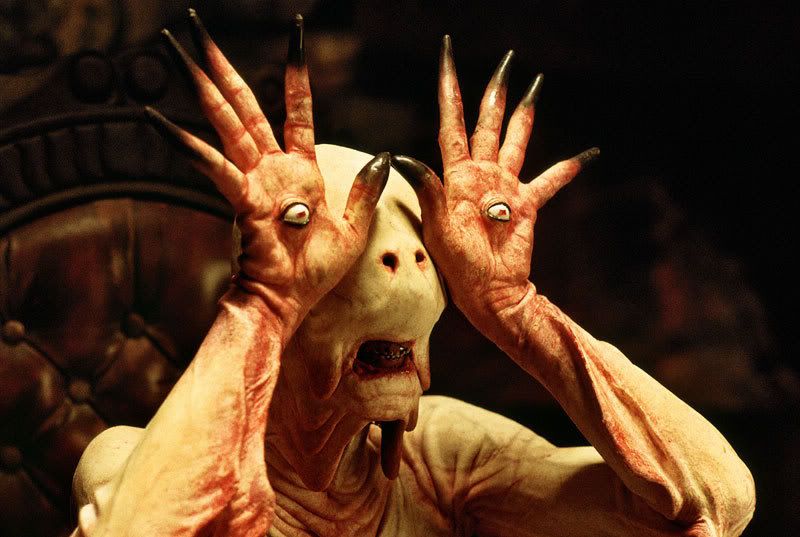
 The film isn't perfect, however. As we can see from it's centerpiece, the Mos Eisly-themed Troll's Market scene, The Golden Army has a tendency to be a tad indulgent, especially in the creature department. Of course, del Toro's indulgences give us monsters like the one pictured above so they are, for the most part, awe-inspiring and quite easily forgiven. Perhaps they should even be encouraged. After all, no one seems to come up with great looking monsters like del Toro. Pan's Labyrinth's Pale Man is perhaps one of the best, and scariest, monsters I've seen in a long, long time. Another flaw, however, which is also a flaw in the first Hellboy, is that The Golden Army seems a bit too disjointed, as if it were merely moving from one set piece to the next, which, I suppose, is what a film like this normally does. Hellboy battles monsters in skyscrapers, on the streets of New York, and in ancient underground cities. He punches, shoots and stabs them. These scenes are often exhilarating; the confrontation between Hellboy and the elven prince is ferocious and quite spectacular; but overall I would have liked a bit more story tying all these scenes together. Del Toro is a first-rate story-teller so I would have liked to have seen a bit more of it here. But these criticisms are minor and, unless you are even more given over to cinematic snobbery than I, will probably not detract from your enjoyment of the film.
Hellboy II: The Golden Army isn't the There Will Be Blood of comic-book movies; it's not a new high-water mark; it probably won't win any awards. It doesn't reinvent anything. What it does do, however, is deliver a solid two hours or pure entertainment and uncompromised fun. It's the kind of movie I want to own and be able to watch over and over. Delo Toro revels in this franchise in ways that his serious high-brow efforts like Pan's Labyrinth or The Devil's Backbone simply do not allow him to do. In the end, any evaluation of this film will probably be based simply enough on whether or not you had fun watching it. I had fun. I had a lot of fun. In a summer of disappointing and lackluster superhero and adventure flicks, Hellboy 2 gets it all right.
 With Hellboy II: The Golden Army, Guillermo del Toro, coming right off his critical success with Pan's Labyrinth (which most definitely was a serious film and which I think was the best film of 2007), seems to have found that way again and delivered an action/adventure film that, without compromising the audience's intellect, is just as loud, just as silly and, most importantly, just as fun as its predecessor. Almost entirely disregarding the source material, del Toro has created a worthy sequel, one which remains faithful to the characters established in the first film and which should please most fans. This time around, Hellboy (Ron Perlman), Liz (Selma Blair) and Abe Sapian (Doug Jones) and the rest of the Bureau for Paranormal Research and Defense face off against an elven prince (Luke Goss) who is intent of ending the centuries long truce between humanity and the world's magical creatures by awakening the legendary and titular golden army, a mechanical/magical army which he will use to eradicate humanity. Hellboy, caught between allegiances to the human world that raised but ultimately rejects him and to the fantastic world to which he more obviously belongs, confronts not only his friends and enemies but his own relationship to them.
 If it sounds as if Hellboy 2 takes place in a different world than the first one did, that's because it does. While the characterizations remain intact, the world they live in is much different this time around. It is as if the grammars of Hellboy and Hellboy 2 are essentially the same but are used in the two films to say very different things. Hellboy told a story of arcane prophecy, occult ritual and of the intrusion of a supernatural element into an otherwise recognizably ordinary world; in other words, it for the most part followed the conventions of most supernaturally themed thriller and superhero stories. The Golden Army, however, tells the story of overlapping worlds, of a human world and a fantastical one, a story of elves, trolls and goblins and of a war between them and humanity. The Golden Army is more closely aligned with conventions of high fantasy, with the mythos of Tolkien or ever J.K. Rowling. In fact, the film's opening scene, in which Dr. Broom (John Hurt) reads a foreshadowing bedtime story to an adolescent Hellboy, sets up The Golden Army's new fairy-tale sensibility, a piece of thematic continuity that perhaps connects Hellboy 2 more closely with Pan's Labyrinth than with the first Hellboy and which, I think, will segue nicely into del Toro's upcoming adaptation of The Hobbit.
 The film isn't perfect, however. As we can see from it's centerpiece, the Mos Eisly-themed Troll's Market scene, The Golden Army has a tendency to be a tad indulgent, especially in the creature department. Of course, del Toro's indulgences give us monsters like the one pictured above so they are, for the most part, awe-inspiring and quite easily forgiven. Perhaps they should even be encouraged. After all, no one seems to come up with great looking monsters like del Toro. Pan's Labyrinth's Pale Man is perhaps one of the best, and scariest, monsters I've seen in a long, long time. Another flaw, however, which is also a flaw in the first Hellboy, is that The Golden Army seems a bit too disjointed, as if it were merely moving from one set piece to the next, which, I suppose, is what a film like this normally does. Hellboy battles monsters in skyscrapers, on the streets of New York, and in ancient underground cities. He punches, shoots and stabs them. These scenes are often exhilarating; the confrontation between Hellboy and the elven prince is ferocious and quite spectacular; but overall I would have liked a bit more story tying all these scenes together. Del Toro is a first-rate story-teller so I would have liked to have seen a bit more of it here. But these criticisms are minor and, unless you are even more given over to cinematic snobbery than I, will probably not detract from your enjoyment of the film.
Hellboy II: The Golden Army isn't the There Will Be Blood of comic-book movies; it's not a new high-water mark; it probably won't win any awards. It doesn't reinvent anything. What it does do, however, is deliver a solid two hours or pure entertainment and uncompromised fun. It's the kind of movie I want to own and be able to watch over and over. Delo Toro revels in this franchise in ways that his serious high-brow efforts like Pan's Labyrinth or The Devil's Backbone simply do not allow him to do. In the end, any evaluation of this film will probably be based simply enough on whether or not you had fun watching it. I had fun. I had a lot of fun. In a summer of disappointing and lackluster superhero and adventure flicks, Hellboy 2 gets it all right.
Wednesday, June 25, 2008
Dreams and Allegory :: Medieval Love Poetry
During these last few weeks I've been taking a class on the poetry of Geoffrey Chaucer, specifically a class on The Canterbury Tales and Troilus and Criseyde. Dreams and allegory, often intermingled, float through the under-current of most medieval poetry and occasionally rise to the surface in a glorious display of poetic expression. I find these two dreams, the first from Troilus and Criseyde and the second from Dante's Vita Nuova, to be shocking and rather beautiful. Their violent imagery, so foreign to our post-modern and often too sentimental notions of love, captures that sense of new-found love that can, when we are not prepared, overthrow our hearts and minds. Enjoy.
And as she slep, anonright tho hire mette
How that an egle, fethered whit as bon,
Under hire brest his longe clawes sette,
And out hire herte he rente, and that anon,
And dide his herte into hire brest to gon-
Of which she nought agroos, ne nothying smerte-
And forth he fleigh, with herte left for herte.
(Troilus and Criseyde, II.925-31, Geoffrey Chaucer)
To every captive soul and loving heart
to whom these words I have composed are sent
for your elucidation in reply,
greetings I bring you for your sweet lord's sake, Love.
The first three hours, the hours of the time
of shining stars, were coming to an end,
when suddenly Love appeared before me
(to remember how he really was appalls me).
Joyous, Love seemed to me, holding my heart
within his hands, and in his arms he had
my lady, loosely wrapped in folds, asleep.
He woke her then, and gently fed to her
the burning heart; she ate it, terrified.
And then I saw him disappear in tears.
("To Every Captive Soul," Vita Nuova, Dante Alighieri)
"To Every Captive Soul" translated by Musa, Mark. The Portable Dante. Penguin, 1995. 592.
And as she slep, anonright tho hire mette
How that an egle, fethered whit as bon,
Under hire brest his longe clawes sette,
And out hire herte he rente, and that anon,
And dide his herte into hire brest to gon-
Of which she nought agroos, ne nothying smerte-
And forth he fleigh, with herte left for herte.
(Troilus and Criseyde, II.925-31, Geoffrey Chaucer)
To every captive soul and loving heart
to whom these words I have composed are sent
for your elucidation in reply,
greetings I bring you for your sweet lord's sake, Love.
The first three hours, the hours of the time
of shining stars, were coming to an end,
when suddenly Love appeared before me
(to remember how he really was appalls me).
Joyous, Love seemed to me, holding my heart
within his hands, and in his arms he had
my lady, loosely wrapped in folds, asleep.
He woke her then, and gently fed to her
the burning heart; she ate it, terrified.
And then I saw him disappear in tears.
("To Every Captive Soul," Vita Nuova, Dante Alighieri)
"To Every Captive Soul" translated by Musa, Mark. The Portable Dante. Penguin, 1995. 592.
Tuesday, May 27, 2008
Review :: George A. Romero's Diary of the Dead
Imagine that you are watching George A. Romero' seminal horror flick Dawn of the Dead. Now imagine that after all the delightful mall carnage and beautifully crafted social satire, an utterly redundant narrator comes on and says, "In case you missed it, the film's about consumerism. It's a metaphor. Get it?" Well, that is unfortunately what it's like to watch Romero's latest zombie foray, the miserable Diary of the Dead, a movie so obnoxiously mediocre and insipidly derivative it makes efforts like Cloverfield seem downright brilliant.
 There isn't really much of a plot to summarize. Instead of continuing the established universe that every other Dead movie has built upon and expanded, Diary, in a poorly conceived (and an even more poorly executed) act of "revisionism," decides to go back to the beginning. The twist? Diary of the Dead follows a group of student filmmakers who were filming their own cheesy horror movie when the outbreak began and who, armed with the cameras and more "the people need to know" and blogs will save the day sentiment than is easily stomached, decide that they should document the deterioration of civilization. And that's the movie. Every single predictable zombie flick convention is present and accounted for, from the tense interpersonal relationships, to the inevitable and by now entirely procedural killing off of characters, and to the morally suspect militia and/or military groups, everything that you've come to expect is here. And it's just tedious.
It's hard not to think that Romero hasn't pulled a Lucas on us and simply revealed himself to be a bad filmmaker. The original trilogy of Night of the Living Dead, Dawn of the Dead, and Day of the Dead are three of the most revered horror movies of all time, and rightly so. They were a nearly perfect combination of shock and gore horror, social satire and artistic vision. Land of the Dead, which I still enjoyed, was a disappointing misstep but still managed to carry the torch. But here... it's like Romero simply has no idea what he's doing. From the ghastly narration, which more often than not just makes horribly explicit whatever ghosts of subtext may have awkwardly floated into the previous scenes, to the third-rate special effects and gore sequences that simply look like made-for-cable sloppy seconds, Romero seems incapable of making the right decision on this film.
But the film's biggest problem is that it fails to execute its central conceit, that this is amateur footage shot by film students. The Blair Witch Project may have been more annoying than scary and Cloverfield may have been more hype than substance but at least both of those films obeyed their own rules and gave us films that stayed within the expected parameters. Romero, on the other hand, seems to think that splicing together several different feeds of video, using some awkward and non-traditional camera angles, and having whole lot of people tell the camera man he's insane for filming during a time like this translates as "amateur video." But instead of feeling like something you could stumble across on youtube, Diary not only still feels like an actually shot and edited film, it feels like a badly shot and edited film. Sure, there's a thin pretext for the film's "polish:" one of the students, for some reason, somehow completed, edited, scored and narrated their little apocalyptic documentary during the crisis because, apparently, uploading the movie and "letting the people know" is more important than survival, as if blogging or some tightly grasped notion of journalistic integrity would suddenly de-animate the dead and save the day.
I'm tempted to think that Romero has just run out of steam and is at this time running on name recognition only. Like Lucas, Coppola and Spielberg, perhaps he should just retire and leave the film business to a younger generation. Films like this tempt me to think that older directors should just stop before they make themselves look ridiculous. But last year William Friedkin released Bug, one of the most psychologically taught and ferocious horror thrillers I've ever seen. It was remarkable not only for it's audacity but also because it felt like the creation of an exciting up-and-comer, someone bristling with new ideas and concepts, someone like a smarter (much smarter) Eli Roth. There are plenty of matured filmmakers that still produce amazing works of art: Cronenberg, Herzog, and Scorsese, just to name a few. Romero, sadly, isn't one of them... and Diary of the Dead is the sad proof of that.
experto crede: unless you are a cinematic masochist, or someone who wants to see the mighty fall, avoid Diary of the Dead. It will only ruin your picture of Romero.
 There isn't really much of a plot to summarize. Instead of continuing the established universe that every other Dead movie has built upon and expanded, Diary, in a poorly conceived (and an even more poorly executed) act of "revisionism," decides to go back to the beginning. The twist? Diary of the Dead follows a group of student filmmakers who were filming their own cheesy horror movie when the outbreak began and who, armed with the cameras and more "the people need to know" and blogs will save the day sentiment than is easily stomached, decide that they should document the deterioration of civilization. And that's the movie. Every single predictable zombie flick convention is present and accounted for, from the tense interpersonal relationships, to the inevitable and by now entirely procedural killing off of characters, and to the morally suspect militia and/or military groups, everything that you've come to expect is here. And it's just tedious.
It's hard not to think that Romero hasn't pulled a Lucas on us and simply revealed himself to be a bad filmmaker. The original trilogy of Night of the Living Dead, Dawn of the Dead, and Day of the Dead are three of the most revered horror movies of all time, and rightly so. They were a nearly perfect combination of shock and gore horror, social satire and artistic vision. Land of the Dead, which I still enjoyed, was a disappointing misstep but still managed to carry the torch. But here... it's like Romero simply has no idea what he's doing. From the ghastly narration, which more often than not just makes horribly explicit whatever ghosts of subtext may have awkwardly floated into the previous scenes, to the third-rate special effects and gore sequences that simply look like made-for-cable sloppy seconds, Romero seems incapable of making the right decision on this film.
But the film's biggest problem is that it fails to execute its central conceit, that this is amateur footage shot by film students. The Blair Witch Project may have been more annoying than scary and Cloverfield may have been more hype than substance but at least both of those films obeyed their own rules and gave us films that stayed within the expected parameters. Romero, on the other hand, seems to think that splicing together several different feeds of video, using some awkward and non-traditional camera angles, and having whole lot of people tell the camera man he's insane for filming during a time like this translates as "amateur video." But instead of feeling like something you could stumble across on youtube, Diary not only still feels like an actually shot and edited film, it feels like a badly shot and edited film. Sure, there's a thin pretext for the film's "polish:" one of the students, for some reason, somehow completed, edited, scored and narrated their little apocalyptic documentary during the crisis because, apparently, uploading the movie and "letting the people know" is more important than survival, as if blogging or some tightly grasped notion of journalistic integrity would suddenly de-animate the dead and save the day.
I'm tempted to think that Romero has just run out of steam and is at this time running on name recognition only. Like Lucas, Coppola and Spielberg, perhaps he should just retire and leave the film business to a younger generation. Films like this tempt me to think that older directors should just stop before they make themselves look ridiculous. But last year William Friedkin released Bug, one of the most psychologically taught and ferocious horror thrillers I've ever seen. It was remarkable not only for it's audacity but also because it felt like the creation of an exciting up-and-comer, someone bristling with new ideas and concepts, someone like a smarter (much smarter) Eli Roth. There are plenty of matured filmmakers that still produce amazing works of art: Cronenberg, Herzog, and Scorsese, just to name a few. Romero, sadly, isn't one of them... and Diary of the Dead is the sad proof of that.
experto crede: unless you are a cinematic masochist, or someone who wants to see the mighty fall, avoid Diary of the Dead. It will only ruin your picture of Romero.
Sex and Video Games
Here's an interesting follow-up to my Grand Theft Auto IV article. In the last little while, several video game critics have begun to pop up, critics like the scabrous though quite amusing Yahtzee over at Zero Punctuation. Perhaps the appearance of critics indicates that at least somewhere someone thinks the medium as a whole has, or may one day have, artistic value. While I myself play video games, I'm very wary about the idea that games can be called Art (note the capital) or even artistic.
In my GTA article, I suggested that games could not be called art because they lack irony. In order to make my point, I may have exaggerated a little, however. I don't think that all art must be ironic; I do think that video games, whose fundamental gameplay elements are often based on violence (see, oh I don't know... nearly every RPG or FPS ever made), need a healthy dose of irony before they can legitimately be artistic.
Anyway, today I ran across a video that is actually quite interesting. I disagree, and rather strongly, on some of the things that Mr Daniel Floyd says in it but find that he does have some good points. Despite what he says, think there is a lot more holding back video game from the artistic threshold than only a prurient and juvenile fixation on hyper-sexuality, and so his seeming acceptance of games as an art form bothers me. But if nothing else, however, his video suggests that there exists within academia a growing critical awareness of gaming, which is no doubt healthy.
In my GTA article, I suggested that games could not be called art because they lack irony. In order to make my point, I may have exaggerated a little, however. I don't think that all art must be ironic; I do think that video games, whose fundamental gameplay elements are often based on violence (see, oh I don't know... nearly every RPG or FPS ever made), need a healthy dose of irony before they can legitimately be artistic.
Anyway, today I ran across a video that is actually quite interesting. I disagree, and rather strongly, on some of the things that Mr Daniel Floyd says in it but find that he does have some good points. Despite what he says, think there is a lot more holding back video game from the artistic threshold than only a prurient and juvenile fixation on hyper-sexuality, and so his seeming acceptance of games as an art form bothers me. But if nothing else, however, his video suggests that there exists within academia a growing critical awareness of gaming, which is no doubt healthy.
Wednesday, May 21, 2008
"Gold and Silver" by Stavesacre
Sometimes life seems to conspire against you. Sometimes things just seem overwhelming. Sometimes you need to retreat and regroup. Other times you need to pray that much harder. At times like these, almost invariably, I end up listening to this song by Stavesacre. They may not be the most well-known group... they might not be the best band ever... but they have always been my band. Their music has carried me through a lot. Sometimes, a song can say it all.
You slipped from my arms
I knew you had to go
Such a heavy heart
Who could hope to hold
And I know where you're going
And that's the hardest part
No matter where tonight ends
You won't escape you're broken heart
Stay a while
Helpless for the words
And it tightens up the air
It's not what you deserve
It's not for lack of care
Inside of me is screaming out
I'm praying for my prayers
Distracting and unworthy
Of each and every burning tear
Seems insincere
Do I see God in all of this?
Maybe all along?
It's just that we're so small
And simply not as strong
Strong like wings of silver
And feathers made of gold
To carry heavy hearts
To cover all our helpless souls
To cover all of us
Under wings of gold and silver sometimes we have to hide
For shelter from this bitter winter... at least tonight
If it were mine to give
I'd give you your own time
Turn it back or forward
Whatever you decide
Stay a while
I wish I could post an mp3 of the song. I won't. But I can point you to Stavesacre's MySpace page, on which you can listen to to the song. I would recommend that everyone listen to it. It certainly calms my soul. It's David to my Saul.
You slipped from my arms
I knew you had to go
Such a heavy heart
Who could hope to hold
And I know where you're going
And that's the hardest part
No matter where tonight ends
You won't escape you're broken heart
Stay a while
Helpless for the words
And it tightens up the air
It's not what you deserve
It's not for lack of care
Inside of me is screaming out
I'm praying for my prayers
Distracting and unworthy
Of each and every burning tear
Seems insincere
Do I see God in all of this?
Maybe all along?
It's just that we're so small
And simply not as strong
Strong like wings of silver
And feathers made of gold
To carry heavy hearts
To cover all our helpless souls
To cover all of us
Under wings of gold and silver sometimes we have to hide
For shelter from this bitter winter... at least tonight
If it were mine to give
I'd give you your own time
Turn it back or forward
Whatever you decide
Stay a while
I wish I could post an mp3 of the song. I won't. But I can point you to Stavesacre's MySpace page, on which you can listen to to the song. I would recommend that everyone listen to it. It certainly calms my soul. It's David to my Saul.
Saturday, May 10, 2008
The Slip
If I were to be honest (and I frequently am), I'd say, without much reservation, that Nine Inch Nails is one of my favourites bands. I've always found Trent Reznor's combinations of moral outrage, schizophrenic self-resentment, and borderline apathy compelling, provocative and more than a little identifiable. But lyrics and poetry aside, on a purely musical level Reznor has always been on the bleeding edge of musical technology while still managing to avoid digital excess. Using samples and everything from the sharpest and most memorable hooks to the faintest and still entirely resonant aural echoes, he has been able to dredge sounds out of his soul that are alarming, other-worldly, and yet entirely human. Lately, Trent Reznor has been giving fans quite a lot to be excited about. Year Zero reaffirmed Reznor's artistic integrity after the slight misstep that was With Teeth; the follow-up Y34RZ3R0R3M1X3D gave us exactly the kind of delirious self-revision that NIN has become famous for; and Ghosts I-IV, Reznor's first release after his much-publicized break with Universal Music Group (the parent company of Interscope Records), was a haunting, beautifully crafted ambient instrumental album that came out of no where and demanded instant attention. Now, Reznor gives us The Slip, a new full-length album available as a free download at nin.com. I just downloaded it and am listening to it for the first time as I write this. It's 100% Reznor: it's the full on noise-rock Reznor of Pretty Hate Machine and it's the ambient/instrumental Reznor of Ghosts I-IV. While on a first listen I'm not quite sure whether or not it ranks among his most important works, such as The Downward Spiral or The Fragile, I am sure that I love it and that it's worth a listen, especially if you have any interest in Nine Inch Nails. Hey, it's free; it's licensed under Creative Commons; if nothing else, it represents a new, more creatively free way of releasing an album and that in itself is pretty exciting. On the nin.com homepage, Reznor writes, "thank you for your continued and loyal support over the years - this one's on me." Thank you, Trent. It's much appreciated.
 Download The Slip for free at http://theslip.nin.com/
 Download The Slip for free at http://theslip.nin.com/
Tuesday, May 6, 2008
The Fall of the House of Usher (excerpt)
Okay, enough ranting. Not only have I been taking flak for Grand Theft Auto, but my beloved digital home away from home, Talking About Games, is experiencing a minor crisis and the emotions are running hot. I need to clear my head and Edgar Allan Poe is one of the best ways to do that. Enjoy.
During the whole of a dull, dark, and soundless day in the autumn of the year, when the clouds hung oppressively low in the heavens, I had been passing alone, on horseback, through a singularly dreary tract of country; and at length found myself, as the shades of evening drew on, within view of the melancholy House of Usher. I know not how it was - but, with the first glimpse of the building, a sense of insufferable gloom pervaded my spirit. I say insufferable; for the feeling was unrelieved by any of that half-pleasurable, because poetic, sentiment, with which the mind usually receives even the sternest natural images of the desolate or terrible. I looked upon the scene before me - upon the mere house, and the simple landscape features of the domain - upon the bleak walls - upon the vacant eye-like windows - upon a few rank sedges - and upon a few white trunks of decayed trees - with an utter depression of soul which I can compare to no earthly sensation more properly than to the after-dream of the reveller upon opium - the bitter lapse into every-day life - the hideous dropping off of the veil. There was an iciness, a sinking, a sickening of the heart - an unredeemed dreariness of thought which no goading of the imagination could torture into aught of the sublime. What was it - I paused to think - what was it that so unnerved me in the contemplation of the House of Usher? It was a mystery all insoluble; nor could I grapple with the shadowy fancies that crowded upon me as I pondered. I was forced to fall back upon the unsatisfactory conclusion, what while, beyond doubt, there are combinations of very simple natural objects which have the power of thus affecting us, still the analysis of this power lies among considerations beyond our depth. It was possible, I reflected, that a mere different arrangement of the particulars of the scene, of the details of the picture, would be sufficient to modify, or perhaps to annihilate its capacity for sorrowful impression; and, acting upon this idea, I reined my horse to the precipitous brink of a black and lurid tarn that lay in unruffled lustre by the dwelling, and gazed down - but with a shudder even more thrilling than before - upon the remodelled and inverted images of the gray sedge, and the ghastly tree-stems, and the vacant and eye-like windows.
Poe, Edgar Allan. "The Fall of the House of Usher." Edgar Allan Poe: Selected Tales. Ed. Julian Symons. Oxford, 1980. 62-78.
During the whole of a dull, dark, and soundless day in the autumn of the year, when the clouds hung oppressively low in the heavens, I had been passing alone, on horseback, through a singularly dreary tract of country; and at length found myself, as the shades of evening drew on, within view of the melancholy House of Usher. I know not how it was - but, with the first glimpse of the building, a sense of insufferable gloom pervaded my spirit. I say insufferable; for the feeling was unrelieved by any of that half-pleasurable, because poetic, sentiment, with which the mind usually receives even the sternest natural images of the desolate or terrible. I looked upon the scene before me - upon the mere house, and the simple landscape features of the domain - upon the bleak walls - upon the vacant eye-like windows - upon a few rank sedges - and upon a few white trunks of decayed trees - with an utter depression of soul which I can compare to no earthly sensation more properly than to the after-dream of the reveller upon opium - the bitter lapse into every-day life - the hideous dropping off of the veil. There was an iciness, a sinking, a sickening of the heart - an unredeemed dreariness of thought which no goading of the imagination could torture into aught of the sublime. What was it - I paused to think - what was it that so unnerved me in the contemplation of the House of Usher? It was a mystery all insoluble; nor could I grapple with the shadowy fancies that crowded upon me as I pondered. I was forced to fall back upon the unsatisfactory conclusion, what while, beyond doubt, there are combinations of very simple natural objects which have the power of thus affecting us, still the analysis of this power lies among considerations beyond our depth. It was possible, I reflected, that a mere different arrangement of the particulars of the scene, of the details of the picture, would be sufficient to modify, or perhaps to annihilate its capacity for sorrowful impression; and, acting upon this idea, I reined my horse to the precipitous brink of a black and lurid tarn that lay in unruffled lustre by the dwelling, and gazed down - but with a shudder even more thrilling than before - upon the remodelled and inverted images of the gray sedge, and the ghastly tree-stems, and the vacant and eye-like windows.
Poe, Edgar Allan. "The Fall of the House of Usher." Edgar Allan Poe: Selected Tales. Ed. Julian Symons. Oxford, 1980. 62-78.
Sunday, May 4, 2008
Video Games and Art :: Grand Theft Auto IV
This article was previously entitled Why I'm Not Playing Grand Theft Auto IV. I've changed the name because I have in fact, since writing the article, played the game. And enjoyed it. As far as I'm concerned, my enjoyment of the game does not invalidate what I say below. This article, though about GTA IV, is really a criticism of gaming itself. That said, perhaps I'm just a hypocrite.
In the last little while, I've got myself into a few discussions, some of which were rather heated, about Rockstar's latest release, the controversial and much-hyped Grand Theft Auto IV. Let me be clear about myself: I am a gamer but I am also a critic of the arts and sometimes I think those two are mutually exclusive. I've been playing video games for many, many years now and I think it's generally expected that all gamers, in some ill-defined act of solidarity and affirmation, will always rise up and defend a game like Grand Theft Auto against such critics as the now-famous Jack Thompson on the grounds that it's fun, dammit. However, I don't defend GTA. I do think gaming can be intelligently and critically defended against its many vehement critics but I do not think that Grand Theft Auto is the platform upon which such a defense can be successfully mounted.
These days anyone in the gaming community who challenges the merits of a video game is considered a puritanical, raving fundamentalist. It does not really matter if you are talking about Manhunt or Halo: if you suggest that some violence is too excessive or that some scenarios go too far you are ridiculed, ostracized and ignored. Not even film critics are this blindly devoted to their chosen art form; most will have the honesty to say that not every film is justifiable or healthy regardless of the ideology they embrace. Gamers, on the other hard, perhaps betraying a deep-seated anxiety about their chosen form of entertainment, see every single game as a representative symbol of gaming as a whole. It's as if censoring one game will lead to the censoring of all video games. The mainstream media outlets do not help on this point since as soon as a particularly violent video game is released they use it as an opportunity to attack all of gaming instead of the game in question.
 Now, I'm not really a fundamentalist or a radical conservative; at least, I don't think of myself as one. I am not particularly bothered by depictions of either extreme violence or sexuality when both are connected to artistic and metaphoric purposes. I just finished a Takashi Miike marathon, for crying out loud. My shelves are filled with the movies of David Cronenberg, Stanley Kubrick, Quentin Tarantino, etc, etc. As I see it, film, along with most of the art forms working with the concepts of narrative or character, is built upon fundamental notions of irony and detachment. It's one of the first things you learn as an English student: don't confuse the narrator with the author; don't mistake the main character's views with the author's. There's a fundamental disconnect between what happens in a poem, a novel, or a film and between what the author or the text actually means. This disconnect is called irony and it is perhaps the most important hermeneutical principle any critic should recognize. Video games, however, lack irony. Actions are not connected to a larger metaphoric scheme; stories, most often lacking real characterization or narrative innovation, are simply pretenses for gameplay. This is true of almost every video game, not just Grand Theft Auto. There is no moral disconnect between a players actions and a game's "artistic" purpose.
What makes Grand Theft Auto such a lightning rod for controversy is that, unlike most games, the gameplay is based upon criminal action. Players, instead of taking on the role of a superhero, cop, soldier, whatever, take on the role of a criminal who, through murder, robbery, arson, etc, rises through the ranks of a particular criminal organization. This sort of gameplay, severed from ironic or metaphoric intentions, becomes extremely hard to justify. It is, perhaps, unjustifiable. In GTA, there's no moral disconnect between the crimes performed by the protagonists and the financial rewards derived with those actions. This is different, much different, from the depiction of crime in cinema. In a crime or gangster movie, the idea that crime destroys lives is built into the very narrative framework. It may be exciting to see Ray Liotta in Goodfellas gain mafia power but we know that it's all going to end badly for him because of it and we know that it's right that it should end badly. It is this moral disconnect, the ability for the audience to recognize the inverse relationship between crime and mental or moral health, that makes films such as Goodfellas and The Godfather justifiable, compelling and important. In video games, however, there is no moral disconnect; there certainly has never been one in and of the GTA games. The player takes on the role of a criminal and never once is encouraged to think reflectively or critically about this.
(I don't agree with everything Glen Beck says in the video above, but I do think that his point about the desensitizing program used by the military and how that relates to video games should be thought about quite seriously.)
I haven't played Grand Theft Auto IV yet so perhaps I'm not qualified to comment on the game like this. I am a gamer, however, and I have played most of the games in the series that came before it, though I never really found any of them to be all that compelling. So I think I'm qualified to say that unless GTA IV is so radical in its narrative presentation that the player, instead of feeling rewarded for his actions, feels like his character should die or spend the rest of his life in jail, then it is once again just another un-ironic glorification of criminal action.
If there is one thing that in my mind could invalidate gaming as a legitimate form of entertainment and that could challenge the notion that games are art it is this lack of irony. Roger Ebert has famously said that video games are not art and, frankly, I'm inclined to agree with him. For every Bioshock that gets released (which is perhaps the closest that a game has ever come to being a work of art) there are a hundred games like Grand Theft Auto released. They may be entertaining, and games like Grand Theft Auto may be entertaining in a very prurient, misogynistic way, but as long as they lack irony, mere entertainment is all that they will remain and it should never enter into our minds to call them art.
And, since I'm not entertained by 30+ hours of mindless and un-ironic crime, I've decided not to play Grand Theft Auto IV.
In the last little while, I've got myself into a few discussions, some of which were rather heated, about Rockstar's latest release, the controversial and much-hyped Grand Theft Auto IV. Let me be clear about myself: I am a gamer but I am also a critic of the arts and sometimes I think those two are mutually exclusive. I've been playing video games for many, many years now and I think it's generally expected that all gamers, in some ill-defined act of solidarity and affirmation, will always rise up and defend a game like Grand Theft Auto against such critics as the now-famous Jack Thompson on the grounds that it's fun, dammit. However, I don't defend GTA. I do think gaming can be intelligently and critically defended against its many vehement critics but I do not think that Grand Theft Auto is the platform upon which such a defense can be successfully mounted.
These days anyone in the gaming community who challenges the merits of a video game is considered a puritanical, raving fundamentalist. It does not really matter if you are talking about Manhunt or Halo: if you suggest that some violence is too excessive or that some scenarios go too far you are ridiculed, ostracized and ignored. Not even film critics are this blindly devoted to their chosen art form; most will have the honesty to say that not every film is justifiable or healthy regardless of the ideology they embrace. Gamers, on the other hard, perhaps betraying a deep-seated anxiety about their chosen form of entertainment, see every single game as a representative symbol of gaming as a whole. It's as if censoring one game will lead to the censoring of all video games. The mainstream media outlets do not help on this point since as soon as a particularly violent video game is released they use it as an opportunity to attack all of gaming instead of the game in question.
 Now, I'm not really a fundamentalist or a radical conservative; at least, I don't think of myself as one. I am not particularly bothered by depictions of either extreme violence or sexuality when both are connected to artistic and metaphoric purposes. I just finished a Takashi Miike marathon, for crying out loud. My shelves are filled with the movies of David Cronenberg, Stanley Kubrick, Quentin Tarantino, etc, etc. As I see it, film, along with most of the art forms working with the concepts of narrative or character, is built upon fundamental notions of irony and detachment. It's one of the first things you learn as an English student: don't confuse the narrator with the author; don't mistake the main character's views with the author's. There's a fundamental disconnect between what happens in a poem, a novel, or a film and between what the author or the text actually means. This disconnect is called irony and it is perhaps the most important hermeneutical principle any critic should recognize. Video games, however, lack irony. Actions are not connected to a larger metaphoric scheme; stories, most often lacking real characterization or narrative innovation, are simply pretenses for gameplay. This is true of almost every video game, not just Grand Theft Auto. There is no moral disconnect between a players actions and a game's "artistic" purpose.
What makes Grand Theft Auto such a lightning rod for controversy is that, unlike most games, the gameplay is based upon criminal action. Players, instead of taking on the role of a superhero, cop, soldier, whatever, take on the role of a criminal who, through murder, robbery, arson, etc, rises through the ranks of a particular criminal organization. This sort of gameplay, severed from ironic or metaphoric intentions, becomes extremely hard to justify. It is, perhaps, unjustifiable. In GTA, there's no moral disconnect between the crimes performed by the protagonists and the financial rewards derived with those actions. This is different, much different, from the depiction of crime in cinema. In a crime or gangster movie, the idea that crime destroys lives is built into the very narrative framework. It may be exciting to see Ray Liotta in Goodfellas gain mafia power but we know that it's all going to end badly for him because of it and we know that it's right that it should end badly. It is this moral disconnect, the ability for the audience to recognize the inverse relationship between crime and mental or moral health, that makes films such as Goodfellas and The Godfather justifiable, compelling and important. In video games, however, there is no moral disconnect; there certainly has never been one in and of the GTA games. The player takes on the role of a criminal and never once is encouraged to think reflectively or critically about this.
(I don't agree with everything Glen Beck says in the video above, but I do think that his point about the desensitizing program used by the military and how that relates to video games should be thought about quite seriously.)
I haven't played Grand Theft Auto IV yet so perhaps I'm not qualified to comment on the game like this. I am a gamer, however, and I have played most of the games in the series that came before it, though I never really found any of them to be all that compelling. So I think I'm qualified to say that unless GTA IV is so radical in its narrative presentation that the player, instead of feeling rewarded for his actions, feels like his character should die or spend the rest of his life in jail, then it is once again just another un-ironic glorification of criminal action.
If there is one thing that in my mind could invalidate gaming as a legitimate form of entertainment and that could challenge the notion that games are art it is this lack of irony. Roger Ebert has famously said that video games are not art and, frankly, I'm inclined to agree with him. For every Bioshock that gets released (which is perhaps the closest that a game has ever come to being a work of art) there are a hundred games like Grand Theft Auto released. They may be entertaining, and games like Grand Theft Auto may be entertaining in a very prurient, misogynistic way, but as long as they lack irony, mere entertainment is all that they will remain and it should never enter into our minds to call them art.
And, since I'm not entertained by 30+ hours of mindless and un-ironic crime, I've decided not to play Grand Theft Auto IV.
Friday, May 2, 2008
"Auguries of Innocence" (excerpt) by William Blake
I've quoted William Blake a few times on this site because more than any other poet or philosopher Blake has shaped the way I think about the world, the church and art. The man in the flames to the left of this, the image that I've adopted as my own personal avatar, is one of Blake's many famous images. But it occurred to me that I've never actually posted any Blake on this site. Well, I've fixed that now.
To see a world in a grain of sand
And a heaven in a wild flower,
Hold infinity in the palm of your hand
And eternity in an hour.
*****
He who doubts from what he sees
Will ne'er believe, do what you please.
If the sun and moon should doubt,
They'd immediately go out.
To be in a passion you good may do,
But no good if a passion is in you.
The whore and gambler, by the state
Licensed, build that nation's fate.
The harlot's cry from street to street
Shall weave old England's winding sheet.
The winner's shout, the loser's curse,
Dance before dead England's hearse.
Every night and every morn
Some to misery are born.
Every morn and every night
Some are born to sweet delight.
Some are born to sweet delight,
Some are born to endless night.
We are led to believe a lie
When we see not through the eye
Which was born in a night to perish in a night,
When the soul slept in beams of light.
God appears, and God is light
To those poor souls who dwell in night,
But does a human form display
To those who dwell in realms of day.
To see a world in a grain of sand
And a heaven in a wild flower,
Hold infinity in the palm of your hand
And eternity in an hour.
*****
He who doubts from what he sees
Will ne'er believe, do what you please.
If the sun and moon should doubt,
They'd immediately go out.
To be in a passion you good may do,
But no good if a passion is in you.
The whore and gambler, by the state
Licensed, build that nation's fate.
The harlot's cry from street to street
Shall weave old England's winding sheet.
The winner's shout, the loser's curse,
Dance before dead England's hearse.
Every night and every morn
Some to misery are born.
Every morn and every night
Some are born to sweet delight.
Some are born to sweet delight,
Some are born to endless night.
We are led to believe a lie
When we see not through the eye
Which was born in a night to perish in a night,
When the soul slept in beams of light.
God appears, and God is light
To those poor souls who dwell in night,
But does a human form display
To those who dwell in realms of day.
Subscribe to:
Posts (Atom)