Showing posts with label martyrs. Show all posts
Saturday, March 12, 2011
Saint Agnes
Agnes was the daughter of a Roman noble. She was very beautiful. Many men lusted after her. But she was pure. Though her parents were not Christians, her nurse, a family slave, was, and it was through this slave--through this shimmering sliver of a Providential design plotted through the motions of an uncaring empire that bought and traded in human lives, through this more-than-mother who loved her dearly despite being the daughter of her masters--that Agnes learned of Jesus and the Gospel and became a Christian. She dedicated her life, her blood, her virginity to Christ. But Phocus, the son of the Roman prefect Sempronius, fell in love with her. He offered her riches; he tried to seduce her. She refused them, refused him. She told him that she already have a Lover, and that this Lover was a better, more powerful, and more rich Lover than he could ever be. Rejected, and enraged, Phocus left. Lust consumed him. He could think of nothing else. But when he discovered that she was a Christian, he was elated and thought he'd found a way to possess her. Diocletian was emperor at the time, and he had ordered the persecution and execution of Christians. Christian blood flowed through the empire, choking the ground, crying out to Heaven. Phocus, assuming she would much rather give herself to him than face an empire's wrath, denounced Agnes as a Christian to his father, and she was brought before him to answer the charge. She freely professed her faith. Sempronius then gave her the ultimatum: make sacrifices in a Roman temple or be executed. She was steady; she did not hesitate. She chose execution. She would rather bow her head to an executioner's sword than to a pagan god. She was condemned. But a Roman law stood in the way, apparently. Virgins could not be executed. It was considered inhumane. Sempronius therefore, in deference to the law, ordered her stripped naked and dragged through the streets to a brothel, where she could be raped in preparation for her execution. It would not be right, after all, to execute an innocent, and so such would be this empire's tender observations of decency. This happened. This is a thing that happens in this world. But it did not happen as Sempronius imagined. As she was being dragged naked through the street, her hair miraculously grew and provided a natural covering and protection for the virgin from the eyes of all those who watched. And there were many who watched. She was thrown into the brothel. An angel appeared and gave Agnes a garment to cover herself. God does not abandon His beloved; the shape of His comforts and tokens of His love, however, are not often recognized in this world. Because this world means something else to Him than it does to us. And so though He may not spare us the trials we must face, His grace is the sort that allows us to face those trials with dignity, knowing that a loving bridegroom stands ready to embrace us at their end. Grateful, she wrapped herself tight, terrified but steadfast in her faith. Men lined up to rape her. Word spreads quickly, especially when youth and beauty are being offered up, and there is never a shortage of people willing to do this, not then and not now. But when they were admitted into the brothel and saw her... well, accounts vary. Some say that any man who looked at her was immediately struck blind; others say that they simply looked at her and did not dare to touch her, so beautiful, so pure, and so young as she was.
She was very young, after all. She was only twelve years old. Entire empires die for things like this. Worlds will burn for things like this.
The men began to flee the brothel. Phocus, who was outside, mocked them, ridiculed them for their weakness, for not being able to rape a small, defenseless child of twelve. See, it was not enough for him that she be violated before being executed; he did not simply want to find a way to overcome a bothersome law; he desired that all the filth of a dying empire penetrate every part of her and erase her intolerable purity. Having once loved her--loved her, that is, in the vulgar, contracted, animal way which was all a mind like his was capable of--and having been once rejected by her, that love turned, and he now desired that no such thing as her exist. So he himself entered the brothel. He would rape away that purity; he himself would smear his stain onto her innocence. He pushed through the crowds of fleeing men and entered the chamber where she was kept and when he saw her he was struck immediately dead. Just like that. But Agnes, though she had no worldly reason to, prayed for him and he revived. I imagine he must have been terrified. I imagine he could not look at her. Sempronius could, however, and he immediately accused her of witchcraft and decided they should dispense with the prohibition on executing virgins. Though Phocus now pleaded with his father to spare her life (perhaps because he, like Pilate's wife, now knew that something awful was happening), she was nevertheless tied to a stake to be burned alive. And here again accounts vary. Some say the wood would not burn no matter how hard they tried to light it; others that it did burn but that the flames refused to touch her, that they actually bent away from her as if the very elements of this world recognized and reverenced her purity, so that she stood--inviolate and inconsumable--within a crown of flames. Sempronius was enraged; Phocus, again I imagine at least, must have fled and spent the rest of his life contemplating the meaning of what he had witnessed. But maybe he did not do this. Maybe he remained insensible, the terror of his encounter with the Divinity through the intercessions of that Divinity's beloved bride gradually fading until it was only an uncomfortable memory, a shining possibility of redemption now reduced to a cancer in his soul. But I do not know what happened to him; I can only imagine. But at the scene of the burning, the living Agnes, the young girl, the betrothed of a Great Lover, would not die; her flesh that man could not touch was not touched either by flame. Eventually, as Sempronius's rage, and probably his terror, increased, and as the mobs that had gathered to cheer on and witness the utter destruction of a young girl gradually began to understand that something terrible, something awful, something holy and beyond their comprehension was happening, and as their long-dead and now too-late pity finally turned towards the innocent girl, the Roman officer in charge, probably fearing that Sempronius's rage would fall on him, drew his sword and cut off her head. And so Agnes died. A child of twelve was martyred for her faith--a faith that could not be staggered, could not be humiliated, could not be unsteadied, and above all could not be touched. And from this dark world and into the arms of her Great Lover she soared.
At her trial Agnes said "To Him I have given my faith; to Him I have commanded my heart. When I love Him then am I chaste, and when I touch him then am I pure and clean, and when I take Him then am I a virgin. This is the love of my God."
Wednesday, July 7, 2010
Saint Cecilia
Sainte Cécile, by Adolphe Lalyre.
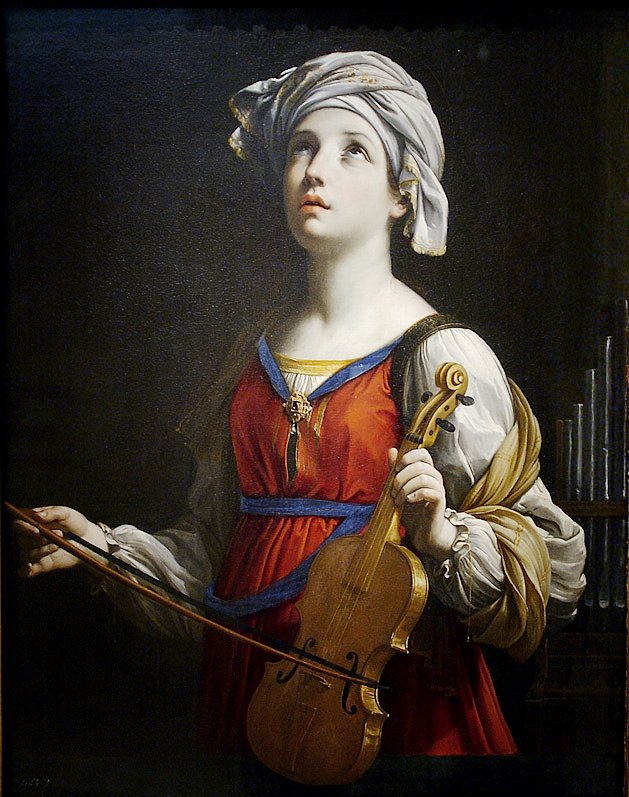
Cecilia was the daughter of a senator, and a Christian. She was married by her family to Valerianus, a virtuous pagan. On her wedding night, however, she told him that she was betrothed to an angel who would guard her body and virginity. Her husband, probably frustrated by this, because Cecilia was very beautiful, and also probably wondering whether Cecilia was entirely sound or not, reasonably asked to see the angel. Cecilia told him to go to a certain street, and he obeyed. There he met the Bishop Urbanus, who converted and baptized him. Maybe Valerianus hoped this would satisfy the angel and he'd be able to sleep with his wife. However, he returned to Cecilia and an angel, perhaps Cecilia's betrothed (but perhaps not), appeared to them and crowned them with roses and lilies. Valerianus never slept with her. Cecilia remained a virgin. Instead, Valerianus and his brother, who was also converted and baptized, dedicated themselves to Christian service, supporting the poor and burying martyrs. This of course attracted the wrong attention, and Valerianus and his brother were arrested, tried, and sentenced to death. However, and this must have infuriated their persecutors, they converted their executioner, who instead of killing them decided to die with them. The three of them were martyred together, and Cecilia buried all three in a single grave. With her husband and brother-in-law dead, Rome came after the virgin herself. She was arrested. She made a glorious confession of her faith. She was sentenced to death. She was to be suffocated by steam in her own bathroom. But though they super-heated the room beyond what is humanly endurable, she was not hurt. She did not die. She sang. Terrified and enraged, they sent in an executioner to cut off her head with a sword. Perhaps he was too scared to do it properly; perhaps no amount of strength would have been enough. But the executioner attempted three times to cut off her head. Three times he sunk his sword into her neck; three time he was unable to sever her head from her body. Terrified, he left the virgin drenched in her own blood (he had cut her, after all; he had mortally wounded her; but he couldn't cut off her head) and fled. They didn't try to kill her again. She lived three days. She saw her family and friends--they came to visit her and comfort her as she died. She sang. I imagine it was very quiet singing, whispered maybe, a trembling song falling from her lips in perfect harmony with her faith. She dedicated all her money to the poor. She left her house, where she had received her martyrdom, to be a church. She finally opened her eyes for the last time, looked at her friends and family, closed them, whispered one last trembling song of faith, and was translated to heaven. Urbanus buried her with the bishops and the confessors because they knew she was a saint. They could see. Much later, when her remains were discovered and removed as relics to the church dedicated to her, it is said that she held out three fingers on one hand, and one on the other, three in one, a confession of the Trinity. Because she sang, she is the patron saint of musicians and is often depicted playing an instrument.
Wednesday, June 16, 2010
Saint Agatha
St. Peter Healing St. Agatha, by Giovanni Lanfranco.
A Roman prefect, Quintianus, wanted Agatha, who was beautiful. But she had dedicated her body, and her virginity, to Christ, and so denied him. He was furious. Knowing of her Christian faith, he arrested her. He himself was her judge. He expected her, threatened with torture and death, to deny her faith and give herself to him. She did not. Her mind and spirit were firm. Quintianus had given himself over to lust and flesh and so he gave Agatha over for a month to a brothel, where she was raped, assaulted, and humiliated. Quintianus thought this would break her and bring her around to his way of thinking. It did not. He imprisoned her next and subjected her to tortures. He cut off her breasts. But St. Peter appeared to her in prison and healed her. Quintianus's sadism mutilated her, attempted to defile the flesh, destroy the body; Peter's love healed her, restored her, made her whole again. (I can imagine his tender hands and fingers trembling as he touched her. I can imagine him weeping with her and comforting her and giving her strength.) Quintianus finally sentenced her to death: he sentenced her to be rolled naked along a bed of coals. He went from wanting to enjoy her flesh to wanting to utterly destroy it. Her body, denied to him, had become an offense, a thing meant for fire. Thus the world loves. And so they put her on the coals. But "anon the ground where the holy virgin was rolled on, began to tremble like an earthquake, and a part of the wall fell down upon Silvain, counsellor of Quintianus, and upon Fastion his friend, by whose counsel she had been so tormented." Her last prayer before she died was "Lord, my Creator, you have always protected me from the cradle; you have taken me from the love of the world and given me patience to suffer. Receive my soul."
Peter's hands were only a promise. He was tender and careful, a paternal power moved not by an impulse to rage and to revenge but by a more delicate desire to hold and to cherish. Things must look different to God. He sent Peter not to save her, not to take her out of prison, not to bring fire and damnation upon the enemies of Agatha's flesh and spirit. He sent him to heal her breasts.
Monday, May 31, 2010
Saint Lucy
The Martyrdom and Last Communion of Saint Lucy, by Paolo Veronese.
"No one's body is polluted so as to endanger the soul if it has not pleased the mind. If you were to lift my hand to your idol and so make me offer against my will, I would still be guiltless in the sight of the true God, who judges according to the will and knows all things. If now, against my will, you cause me to be polluted, a twofold purity will be gloriously imputed to me. You cannot bend my will to your purpose; whatever you do to my body, that cannot happen to me" - Saint Lucy.
Sunday, May 23, 2010
Lady Jane Grey
The Execution of Lady Jane Grey (1833), by Paul Delaroche.
An image like this fills my mind. I can't escape it. It works in me, arresting me with its cold horror until abstraction is lost and all I can imagine is the reality of those last moments. It's an over-charged human sympathy: an inability to extricate myself or to enjoy any sense of detachment. It activates inside and tightens into a knot that makes me feel ill; it casts a shadow over the world. The delicacy of this particular image is tormenting. It's the last whispers, the slow reluctance, the inevitable swing. No one involved seems to want this act to happen. And yet it will happen. It's a moment in history. History removes, the lines blur, the human moves further away. Lady Jane Grey, queen of England for a little over a week, was executed by beheading in the Tower of London because she was protestant. She was either sixteen or seventeen years old. History slouches through the blood of individuals and personal moments of horror and sorrow.
Sunday, May 16, 2010
Subscribe to:
Posts (Atom)