Gotta say: it's contending with Alice Creed right now. Bless him, Danny Boyle does not disappoint. For him, the human suffers, often in extreme and grueling circumstances, often to the point of despair... but ultimately survives, endures, hopes. While not as visceral, or quite as devastating-slash-triumphant, as the remarkable Slumdog Millionaire (a movie that returned Boyle to the kinetic, bursting-at-the-seams, lusting-after-life energy he'd harnessed in Trainspotting), 127 Hours continues the aesthetic and thematic direction set in that movie: one motivated by hope, spun through with life, and held together by an abiding conviction that the "human spirit," ambiguous a term as that may be, or clichéd as it has been by more cynical artists, has the capacity to overcome and burst its way upwards towards redemption.
Showing posts with label movies. Show all posts
Wednesday, March 9, 2011
Saturday, February 5, 2011
Alice Creed
The ridiculous "grippingly twisty thriller" quote on this poster notwithstanding, this is my favourite movie of 2010 (unless I'm allowed to count the North American releases of either The Girl with the Dragon Tattoo or the Red Riding trilogy). The less you know about Alice Creed going into it, the better the movie plays. In fact, don't even watch the trailer. Watch this movie cold.
Monday, December 6, 2010
Walkabout
The centerpiece scene in this film, the scene which this somewhat horrible and sensationalist poster references--a scene of a white teenage girl lost in the Australian outback swimming in a rock pool while her younger brother and their befriended aborigine explore and hunt---is perhaps one of the best erotic scenes I have ever not been aroused by. It is a beautiful scene, but not a sexy scene, and that is its triumph. It's flesh, but it is flesh as life not flesh as object; it is flesh as subject in nature, as subject of nature, as a thing unto itself--warm, vital, nascent, and feather-like fragile. Nicolas Roeg finds the balance that so many lesser directors, fumbling to portray innocence from their own so-experienced position, often trip over. The scene is about innocence and sexual naivety awakening to, and glorying in, its own sensuality while still being childishly ignorant of the darker impulses, impulses both from within and from without, that can overcome it and that will, as the film unfolds towards its end, threaten it. But here, now in this scene, there is no hint of shadow. Here there is no outside other. Here are memories of Eden. There is display in the girl's action. She vibrates with sensual energy. But it is an unwitnessed, un-ritual display, a self-display; she swims naked for herself. Here is lightness and water and a camera that, aware of how precarious an edge this moment hangs on, does not gaze but that humbly witnesses. For us watching her swim there is perhaps some voyeurism, but it is voyeurism couched in time and memory--and while we look at the girl, the girl becomes us.
IMDb. Trailer. Criterion.
Tuesday, November 23, 2010
The Red Shoes
Simply stunning. The quintessential backstage drama, as Criterion appropriately describes it. This film is magic. There has perhaps never been a better movie about the so-called "life of the artist." I put this disc in a few nights after watching Black Narcissus for the first time and was hardly prepared for how much I would love it. It's exquisite. It's haunting. It's beautiful. It's lodged tightly in my brain.
IMDb. Trailer. Criterion.
Monday, July 12, 2010
Epoch
I used to review movies here. The reason was simple. For years, for almost as long as I can remember, I had been committed to the idea that films are art, that actors are artists, that directors had something important to say and that whatever it was they were saying was worth listening to, or at the very least worth analyzing. From Cronenberg to Kurosawa, from torture porn to historical drama--from sci-fi to horror to romantic comedy to nearly everything I could get my hands on--I watched it all. I was large in film. And I enjoyed it. I enjoyed the wonder, the amusement, the excitement, the arousal. I took it as a whole, as one amalgam, one attempt to trace the boundaries and fill in the gaps of the human condition. And all the while, I brought what I hoped was a dedicated critical eye. I didn't submit to film; I submitted film to judgment. My dedication to film grew from the same root as my dedication to literature: a desire to understand, and to sympathize with, the human.
I haven't reviewed a film here in almost a year. The reason was, again, or at least at the time, quite simple. I was busy. I had begun my graduate studies, see. Suddenly I didn't have as much time for old hobbies as I would have liked. I suppose that, like I did with other interests, I could have made time, rescued time, snatched time for movies. I didn't. I didn't even try. I didn't because what I'd discovered was a gradual departure, a sort of out-growing, that has made a new epoch in my life. There is a rift--and a rift that at this time I see no chance, or even desire, of bridging or repairing--between what I want from art and imaginative creation and what Hollywood, as a mythic whole, as an institution, as a collection of individuals artist working together, can offer.
As film gradually began to occupy less imaginative space for me, several developments within Hollywood itself enlarged the rift, made it more pronounced, made it a chasm. It was at first only an imaginative rift: I simply wasn't interested, either on an intellectual or entertainment level, with what was being released this last year. Never before had I been so disinterested in film. From Avatar to The Hurt Locker and even A Simple Man... I simply didn't care. It all looked boring. It all looked contrived and manipulative. I had better things to do. But then it wasn't just an imaginative rift that separated me from film. It was a moral and spiritual rift. When in horror I sat and read the list of names of Hollywood elites, filmmakers I'd dedicated time and mental space to, who had signed a petition to release Roman Polanski and absolve and forgive him for the the 1977 drugging, rape, and sodomy of a 13-year old girl--names such as Woody Allen, Martin Scorsese, David Lynch, Michael Mann, Wes Anderson; when I realized that people whose art I'd admired pretended to think their art and their status entitled them to a few liberties such as the occasional bit of forced anal sex with a minor; when I heard people like Whoopi Goldberg attempt to defend Polanski and say it wasn't "rape-rape" because, c'mon, the 13-year old drugged girl was just asking for it, and besides, Hollywood is "a different kind of society" that "sees things differently"; when I read, and realized, and heard all this, everything changed. Hollywood revealed itself. Perhaps not in a new light; perhaps it had always been like that, embracing a double standard and indulging in the worst forms of amoral transgression; but it was a a new light to me. Or maybe it was a light I simply didn't want to see it in or could until now ignore.
Today, Swiss authorities, who had been holding Polanski under house arrest until he could be extradited to the US, decided not to extradite and to release him. He's now free to do whatever he wants. Hollywood is quietly celebrating. And I'm done.
I'd always dismissed comparisons between Hollywood and Babylon, or things like that, as alarmist, if not ridiculous. I don't know now if Hollywood actually is Babylon. Perhaps it is. That seems likely. Who else but Babylon could give a standing ovation to an unrepentant child rapist? Whatever Hollywood is, however, I've turned away from it. I've turned my back on film. It will never be for me what it once was. It's not as if I'll never watch a movie again. That would be an absurd thing to say. But I'm now much more aware of the disconnect and the deeply distressing hypocrisy that separates what a film seems to be about and what a director or actor thinks and says. It may be helpful to trust the story and not the teller. Actually, it would be really helpful right now. I wish I knew nothing of the personal lives and opinions of the men and women who have produced so many of the films that I have loved. But I do know these things. I know them because Hollywood hasn't even tried to hide them, has been proud of them, proud of their moral deficiencies. Super-producer Harvey Weinstein defended Polanski and said that “Hollywood has the best moral compass, because it has compassion.” Its compassion, however, lies with the rapist and not the raped. And when the difference between the story and the teller is that enormous, it annihilates, at least as far as I'm concerned, the value of the story.
The strange thing is how easy film is to walk away from. I'm not distressed by this. This isn't a Lenten act of self-denial. My waning interest in what film can offer, combined with a new and ugly insight into the heart and mind of Hollywood, has made this an easy break, has made Hollywood a dead thing to me. It has simply ceased to hold any imaginative grasp on my mind.
That's okay. I have better things to do.
Saturday, March 21, 2009
Dr. Manhattan's Penis
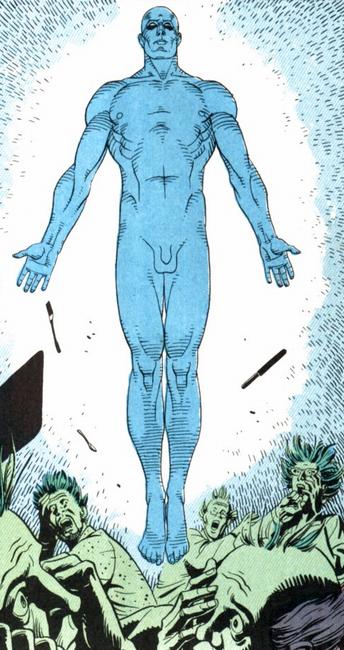
At work, as I stand in a billowing cloud of dust, a haze I suspect of being both physical and epistemological and one that I'm trying my damnedest to see through, one of the many things that I have been thinking incompletely about lately (it's hard to follow any single thought to conclusion inside this cloud of dust... hence, epistemological haze) ever since the release of Watchmen at least, a movie that I can't seem to get out of my head, but not for the right reasons, not because I liked it so much, but because for me, being a fan of the Alan Moore graphic novel, that film highlighted for me in ways that I hadn't quite thought of before the limitations of the cinematic medium, and not just the limitations of an uninspiring director, nope, but of the medium itself, but so anyway, one of the things that I've been thinking about lately is that a terrible clarity exists in film. Film, pictures of any sort really, impose a vision - one might say version - of reality upon us that, at least as far as our visual sense is concerned, should be accepted as reality. Pictures make certain demands upon or awareness of reality. Of course, when it comes to films, most of us, instead of being left to the mercies of clogged doors of perception, appeal to an epistemological structure that does not depend solely on sight, allowing us to discriminate without much hesitation or confusion between reality and fantasy. But I am not talking about artistic irony or suspension of disbelief. No, I'm talking about perception and how it relates to artistic interpretation. The clearer the image, the less room we have to negotiate with what we are seeing. I am talking, you see, about Dr. Manhattan's Penis.*
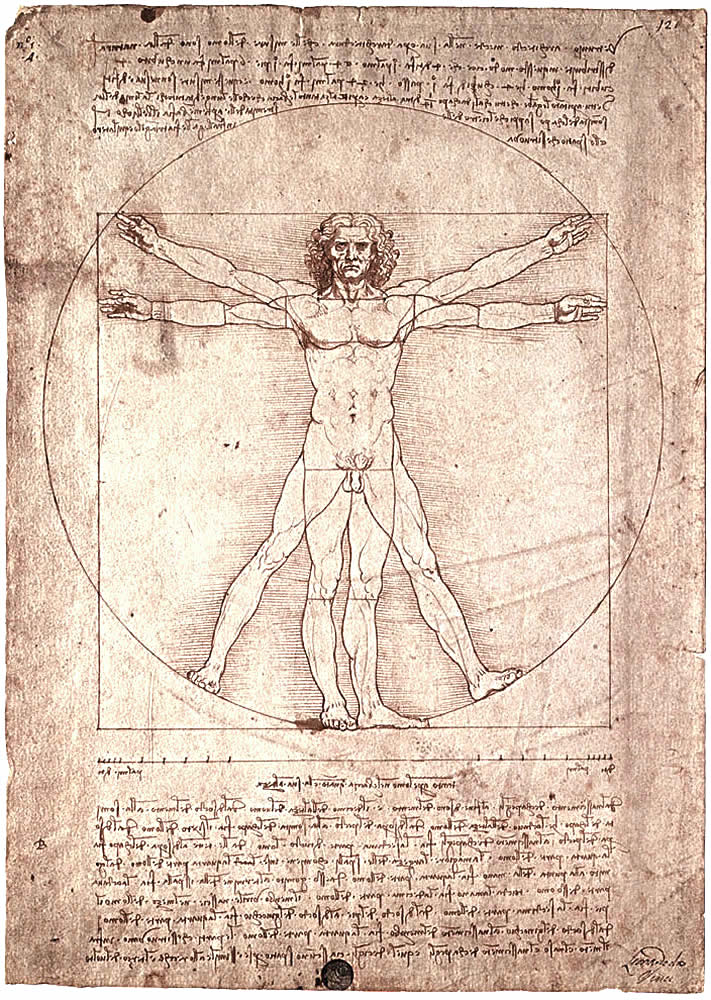
In Watchmen, Dr. Manhattan, previously John Osterman, is a sort of atomic super-being. Having been literally atomized in a laboratory accident, he reconstructed himself, particle by particle, into something else entirely, a being capable of manipulating matter and energy with nothing more than thought and will. As his fellow scientist and friend put it after John's post-accident reappearance: God exists, and he is American. But so, John, now far beyond anything recognizably human, finds himself slowly becoming detached from normal, everyday experience, a withdrawal that plays an important part in the Watchmen narrative. One of those detachments, it seems, is clothing. Though he does wear a sort of loincloth, or even sometimes a suit, when appearing in public, these are really more concessions to public morality than attempts at true modesty. Dr. Manhattan, probably because they have no meaning for him, just doesn't normally wear clothes, and in a novel so concerned with costumes and the way they create or conceal identity, this is likely important. So, for a good deal of Watchmen, you have a giant, blue-glowing man who recalls, more than anything, Da Vinci's Vitruvian man,walking around with no pants on. Just, you know, swinging in the breeze. On paper, in the panels of the novel, this works, partly because on the page the whole thing remains largely conceptual but also because of the way that Dave Gibbons chose to draw him (see above linked image), you do not so much get a penis as the suggestion of a penis.
In Zack Snyder's Watchmen, however, Dr. Manhattan's penis thrusts itself off the page, out of the realm of the conceptual, and into the full monty of visual clarity. There is no negotiating with this penis, no sir. It is there, on the screen. It moves. It possesses a lurid gravity.
Setting aside - setting far, far aside, so far aside, in fact, that you can't even see them, since they really aren't what I want to get into here - questions about the morality of on-screen nudity, it seems to me that something is lost, something perhaps critical, in this transition from concept to image, something I'm only starting to become aware of. The graphic novel is already a bridge between what is strictly textual and strictly visual, but even on the page, in this gentle blending of mediums, wiggle room can be found. A great deal of imagination is required to bring to life the images, either visual or literary. Readers aren't only consumers, they are participants. In film, or at least in most films, however, this type of imagination - which brings to life the art in the reader's mind, which brings the opportunity for self-evaluation and interpretation, which brings moments of insight - is no longer required. Another type may be, but not this one, not normally. Much of the imaginative, and what's worse, much of the hermeneutical work traditionally performed by the consumer of art is now done by the film itself. This is not an insurmountable hurdle, however, but it does require a deft hand and and a bit of trust in the audience. It requires relocating the conceptual, being aware that, though there are a few, there are not many overlaps between the literary and visual mediums. What is preciously ambiguous in one is crudely, vulgarly made obvious and dull in the full light of the other. A picture may be worth a thousand words but make that same picture move and its worth suddenly plummets. Ten words, maybe. Or fifteen. It is analogous, I think, to language. In the fuzzy passages of abstraction and conceptualization, a thought grows and expands, fills cathedrals worth of psychic pages: the thought is infinite. Spoken aloud or written down, that thought is shackled, chained, shoved roughly through Blake's dirty doors of perception. Limited, probably unintentionally, by our fumbling attempts at language.
Recently, Battlestar Galactica came to a triumphant finish. In poking around the various discussions online, however, I came across an interesting species of thought: some fans were actually disappointed in the series' finale because it left so many things "open." This sort of puzzled me because, other than a few narrative threads that simply didn't get treated (and most of these weren't terribly important), the last episodes wrapped up all the big questions. Wrapped up, that is, in that much was suggested, much was implied, much left in appropriate ways to the viewers imagination. But some viewers seemed angered by the endings provided. They apparently wanted everything spelled out. Perhaps they would have been satisfied if Edward James Olmos had turned to the camera and narrated each characters conclusions in detail, perhaps including such pointless things as what each of them ate for breakfast the next day. Maybe then they would have been satisfied. But this sort of petulent demand for absolute clarity is, I think, a consequence of what I am talking about. having grown accustomed to the cinematic medium's ability to provide absolute visual clarity, the viewer/reader's place in the creative process is lost. It goes beyond want... most viewers need everything spelled out to them, just like in a CSI episode.
We have lost the ability to negotiate with art. We are no longer adults, conversing like friends. At the feet of art, we are children. Uncomprehending. Dull. Unable to fully engage.
There are ways for the visual medium to be challenging. In the hands of filmmakers like David Cronenberg, Paul Thomas Anderson, the late Stanley Kubrick, people like this, filmmakers who understood the strenghts and weakness of visual communication, movies possess as much power, as much ambiguity, as much "literariness" as literature. There is no reason to settle for dull art.
So, trapped in my dusty haze, I ponder these things. Incompletely. No single medium is without limitation. And I am growing more and more aware of film's limitations. Watchmen isn't a horrible film. But it does highlight the problem of a medium's versitility. Brought to life, Dr. Manhattan's giant blue member is distracting. But Snyder was, I think, trapped: he could either be "faithful" to the text** (whatever that means) or adapt it to the new medium. Neither is entirely preferrable, so I think Watchmen should have stayed exactly what it was. But Watchmen isn't the problem. It only tugged into the open a question that had been slowing gathering force in my mind. As we hurl ourselves headlong into new technological frontiers, with ever expanding entertainment vistas opening up in front of us, as hi-def technology becomes more readily and easily available, I'm wondering if a clearer, sharper image is really what we need. Maybe the older, fuzzier images nurtered healthier imagintions.
*****
UPDATE: As my friend Life of Turner points out - and I can always trust him to point these things out - I may have come across as a bit too iconoclastic here. I'm not dismissing the medium entirely. As anyone who has met me or reads this site already knows, I have invested a great deal of my time and mental activity into film. I'm not about to abandon it. I think great directors, and sometimes even not so great ones, powerfully employ the medium, twisting it, manipulating it, forcing it to play on our emotions and intellects in ways we may not have been prepared for; they throw back into Marshall McLuhan's face his aphoristic assertion: the medium may be the message, but we can manipulate the medium. However, unless you*** are Lynch or Herzog or Cronenberg or (P. T.) Anderson, or some one of the other very few people out there really making films, and I mean really making them, you are more likely the manipulated in this situation and not, as you may think, the manipulator. And for the self-unaware, mediums are tyrannical masters: they will break your back and take from you everything. The cinematic medium is a savagely literal one. It relies, almost exclusively, on sight, and sight, as my master William Blake taught me, is defective. "We are led to believe a lie / when we see not thro the eye." Years of literal conditioning has left audiences far less jaded and sophisticated than they think. They are often imaginative infants, craddled within the medium's dictatorial arms. What we read, what we watch, what we play - these things shape our minds. So this isn't a dismissal of the medium. It's a desire to see the medium used properly. As long as filmmakers rely on their medium's visual clarity (and those who do almost always couple visual clarity with dialogue so utterly banal and dull as to boggle the mind - a double crime against art), as long as, in other words, we as viewers are meant to turn off our minds and simply accept what we are seeing, film and television will continue encouraging us into a downward spiral that ends in the opposite of enlightenment, in mental darkness.
Too much? Nay, not enough!
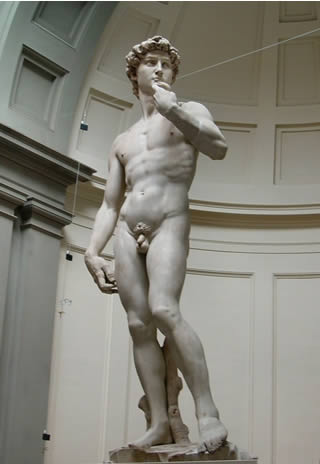
*Interesting side-story. The other day I found and uploaded onto photobucket.com this picture of Dr. Manhattan taken from the Watchmen graphic novel. When I logged back into photobucket, however, I was told that the image, I guess because it includes a picture of a penis, had been moderated. Frustrating. I wonder if an uploaded picture of David would receive the same treatment.
** I think that he, by remaining so visually faithful to the text (in this case image), probably thought he was being "edgy" (whatever that means) by so prominently including the Doc's giant dong. Sorry, Snyder... it just adds another layer of tonal schizophrenia to an already confused film.
*** This is perhaps my most inappropriate use of "you" ever. Really, it doesn't make any sense.
Subscribe to:
Posts (Atom)