Friday, July 16, 2010

The Scarlet Letter (excerpt)


Lillian Gish as Hester Prynne in The Scarlet Letter, 1926.

A lane was forthwith opened through the crowd of spectators. Preceded by the beadle, and attended by an irregular procession of stern-browed men and unkindly-visaged women, Hester Prynne set forth towards the place appointed for her punishment. A crowd of eager and curious school-boys, understanding little of the matter in hand, except that it gave them a hold-holiday, ran before her progress, turning their heads continually to start into her face, and at the winking baby in her arms, and at the ignominious letter on her breast. It was no great distance, in those days, from the prison-door to the market-place. Measured by the prisoner's experience, however, it might be reckoned a journey of some length; for, haughty as her demeanour was, she perchance underwent an agony from every footstep of those that thronged to see her, as if her heart had been flung into the street for them all to spurn and trample upon. In our nature, however, there is a provision, alike marvellous and merciful, that the sufferer should should never know the intensity of what he endures by its present torture, but chiefly by the pang that rankles after it. With almost a serene deportment, therefore, Hester Prynne passed through this portion of her ordeal, and come to a sort of scaffold, at the western extremity of the marketplace. It stood nearly beneath the eaves of Boston's earliest church, and appeared to be a fixture there.

The Scarlet Letter, by Nathanial Hawthorne

Wednesday, July 14, 2010

The Wings of the Dove (excerpts)

Girl in White Resting on a Sofa, by Alfred-Emile-Leopole Stevens

There was something deep within him that he had absolutely shown to no one--to the companion of these walks in particular not a bit more than he could help; but he was none the less haunted, under its shadow, with a dire apprehension of publicity. It was as if he had invoked that ugliness in some stupid good faith; and it was queer enough that on his emergent rock, clinging to it and to Susan Shepherd, he should figure himself as hidden from view. That represented no doubt his belief in her power, or in her delicate disposition to protect him. Only Kate at all events knew--what Kate did know, and she was also the last person interested to tell it; in spite of which it was as if his act, so deeply associated with her and never to be recalled nor recovered, was abroad on the winds of the world. His honesty, as he viewed it with Kate, was the very element of that menace: to the degree that she saw at moments, as to their final impulse or their final remedy, the need to bury in the dark blindness of each other's arms the knowledge of each other that they couldn't undo.

  *****
He watched her, when she went her way, with the vision of what she thus a little stiffly carried. It was confused and obscure, but how, with her head high, it made her hold herself! He really in his own person might at these moments have been swaying a little aloft as one of the objects in her poised basket. It was doubtless thanks to some such consciousness as this that he felt the lapse of the weeks, before the day of Kate's mounting of his stairs, almost swingingly rapid. They contained for him the contradiction that, whereas periods of waiting are supposed in general to keep the time slow, it was the wait, actually, that made the pace trouble him. The secret of that anomaly, to be plain, was that he was aware of how, while the days melted, something rare went with them. This something was only a thought, but a thought precisely of such freshness and such delicacy as made the precious, of whatever sort, most subject to the hunger of time. The thought was all his own, and his intimate companion was the last person he might have shared it with. He kept if back like a favourite pang; left if behind him, so to say, when he went out, but came home again the sooner for the certainty of finding it there. Then he took it out of its sacred corner and its soft wrappings; he undid them one by one, handling them, handling it, as a father, baffled and tender, might handle a maimed child. But so it was before him--in his dread of who else might see it. Then he took to himself at such hours, in other words, that he should never, never know what had been in Milly's letter. The intention announced in it he should but too probably know; only that would have been, but for the depths of his spirit, the least part of it. The part of it missed for ever was the turn she would have given her act. This turn had possibilities that, somehow, by wondering about them, his imagination had extraordinarily filled out and refined. It had made of them a revelation the loss of which was like the sight of a priceless pearl cast before his eyes--his pledge given not to save it--into the fathomless sea, or rather even it was like the sacrifice of something sentient and throbbing, something that, for the spiritual ear, might have been audible as a faint far wail. This was the sound he cherished alone in the stillness of his rooms. He sought and guarded the stillness, so that it might prevail there till the inevitable sounds of life, once more, comparatively coarse and harsh, should smother and deaden it--doubtless by the same process with which they would officiously heal the ache in his soul that was somehow one with it. It moreover deepened the sacred hush that he couldn't complain. He had given poor Kate her freedom.

The Wings of the Dove by Henry James

Monday, July 12, 2010

Epoch

I used to review movies here. The reason was simple. For years, for almost as long as I can remember, I had been committed to the idea that films are art, that actors are artists, that directors had something important to say and that whatever it was they were saying was worth listening to, or at the very least worth analyzing. From Cronenberg to Kurosawa, from torture porn to historical drama--from sci-fi to horror to romantic comedy to nearly everything I could get my hands on--I watched it all. I was large in film. And I enjoyed it. I enjoyed the wonder, the amusement, the excitement, the arousal. I took it as a whole, as one amalgam, one attempt to trace the boundaries and fill in the gaps of the human condition. And all the while, I brought what I hoped was a dedicated critical eye. I didn't submit to film; I submitted film to judgment. My dedication to film grew from the same root as my dedication to literature: a desire to understand, and to sympathize with, the human.

I haven't reviewed a film here in almost a year. The reason was, again, or at least at the time, quite simple. I was busy. I had begun my graduate studies, see. Suddenly I didn't have as much time for old hobbies as I would have liked. I suppose that, like I did with other interests, I could have made time, rescued time, snatched time for movies. I didn't. I didn't even try. I didn't because what I'd discovered was a gradual departure, a sort of out-growing, that has made a new epoch in my life. There is a rift--and a rift that at this time I see no chance, or even desire, of bridging or repairing--between what I want from art and imaginative creation and what Hollywood, as a mythic whole, as an institution, as a collection of individuals artist working together, can offer.

As film gradually began to occupy less imaginative space for me, several developments within Hollywood itself enlarged the rift, made it more pronounced, made it a chasm. It was at first only an imaginative rift: I simply wasn't interested, either on an intellectual or entertainment level, with what was being released this last year. Never before had I been so disinterested in film. From Avatar to The Hurt Locker and even A Simple Man... I simply didn't care. It all looked boring. It all looked contrived and manipulative. I had better things to do. But then it wasn't just an imaginative rift that separated me from film. It was a moral and spiritual rift. When in horror I sat and read the list of names of Hollywood elites, filmmakers I'd dedicated time and mental space to, who had signed a petition to release Roman Polanski and absolve and forgive him for the the 1977 drugging, rape, and sodomy of a 13-year old girl--names such as Woody Allen, Martin Scorsese, David Lynch, Michael Mann, Wes Anderson; when I realized that people whose art I'd admired pretended to think their art and their status entitled them to a few liberties such as the occasional bit of forced anal sex with a minor; when I heard people like Whoopi Goldberg attempt to defend Polanski and say it wasn't "rape-rape" because, c'mon, the 13-year old drugged girl was just asking for it, and besides, Hollywood is "a different kind of society" that "sees things differently"; when I read, and realized, and heard all this, everything changed. Hollywood revealed itself. Perhaps not in a new light; perhaps it had always been like that, embracing a double standard and indulging in the worst forms of amoral transgression; but it was a a new light to me. Or maybe it was a light I simply didn't want to see it in or could until now ignore.

Today, Swiss authorities, who had been holding Polanski under house arrest until he could be extradited to the US, decided not to extradite and to release him. He's now free to do whatever he wants. Hollywood is quietly celebrating. And I'm done.

I'd always dismissed comparisons between Hollywood and Babylon, or things like that, as alarmist, if not ridiculous. I don't know now if Hollywood actually is Babylon. Perhaps it is. That seems likely. Who else but Babylon could give a standing ovation to an unrepentant child rapist? Whatever Hollywood is, however, I've turned away from it. I've turned my back on film. It will never be for me what it once was. It's not as if I'll never watch a movie again. That would be an absurd thing to say. But I'm now much more aware of the disconnect and the deeply distressing hypocrisy that separates what a film seems to be about and what a director or actor thinks and says. It may be helpful to trust the story and not the teller. Actually, it would be really helpful right now. I wish I knew nothing of the personal lives and opinions of the men and women who have produced so many of the films that I have loved. But I do know these things. I know them because Hollywood hasn't even tried to hide them, has been proud of them, proud of their moral deficiencies. Super-producer Harvey Weinstein defended Polanski and said that “Hollywood has the best moral compass, because it has compassion.” Its compassion, however, lies with the rapist and not the raped. And when the difference between the story and the teller is that enormous, it annihilates, at least as far as I'm concerned, the value of the story.

The strange thing is how easy film is to walk away from. I'm not distressed by this. This isn't a Lenten act of self-denial. My waning interest in what film can offer, combined with a new and ugly insight into the heart and mind of Hollywood, has made this an easy break, has made Hollywood a dead thing to me. It has simply ceased to hold any imaginative grasp on my mind.

That's okay. I have better things to do.

Wednesday, July 7, 2010

Daniel Deronda (excerpt)

Could there be a slenderer, more insignificant thread in human history than this consciousness of a girl, busy with her small inferences of the way in which she could make her life pleasant? -- in a time, too, when ideas were with fresh vigour making armies of themselves, and the universal kinship was declaring itself fiercely: when women on the other side of the world would not mourn for the husbands and sons who died bravely in a common cause, and men stinted of bread on our side of the world heard of that willing loss and were patient: a time when the soul of man was waking to pulses which had for centuries been beating in him unheard, until their full sum made a new life of terror or of joy.

What in the midst of that mighty drama are girls and their blind visions? They are the Yea or Nay of that good for which men are enduring and fighting. In these delicate vessels is borne onward through the ages the treasure of human affection.

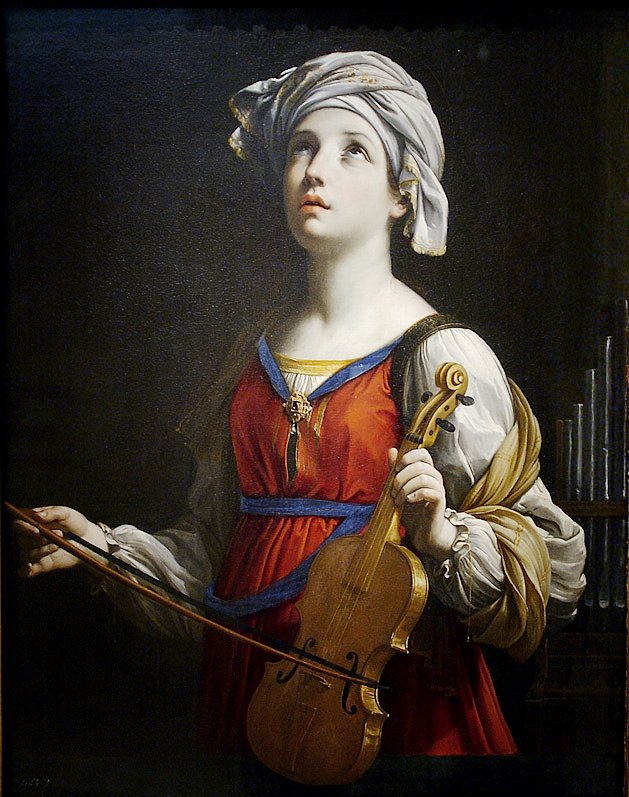
Saint Cecilia

Sainte Cécile, by Adolphe Lalyre.

Cecilia was the daughter of a senator, and a Christian. She was married by her family to Valerianus, a virtuous pagan. On her wedding night, however, she told him that she was betrothed to an angel who would guard her body and virginity. Her husband, probably frustrated by this, because Cecilia was very beautiful, and also probably wondering whether Cecilia was entirely sound or not, reasonably asked to see the angel. Cecilia told him to go to a certain street, and he obeyed. There he met the Bishop Urbanus, who converted and baptized him. Maybe Valerianus hoped this would satisfy the angel and he'd be able to sleep with his wife. However, he returned to Cecilia and an angel, perhaps Cecilia's betrothed (but perhaps not), appeared to them and crowned them with roses and lilies. Valerianus never slept with her. Cecilia remained a virgin. Instead, Valerianus and his brother, who was also converted and baptized, dedicated themselves to Christian service, supporting the poor and burying martyrs. This of course attracted the wrong attention, and Valerianus and his brother were arrested, tried, and sentenced to death. However, and this must have infuriated their persecutors, they converted their executioner, who instead of killing them decided to die with them. The three of them were martyred together, and Cecilia buried all three in a single grave. With her husband and brother-in-law dead, Rome came after the virgin herself. She was arrested. She made a glorious confession of her faith. She was sentenced to death. She was to be suffocated by steam in her own bathroom. But though they super-heated the room beyond what is humanly endurable, she was not hurt. She did not die. She sang. Terrified and enraged, they sent in an executioner to cut off her head with a sword. Perhaps he was too scared to do it properly; perhaps no amount of strength would have been enough. But the executioner attempted three times to cut off her head. Three times he sunk his sword into her neck; three time he was unable to sever her head from her body. Terrified, he left the virgin drenched in her own blood (he had cut her, after all; he had mortally wounded her; but he couldn't cut off her head) and fled. They didn't try to kill her again. She lived three days. She saw her family and friends--they came to visit her and comfort her as she died. She sang. I imagine it was very quiet singing, whispered maybe, a trembling song falling from her lips in perfect harmony with her faith. She dedicated all her money to the poor. She left her house, where she had received her martyrdom, to be a church. She finally opened her eyes for the last time, looked at her friends and family, closed them, whispered one last trembling song of faith, and was translated to heaven. Urbanus buried her with the bishops and the confessors because they knew she was a saint. They could see. Much later, when her remains were discovered and removed as relics to the church dedicated to her, it is said that she held out three fingers on one hand, and one on the other, three in one, a confession of the Trinity. Because she sang, she is the patron saint of musicians and is often depicted playing an instrument.

Wednesday, June 16, 2010

Saint Agatha

St. Peter Healing St. Agatha, by Giovanni Lanfranco.

A Roman prefect, Quintianus, wanted Agatha, who was beautiful. But she had dedicated her body, and her virginity, to Christ, and so denied him. He was furious. Knowing of her Christian faith, he arrested her. He himself was her judge. He expected her, threatened with torture and death, to deny her faith and give herself to him. She did not. Her mind and spirit were firm. Quintianus had given himself over to lust and flesh and so he gave Agatha over for a month to a brothel, where she was raped, assaulted, and humiliated. Quintianus thought this would break her and bring her around to his way of thinking. It did not. He imprisoned her next and subjected her to tortures. He cut off her breasts. But St. Peter appeared to her in prison and healed her. Quintianus's sadism mutilated her, attempted to defile the flesh, destroy the body; Peter's love healed her, restored her, made her whole again. (I can imagine his tender hands and fingers trembling as he touched her. I can imagine him weeping with her and comforting her and giving her strength.) Quintianus finally sentenced her to death: he sentenced her to be rolled naked along a bed of coals. He went from wanting to enjoy her flesh to wanting to utterly destroy it. Her body, denied to him, had become an offense, a thing meant for fire. Thus the world loves. And so they put her on the coals. But "anon the ground where the holy virgin was rolled on, began to tremble like an earthquake, and a part of the wall fell down upon Silvain, counsellor of Quintianus, and upon Fastion his friend, by whose counsel she had been so tormented." Her last prayer before she died was "Lord, my Creator, you have always protected me from the cradle; you have taken me from the love of the world and given me patience to suffer. Receive my soul."

Peter's hands were only a promise. He was tender and careful, a paternal power moved not by an impulse to rage and to revenge but by a more delicate desire to hold and to cherish. Things must look different to God. He sent Peter not to save her, not to take her out of prison, not to bring fire and damnation upon the enemies of Agatha's flesh and spirit. He sent him to heal her breasts.

Monday, May 31, 2010

Saint Lucy


"No one's body is polluted so as to endanger the soul if it has not pleased the mind. If you were to lift my hand to your idol and so make me offer against my will, I would still be guiltless in the sight of the true God, who judges according to the will and knows all things. If now, against my will, you cause me to be polluted, a twofold purity will be gloriously imputed to me. You cannot bend my will to your purpose; whatever you do to my body, that cannot happen to me" - Saint Lucy.

Sunday, May 23, 2010

Lady Jane Grey

The Execution of Lady Jane Grey (1833), by Paul Delaroche.

An image like this fills my mind. I can't escape it. It works in me, arresting me with its cold horror until abstraction is lost and all I can imagine is the reality of those last moments. It's an over-charged human sympathy: an inability to extricate myself or to enjoy any sense of detachment. It activates inside and tightens into a knot that makes me feel ill; it casts a shadow over the world. The delicacy of this particular image is tormenting. It's the last whispers, the slow reluctance, the inevitable swing. No one involved seems to want this act to happen. And yet it will happen. It's a moment in history. History removes, the lines blur, the human moves further away. Lady Jane Grey, queen of England for a little over a week, was executed by beheading in the Tower of London because she was protestant. She was either sixteen or seventeen years old. History slouches through the blood of individuals and personal moments of horror and sorrow.

Middlemarch (excerpts)

One fine morning a young man whose hair was not immoderately long, but abundant and curly, and who was otherwise English in his equipment, had just turned his back on the Belvedere Torso in the Vatican and was looking out on the magnificinet view of the mountains from the adjoining round vestibule. He was sufficiently absorbed not to notice the approach of a dark-eyed, animated German who came up to him and placing a hand on his shoulder, said with a strong accent, "Come here, quick! else she will have changed her pose."

Quickness was ready at the call, and the two figures passed lightly along by the Maleager towards the hall where the reclining Ariadne, then called the Cleopatra, lies in the marble voluptuousness of her beauty, the draper folding around her with a petal-like ease and tenderness. They were just in time to see another figure standing against a pedestal near the reclining marble: a breathing blooming firl, whose form, not shamed by Ariadne, was clad in Quakerish grey drapery; her long cloak, fastened at the neck, was thrown backwards from her arms, and one beautiful ungloved hand pillowed her cheek, pushing somewhat backward the white beaver bonnet which made a sort of halo to her face around the simply braided dark-brown hair. She was not looking at the sculpture, probably not thinking of it: her large eyes were fixed dreamily on a streak of sunlight which fell across the floor. But she became conscious of the two strangers who suddenly paused as if to contemplate the Cleopatra, and, without looking at them, immediately turned away to join a maid-servant and courier who were loitering along the hall at a little distance off.

"What do you think of that for a fine bit of antithesis?" said the German, searching in his friend's face for responding admiration, but going on volubly without waiting for any other answer. "There lies antique beauty, not corpse-like even in death, but arrested in the complete contentment of its sensuous perfection: and there stands beauty in its breathing life, with the consciousness of Christian centuries in its bosom. But she should be dressed as a nun; I think she looks almost what you call a Quaker; I would dress her as a nun in my picture. However, she is married; I saw her wedding-ring on that wonderful left hand, otherwise I should have thought the sallow Geistlicher was her father. I saw him parting from her a good while ago, and just now I found her in that magnificent pose. Only think! he is perhaps rich, and would like to have her portrait taken. Ah! it is no use looking after her--there she goes! Let us follow her home!"

*****

She did not really see the streak of sunlight on the floor more than she saw the statues: she was inwardly seeing the light of years to come in her own home and over the English fields and elms and hedge-bordered highlands; and feeling that the way in which they might be filled with joyful devotedness was not so clear to her as it had been. But in Dorothea's mind there was a current in which all thought and feeling were apt sooner or later to flow--the reaching forward of the whole consciousness towards the fullest truth, the least partial good. There was clearly something better than anger and despondency.

*****

But Dorothea remembered it to the last with the vividness with which we all remember epochs in our experience when some dear expectations dies, or some new motive is born. To-day she had begun to see that she had been under a wild illusion in expecting a response to her feeling from Mr Casaubon, and she had felt the waking of a presentiment that there might be a sad consciousness in his life which made as great a need on his side as on her own.

We are all of us born in moral stupidity, taking the world as an udder to feed our supreme selves: Dorothea had early begun to emerge from that stupidity, but yet it had been easier to her to imagine how she would devote herself to Mr Casaubon, and become wise and strong in his strength and wisdom, than to conceive with that distinctness which is not longer reflection but feeling--an idea wrought back to the directness of sense, like the solidity of objects--that he had an equivalent centre of self, whence the lights and shadows must always fall with a certain difference.

Monday, May 17, 2010

Christina's World

Christina's World by Andrew Wyeth

I've been staring at this all day. I have no vocabulary for this sort of art. My grammar is entirely literary and cinematic. I can say this looks like an image from a Terrance Malick film, for instance; and if I had never seen this painting and someone told me it looked like something from Days of Heaven, I'd have had a surprisingly accurate, though admittedly rough, sense of its feeling--of its loneliness, its pathos, its desperate beauty. But the still, mute force of an image like this... I'm not equipped to write about it. All I can do is sit in front of it all day.

Degas

Vor dem Spiegel

Place de la Concorde

Vier Tänzerinnen

Ballettprobe

Sunday, May 16, 2010

Saturday, May 15, 2010

The Portrait of a Lady (excerpt)

Mlle. Irene Cahen d'Anvers (detail) (1880) by Jean-Auguste Renoir

This last week I read The Portrait of a Lady by Henry James. Isabel Archer, I think, shall live long in my imagination. Most of the time, characters in a novel make sense only within that novel. What they say, what they do--it's all contained in a limited vision. They begin and end between the book covers. These characters exist as pieces of a large machine, moved and plotted by events and fitted exactly to situations. Isabel Archer is larger than her novel. Rarely have I felt so convinced of a character's reality. She is real. She is living now, in my imagination. I felt hollowed out, emptied, after I finished the novel, which I devoured... or rather, I think, which devoured me. This is one of my favourite early passages. Enjoy.

"One wet afternoon, some four months earlier than the occurrence lately narrated, this young lady had been seated alone with a book. To say she was so occupied is to say that her solitude did not press upon her; for her love of knowledge had a fertilising quality and her imagination was strong. There was at this time, however, a want of fresh taste in her situation which the arrival of an unexpected visitor did much to correct. The visitor had not been announced; the girl heard her at last walking about the adjoining room. It was in an old house at Albany, a large, square, double house, with a notice of sale in the windows of one of the lower apartments. There were two entrances, one of which had long been out of use but had never been removed. They were exactly alike--large white doors, which an arched frame and wide side-lights, perched upon little "stoops" of red stone, which descended sidewise to the brick pavement of the street. The two houses together formed a single dwelling, the party-wall having been removed and the rooms placed in communication. These rooms, above-stairs, were extremely numerous, and were painted all over exactly alike, in a yellowish white which have grown sallow with time. On the third floor there was a sort of arched passage, connecting the two sides of the house, which Isabel and her sisters used in their childhood to call the tunnel and which, though it was short and well-lighted, always seemed to the girl to be strange and lonely, especially on winter afternoons. She had been in the house, at different periods, as a child; in those days her grandmother lived there. Then there had been an absence of ten years, followed by a return to Albany before her father's death. Her grandmother, old Mrs. Archer, had exercised, chiefly within the limits of the family, a large hospitality in the early periods, and the little girls often spent weeks under her roof--weeks of which Isabel had the happiest memory. The manner of life was different from that of her own home--larger, more plentiful, practically more festal; the discipline of the nursery was delightfully vague and the opportunity of listening to the conversation of one's elders (which with Isabel was a highly-valued pleasure) almost unbounded. There was a constant coming and going; her grandmother's sons and daughters and their children appeared to be in the enjoyment of standing invitations to arrive and remain, so that the house offered to a certain extent the appearance of a bustling provincial inn kept by a gentle old landlady who sighed a great deal and never presented a bill. Isabel of course knew nothing about bills; but even as a child she thought her grandmother's home romantic. There was a covered piazza behind it, furnished with a swing which was a source of tremulous interest; and beyond this was a long garden, sloping down to the stable and containing peach-trees of barely credible familiarity. Isabel had stayed with her grandmother at various season, but somehow all her visits had a flavour of peaches. On the other side, across the street, was an old house that was called the Dutch House--a peculiar structure dating from the earliest colonial time, composed of bricks that had been painted yellow, crowned with a gable that was pointed out to strangers, defended by a rickety wooden paling and standing sidewise to the street. It was occupied by a primary school for children of both sexes, kept or rather let go, by a demonstrative lady of whom Isabel's chief recollection was that her hair was fastened with strange bedroomy combs at the temples and that she was the widow of some one of consequence. They little girl had been offered the opportunity of laying a foundation of knowledge in this establishment; but having spent a single day in it, she had protested against its laws and had been allowed to stay at home, where, in the September days, when the windows of the Dutch House were open, she used to hear the hum of childish voices repeating the multiplication-table--an incident in which the elation of liberty and the pain of exclusion were indistinguishably mingled. The foundation of her knowledge was really laid in the idleness of her grandmother's house, where, as most of the other inmates were not reading people, she had uncontrolled use of a library full of books with frontispieces, which she used to climb upon a chair to take down. When she had found one to her taste--she was guided in the selection chiefly by the frontispiece--she carried it into a mysterious apartment which lay beyond the library and which was called, traditionally, no one knew why, the office. Whose office it had been and at what period it had flourished, she never learned; it was enough for her that it contained an echo and a pleasant musty smell and that it was a chamber of disgrace for old pieces of furniture whose infirmities were not always apparent (so that the disgrace seemed unmerited and rendered them victims of injustice) and with which, in the manner of children, she had established relations almost inhuman, certainly dramatic. There was an old haircloth sofa in especial , to which she had confided a hundred childish sorrows. The place owed much of its mysterious melancholy to the fact that it was properly entered from the second door of the house, the door that had been condemned, and that it was secured by bolts which a particularly slender little girl found it impossible to slide. She knew that this silent, motionless portal opened into the street; if the sidelights had not been filled with green paper she might have looked out upon the little brown stoop and the well-worn brick pavement. But she had not wish to look out, for this would have interfered with her theory that there was a strange, unseen place on the other side--a place which become to the child's imagination, according to its different moods, a region of delight or of terror."

The Portrait of a Lady, by Henry James. New York: The Modern Library, 1951. 27-30.

Sunday, January 17, 2010

Psyche and Cupid


Psyche et L'Amour by William-Adolphe Bouguereau


Amor and Psyche by Antonio Canova


Amor and Psyche by Johann Heinrich Fussli

With Till We Have Faces, C. S. Lewis took Psyche and Cupid's already allegorically charged myth of love, perseverance, and redemption and re-told it as an extended metaphor for the human soul's relationship with God. It is one of the only novels that haunts me. Its images live powerfully in my imagination. These paintings, which have nothing to do with the Lewis novel, I know, nevertheless take from my eye a retrospective light: Till We Have Faces, for me at least, eclipses the myth, or at least becomes so entangled with it that I cannot look at these images as anything other than before-the-fact illustrations for a novel that hadn't been written yet. There might be some sort of temporal-hermeneutical anomaly happening here. 

Saturday, January 16, 2010

Pamela, by Joseph Highmore

Pamela and Mr B in the Summerhouse

Pamela Leaves Mr B's House in Bedfordshire

Pamela Shows Mr Williams a Hiding Place for Her Letters

Pamela Tells a Nursery Tale

Sunday, January 3, 2010

Clarissa

Robert Lovelace Preparing to Abduct Clarissa Harlowe by Francis Hayman

Thursday, December 24, 2009

Magnificat

My soul glorifies the Lord and my spirit rejoices in God my Saviour, for He has been mindful of the humble state of His servant. From now on all generations will call me blessed, for the Mighty One has done great things for me-- Holy is His name.

Merry Christmas, my friends.

Pamela

Pamela in the Bedroom with Mrs Jewkes and Mr B, by Joseph Highmore

I recently, and by recently I mean in the last couple days since I put a bow on top of and kicked in the ass term one of my MA, read--okay, perhaps devoured--Samuel Richardson's novel Pamela. After four months of reading postmodern, postcolonial lit, it was a relief to sink into what I will arrogantly refer to as real literature, literature that--as Northrop Frye describes it--you can live inside.

Pamela, or Virtue Rewarded was written in 1740 and is often referred to as one of the first, if not the first, true novels. The eponymous Pamela, a girl born, as one character ominously insinuates, either to undo or be undone, is a sixteen year old handmaid who, when the lady who raised her out of poverty dies, finds herself the unwanted object of Mr. B's, that late lady's son's, rakish desire, even though Pamela's honesty and virtue (eighteenth-century euphemisms for, particularly, virginity but also, more generally, for an entire moral and religious ethos) are her only concerns. She resists repeatedly and steadfastly his advances, which grow stronger each time he fails to seduce her, until, just when she thought she was finally free to return to her parents, he makes her his prisoner, kidnapping her and carrying her off to a private estate where, aided by the sinister Mrs. Jewkes, his house-keeper, he hopes to force her to his will. After she continually refuses his bargains and advances, he attempts to rape her--again aided, quite literally, by Mrs. Jewkes, who holds the stripped Pamela down on the bed for her master. "What you do, Sir, do; don't stand dilly-dallying," Mrs. Jewkes encourages. (The image above is from this scene: Pamela is undressing for bed; Mrs. Jewkes, who is Pamela's jailer even when she sleeps, is ready; and Mr. B, disguised as a drunk and passed-out servant, is watching and waiting.) But Pamela, as she has several times before when Mr. B tried to force her, and because of her delicate mind and because this is, after all, the age of sensibility, falls into a fit, one so violent her attackers thought she was dying. When he sees this, Mr. B, who apparently does love Pamela quite sincerely but has grown up never having his desires frustrated, repents his actions, leaves her unspoiled, and (I'll just skip over a whole bunch here) eventually reforms, and (I'll just skip over a whole bunch more here) finally marries her, much to everyone's relief and happiness, including and especially Pamela's.

There's too much to say. The novel does so many things that my brief gloss only hints at. It upsets hierarchy, placing Pamela, a mere servant girl, in the centre of a new moral order--one in which handmaids and princesses have equal merit. It projects a moral cosmology that transcends class and gender. It offers a vision of justice and reward based on personal moral agency. It vindicates the oppressed, reforms the oppressor, and ends in a subtle apocalypse (by which I mean revelation) of an ordered, unified, purified world. Through Pamela, sort of like an eighteenth-century Beatrice, the world is made better.

What I most love about Pamela, however, is its sincerity, especially in its vision of sexuality. It could be read as a metaphor, I guess, sure, but that is not how Richardson wrote it. It is about virginity and sex; it does not treat them lightly but injects into them weight and gravitas. Which, again... after four months of postmodern lit--and here my well-documented conservative streak emerges--I was ready for a little sincerity and gravitas.

I had selfish reasons for reading Pamela and for now reading the much more formidable Clarissa (Richardson's masterpiece, the novel he will always be remembered for. It's 1500 pages long. There go my holidays). Those reasons might be guessed by those aware of my own projects. Too many of the themes found in Pamela touch very closely those of The Execution... too closely, in fact, for me not to have read it and been aware of it, though I suppose canonical influence isn't what it used to be. The central image--a girl facing the sexual menaces and devices of an all-powerful oppressor, aided only by an unassailable and impenetrable surety and purity of self--is dramatized much differently here than in my own novel, much to my relief (I was worried for a while... and still might be, having only just started Clarissa). I know now that Pamela will, somehow... I'm not sure how... creep into The Execution. It must. I've read it; I can't unread it. But perhaps, as with C. S. Lewis' Till We Have Faces, which I've always thought of as the guiding literary light that I want to follow in The Execution, only I will see the influence.

(Just a note: inspired and slightly put off balance by Pamela, I've been compiling a list of books that I should probably read or be aware of as I continue with The Execution. It's a long list. Mostly, though... and this might sound strange... I've been coming up with a very particular list, a list of books written by men in which the central character is a woman. There is something--and I know many people who will think this sexist, so I'm sorry--about the image of woman that perfectly suits her as a symbol of moral or religious integrity. Dante uses a woman as his central image. So does Donne. So does Richardson. Dickens, too (not always). Lewis, of course. The list goes on. There are, I think, metaphors hardwired into our bodies. Into and out of our bodies can be read metaphors... some arising naturally, I think, others being scribed onto us. I'm interested in seeing what those metaphors are or can be. There might be a dissertation in there somewhere.)

Saturday, November 14, 2009

Trailer :: Bad Lieutenant


Except for his dual performance in Adaptation, I can't say I've really liked much of Cage's work since Wild at Heart (full disclosure: have not seen Leaving Las Vegas). But the idea of him and legendary director Werner Herzog teaming up is intriguing and... tantalizing.

Tuesday, September 29, 2009

Reports of My Untimely Demise...

... Probably don't exist, but it's nice to think that someone, somewhere - perhaps some deranged and forever unknown devotee of cynical film review and cultural skepticism lurking out there in this troubled and convulsing series of tubes - has noticed a certain plunging towards flatline drop-off in my posting regularity. Perhaps I need more fiber, or at least fiber's internet equivalent. (You see, in this metaphor, mixed and vexed as it is, posting on a blog and pooping are essentially equivalent activites.)

I am not without excuse for this update shortage. Oh no. I have many excuses in fact. Good ones. Graduate studies in English have commenced, once again at that institute of dubious credibility, the University of Saskatchewan. I now descend even further into the stygian corners of academia, taking on not only the role of bewildered pilgrim, stumbling and fumbling about and occasionally stopping to shout out some curse against the prevailing powers-that-be who keep, ridiculously and with increasing futility, trying to tell me that things like postmodernism and theory are important... but also, apparently, and now when did this happen, the role of guide, of some Virgil-esque (-ish?) agent of academic mercy, sent of help shuffle freshmen students across the seething currents of Acheron and file them away in some departmental bolge, all while avoiding the chomping, slobbering advances of that insatiable beast Cerberus, who in this by now incomprehensible metaphor doesn't really represent anything at all, except maybe my own irrational need to render university as if it where some Dantean punishment. Anyway, in case you didn't catch all that, I'm now leading a first-year English lit tutorial. That, and my own studies, keep me busy.

Also, and I have no half-cooked metaphor to describe this, sorry, I am still writing The Execution. It has become, uh well... distracting. Which is a downgrade. Before, it was consuming. But even so, when I should be reading, I'm writing. And when I should be writing, I'm writing, but not, see, what I'm supposed to be writing, which is essays and seminar presentations and other necessary but, you know, really intrusive things like that. However, I remain pleased with the results. This whole thing has been a remarkable experience. I really had no idea what I was setting out on when I started. It has already surpassed all the personal goals I set for myself. Work on the novel has dramatically slowed with my reentry into the academy, but it remains my primary focus. I might regret that later. You know, when professors start glaring at me that projects are due. But much, much later, when I'm published and celebrated and really filthy rich, it will all have been worth it.

And in whatever time remains, I indulge in grandiose and narcissistic fantasy. With all that, I'm swamped!

So in the next little while, as I attempt to find anything approaching a working knowledge of the English language in freshmen papers; struggle to prove that I myself possess such knowledge, however limited, in my own writing, academic or otherwise; and as I once again consider the merit of complete withdrawal from human civilization - I don't know, up on a mountain somewhere, or in the middle of the desert, perhaps surrounded by landmines, or at least a moat - I may not update the old blog all that much.