Thursday, July 30, 2009

Friday, July 24, 2009
Abandon All Hope...
A while back, Electronic Arts announced that they were adapting Dante's Inferno as an action video game, as a sort of God of War clone, but one in which a Medieval Christian iconography, as depicted in the first canticle of the Commedia, is substituted for the Greek mythos. If that makes no sense to you... that's because it makes no sense. Look:
I've been trying to figure out what to make of this. My initial reaction was unmitigated hostility. That anyone could even think any aspect of the Commedia was suitable material for an action game boggled and enraged me. And that then shifted into a sort of anxious curiosity. Translations, even from one medium to another, are not necessarily, in theory, doomed undertakings. But now that I've looked at some of their publicity material and seen some of their PR stunts, the hostility is back. The game is shaping up to be an offensive, ugly parody of Dante's intention... a prurient and savage mockery of his moral and religious kerygma. Leaving aside the more obvious narrative departures (especially what looks to be an unforgiveable mutilation of Beatrice), the developers seem either not to understand or, I think more likely, to be willfully working against the poem, as can be seen here, where they talk about their interpretation of the Circle of Lust. I can only assume most of them, if they've even read the Inferno, read it only to revel within, and now exaggerate, the poem's strong images. I'm going to guess that, if the game is even partially successful, the sequel will not be called Dante's Purgatorio or Dante's Paradiso.
It's not so much the imagery and art direction of the video above that agitates me. It's the fact that this - this! - is being called an interpretation of the Inferno. If you want to make a game about hell and about a warrior (not a poet or a pilgrim, but a warrior) dismembering demons and damned souls... fine. But don't call it the Inferno. Don't bring Dante into it.
In the past, I have posted about the Commedia. Dante's work, not only the Commedia but also his lesser-known works like La Vita Nuova, have had a profound impact upon me. In my personal canon, the Commedia is a central text - not a planet but a star around which spins an entire textual universe. To see it used like this, reduced like this... it feels a bit like witnessing a sex crime, one committed against Dante, against Beatrice, against the entire history of Western literature.
I hope this game fails... I mean really fails.
I've been trying to figure out what to make of this. My initial reaction was unmitigated hostility. That anyone could even think any aspect of the Commedia was suitable material for an action game boggled and enraged me. And that then shifted into a sort of anxious curiosity. Translations, even from one medium to another, are not necessarily, in theory, doomed undertakings. But now that I've looked at some of their publicity material and seen some of their PR stunts, the hostility is back. The game is shaping up to be an offensive, ugly parody of Dante's intention... a prurient and savage mockery of his moral and religious kerygma. Leaving aside the more obvious narrative departures (especially what looks to be an unforgiveable mutilation of Beatrice), the developers seem either not to understand or, I think more likely, to be willfully working against the poem, as can be seen here, where they talk about their interpretation of the Circle of Lust. I can only assume most of them, if they've even read the Inferno, read it only to revel within, and now exaggerate, the poem's strong images. I'm going to guess that, if the game is even partially successful, the sequel will not be called Dante's Purgatorio or Dante's Paradiso.
It's not so much the imagery and art direction of the video above that agitates me. It's the fact that this - this! - is being called an interpretation of the Inferno. If you want to make a game about hell and about a warrior (not a poet or a pilgrim, but a warrior) dismembering demons and damned souls... fine. But don't call it the Inferno. Don't bring Dante into it.
In the past, I have posted about the Commedia. Dante's work, not only the Commedia but also his lesser-known works like La Vita Nuova, have had a profound impact upon me. In my personal canon, the Commedia is a central text - not a planet but a star around which spins an entire textual universe. To see it used like this, reduced like this... it feels a bit like witnessing a sex crime, one committed against Dante, against Beatrice, against the entire history of Western literature.
I hope this game fails... I mean really fails.
Thursday, July 23, 2009
Review :: Slumdog Millionaire
In my distraction last year, Slumdog Millionaire was one of the films I unfortunately let fall to the side, which is odd because I am quite the fan of Danny Boyle's work. But there seemed, to me at least, to be something about the film - actually, now that I think about it, probably something about its campaign and publicity, which tried to sell it as a "feel-good movie" - that turned me off, even when the Oscar glitter descended around it. It puzzled me that the man who had very nearly reinvented the zombie genre would make this film. It seemed a bit... I don't know, a bit like James Cameron making Titanic, or something, and that left me twisting in cinematic ambivalence. And in a sense, I was right. Slumdog marks a bit of a thematic shift in Boyle's work - or, if not a shift, then at least a maturation into new territory. Gone is the satiric acid of Shallow Grave and Trainspotting; gone are the thundering apocalyptics of 28 Days Later and Sunshine. In their place rushes and grins a new bounding sense of sincerity, life, and struggle. Slumdog Millionaire startled me by just how alive it felt - like it was bursting and surging and breaking loose across the screen. And almost immediately, as the film started, I found myself victim to it - I let myself fall into Boyle's hands, and for the next two hours he worked upon me, tortured me, and then sent me soaring into the air. Slumdog Millionaire is pure cinematic exhileration.
 Jamal (Dev Patel) is a young man from the slums of Mumbai who finds himself on the Indian version of Who Wants to be a Millionaire... and he's winning. But the life that has led him to this moment has been one of constant struggle, pain, and heartache. He has, for so long, been trying to find and rescue the girl that he loves, Latika (the luminous Freida Pinto - seriously, this girl destroyed me. Just look at her!), and every time he finds her some horrible circumstance will pull them unfairly and violently apart. Now, one question away from winning it all, his hopes for finding her seem balanced on a knife-blade. It sounds like a strange set-up, I know, which is partly why, fool that I was, I let this movie escape me for so long. But though the premise sounds slightly ridiculous, there is so much packed into here - tragic vignettes from Jamal's life, the moments of hope and terror that have constantly provoked him; a stunning picture of squalor and poverty in which life somehow still flourishes; moments of bleak hopelessness and fierce determination. The gameshow narrative - important, sure - isn't really the story of Slumdog Millioniare; it's just the conceit that ties everything together and provides the framework on which Boyle will hang the stories from Jamal's life.
The soundtrack grooves in some Western/Eastern tehno-pop hybrid, and it works. The gorgeous and lush cinematography, always a feature in Boyle's films, glitters and stuns. The edits slash and stitch so rapidly sometimes and with such feverish vitality they spin your head and leave your breathless. It all works, story and execution.
In a sense, Slumdog is pure indulgence. As I browse around and skim the reviews, forums, and comments for the film, I'm bewildered (and enraged) at some of the things I'm finding. There are people who don't like this film! There are people who think it's cheesy, simple, or - most puzzling to me - boring. But it's the film's simplicity and sincerity, its uninhibited embrace of all things pure and immediate, that gives it so much power. Yes, the ending is an uninhibited display of emotion that - I suppose, maybe... - you could look at as being... uh, I guess discordant, as not fulfilling the gritty and wrenching realities that have come before it. But I would say that the film, and its ending, are entirely cohesive, and that the end, which seems not just to take a dip in but actually to dive headfirst into fairy tale sensibilities, reveals the movie's true intentions. All the grit, all the dirt, all the struggle that has kept Jamal from Latika... it's all groundwork for the film's final, nearly transcendent conclusion. It is the "feel-good movie of the year." It's just a feel-good movie that destroys you before it recreates you. It will drag you through the mud and shit (literally, at one point) and then it will lift you up.
 And now I'm just gushing and it's getting embarrassing. I'm actually listening to the film's soundtrack as I'm writing this and it's... infecting me. I absolutely adored this film. Not in the same way I adore something like Synecdoche, New York or Let the Right One In... but in that pure way. It's the kind of movie you watch not to be challenged but the kind you watch to see life and hope affirmed. And it's rare to find a film like that these day and even rarer to find one that does it so well and with as much vitality and sincerity as this one. I love Slumdog Millionaire... and you should, too.
 Jamal (Dev Patel) is a young man from the slums of Mumbai who finds himself on the Indian version of Who Wants to be a Millionaire... and he's winning. But the life that has led him to this moment has been one of constant struggle, pain, and heartache. He has, for so long, been trying to find and rescue the girl that he loves, Latika (the luminous Freida Pinto - seriously, this girl destroyed me. Just look at her!), and every time he finds her some horrible circumstance will pull them unfairly and violently apart. Now, one question away from winning it all, his hopes for finding her seem balanced on a knife-blade. It sounds like a strange set-up, I know, which is partly why, fool that I was, I let this movie escape me for so long. But though the premise sounds slightly ridiculous, there is so much packed into here - tragic vignettes from Jamal's life, the moments of hope and terror that have constantly provoked him; a stunning picture of squalor and poverty in which life somehow still flourishes; moments of bleak hopelessness and fierce determination. The gameshow narrative - important, sure - isn't really the story of Slumdog Millioniare; it's just the conceit that ties everything together and provides the framework on which Boyle will hang the stories from Jamal's life.
The soundtrack grooves in some Western/Eastern tehno-pop hybrid, and it works. The gorgeous and lush cinematography, always a feature in Boyle's films, glitters and stuns. The edits slash and stitch so rapidly sometimes and with such feverish vitality they spin your head and leave your breathless. It all works, story and execution.
In a sense, Slumdog is pure indulgence. As I browse around and skim the reviews, forums, and comments for the film, I'm bewildered (and enraged) at some of the things I'm finding. There are people who don't like this film! There are people who think it's cheesy, simple, or - most puzzling to me - boring. But it's the film's simplicity and sincerity, its uninhibited embrace of all things pure and immediate, that gives it so much power. Yes, the ending is an uninhibited display of emotion that - I suppose, maybe... - you could look at as being... uh, I guess discordant, as not fulfilling the gritty and wrenching realities that have come before it. But I would say that the film, and its ending, are entirely cohesive, and that the end, which seems not just to take a dip in but actually to dive headfirst into fairy tale sensibilities, reveals the movie's true intentions. All the grit, all the dirt, all the struggle that has kept Jamal from Latika... it's all groundwork for the film's final, nearly transcendent conclusion. It is the "feel-good movie of the year." It's just a feel-good movie that destroys you before it recreates you. It will drag you through the mud and shit (literally, at one point) and then it will lift you up.
 And now I'm just gushing and it's getting embarrassing. I'm actually listening to the film's soundtrack as I'm writing this and it's... infecting me. I absolutely adored this film. Not in the same way I adore something like Synecdoche, New York or Let the Right One In... but in that pure way. It's the kind of movie you watch not to be challenged but the kind you watch to see life and hope affirmed. And it's rare to find a film like that these day and even rarer to find one that does it so well and with as much vitality and sincerity as this one. I love Slumdog Millionaire... and you should, too.
Wednesday, July 15, 2009
The Execution (Excerpts)
In the last little while I've been hard at work on The Execution. A rough draft of the novel's first section is now complete and I feel pretty exhausted. I've written essay for the past eight years of my life... writing like this, however, is very different. It's draining. But I'm please with the results. I'm eager to start getting some feedback. Here's a quick look at some of what I have so far. The novel is about David and Alee, a young couple who have been arrested for their faith and are awaiting their sentence. But the sentence isn't simply: it's called the Demonstration and it's designed to break a person's will and faith through torture and degradation. These two passages come from early descriptions of the two of them.
During the day, when the business of survival was not so immediately pressing, Alee helped with the cooking, taking care of the remnant children, mending clothes, or, if she had a moment to herself and Carly wasn’t around to talk, she’d read some of the books that David had managed to salvage before the New Order’s grip on the surrounding territory had forced them to stay huddled on the farm. She had already read The Voyage of the Dawn Treader, Perelandra, Till We Have Faces (David was a big C. S. Lewis fan, see...) part of The Broom of the System (she didn’t like it, she said, when she tucked it back in with the others; nothing happened in it, and the things that did happen are confusing...), and The Complete Stories of Flannery O’Connor, which startled her and made her laugh. She was now, or had been before the raid, reading a sermon called Death’s Duel. David has said it was one of his favourites. Most nights, in their closet, sometimes before, sometimes after they made love, which, depending on how early in the evening they shut the closet door, required a degree of self-mastery and discretion in order not to wake the people sleeping or talking just inches away from them, David would read to her, quietly, just barely whispering, and she’d fall asleep while the words of great authors, and sometimes not so great ones, wiggled their way into her mind and her dreams. Though she always liked the sound of his voice, she didn’t always like the stuff that David read to her. Blake upset her; Pynchon offended her. When she’d tell David she didn’t like what he was reading to her, he’d sometimes laugh, sometimes nod, but would always offer to change books, which made Alee feel guilty because he obviously loved these books that were strange to her, and she’d also feel a little stupid for not seeing in them what he saw. When she told him this one night after he had put down Blake and was picking up A Midsummer Night’s Dream from the small library he kept stacked in the closet along with their clothes (his few books, their clothes, and a small collection of precious things – Alee’s diary, some pictures of both their families, a Bible that had belonged to David’s mother and one that had been given to Alee by her father and mother on her sixteenth birthday – this was all they owned, really), he paused, the book not yet opened, and looked at her and, after thinking for a moment and coming up with nothing to say, kissed her instead and blew out the candle. “Don’t feel stupid,” he whispered to her as they curled into each other.
***
Their first night together, back in the dying city, they had found a basement to hide in and sleep while the bombs and the gunfire continue to rattle and burst. Most of the house had been destroyed except for the basement, which had one bathroom, two bedrooms, and what had obviously been a play area for children – toys scattered about, a TV turned-off and somehow suggesting Death, the kind of old and worn furniture that gets banished to rooms not meant for entertaining guests. David had offered to sleep in the other bedroom but the girl had insisted they stay in the same room, so he had taken the floor. He found a blanket and a pillow in the other room and lay down beside the bed. There was no light, only the glow of moon coming through the window. This must have been a young girl’s room, she had said, stating the obvious. The room has done up in soft shades of pink. I guess so, he had nodded. Before lying down on the bed, she spent some time just sitting on it, looking at the room, at the posters on the wall, at the clothes lying on the floor that hadn’t been included in the hasty retreat; she picked up a stuffed animal and hugged it close. Then she lay down above the covers. David lay in the semi-dark, listening to Alee’s quiet crying, feeling useless and miserable and, looking at her – face smudged with tears, clothes dirty and in places ripped – afflicted, as oh God what’s this? ... as several pornographic fantasies, not all of which included a willing partner, rose up in him with alarming haste. He had never before felt tempted by, even flirted with, the idea of rape, of power... but, could that maybe have been because, oh dear... because there were rules outside of him? And if the outside rules were gone, did inside rules take their place? The world had gone away... so too, perhaps, had its expectations? A chance to reinvent...? A chance... for anything...! So then, here is the Question. David discovered several unpleasant things about himself that night. However, he had fallen asleep, determined, at least, if not to resolve the Question right now then at least to delay it until morning. (He never told her any of this later, by the way... how could he?)
Alee was awake longer. She stared down at David on the floor next to her for a long time, puzzling with her own question, evaluating him, unsure whether she should listen to and trust the voice in her heart that seemed to say he will protect you – a voice not necessarily her own but belonging to Something Else, who was apparently certain about which side of the Question David would eventually – and quite soon in fact – land on. Later, when David woke up in the middle of the night, gunfire jangling through the darkness and flaring down his legs into the clench and curl of toes, he found Alee wiggled up under his blanket on the floor next to him. Her eyes were open and she was staring at him, face ready, in the dropped flutter of a skipped heartbeat, to respond however David’s next move would demand. A test! And so soon... ? Alee – and she probably wouldn’t have been able to say why if questioned – had decided to force the Question, to use herself, to submit herself as the test, right here, now, tonight, knowing that, if she had somehow manage to misread entirely the man in front of her that she could be lost forever, would turn to vapour and drift away and cease to be Alee. An entire world, two of them, in fact – his and hers – hung in the Moment, and David once again found himself on the frontlines of that ancient duel... the Question: Good vs. Evil... a struggle now concentrated in him, only him, faced with the only decision in the universe left to make. And here she is beside him... vulnerable and waiting... “Uh,” is how he stumbles his way out of kicked-up dust, clearing his throat and declaring himself for Good with all the eloquence of firm resolution, “... you okay...?” She smiles, tears somehow still fresh around her eyes, and, after a relieved sigh, whispers, mouths really but David understands her, “Yes. Thank you.” Her evaluation of him apparently complete, he passing several tests he hadn’t even known had drawn swords with him, tests put to him by her and, yes, by God, too... She moved in closer to him and asked him to put an arm around her, which he did, and like this she eventually fell asleep, head resting on his shoulder and now-and-then fretfully rolling in her sleep towards his chest, leaving him – moral victor, yes, but still subject to all the hungers and wants of flesh, yes oh yes – to ache out the night in confusion and, strange he thinks in this confliction, in a settling sense of purpose and, perhaps, yes perhaps, a promise of future contentment...
Friday, June 12, 2009
A Chorus of Resistance
In the last little while, I've noticed that I've become increasingly sensitive to the problem of evil. This has probably come through in my writing in the last little while, I know. But there has been a softening in my heart, and I'm not exactly sure why... but it has left me struggling not to give into despair.
It's not the presence of evil that bothers me. I'm equipped, through years of philosophical and theological training, to understand, at least on a conceptual level, why evil exists. I never ask myself - as I read headlines of horror, as I watch movies that depict it, as I read novels that dive deeper into human heart than is comfortable - why the world is like this, why people hurt each other, why God doesn't intervene. Those aren't the questions with which I wrestle since I consider them answered, resolved. No, instead, it's my experience of evil, even from afar, that plagues me, that turns my stomach, that keeps me up. I feel it. Either through some newly developing sense of sympathy and empathy, of through a more now more keenly felt awareness that I, even I, participate in these structures of evil, I feel the consequences of evil, the dear human cost, the suffering... I feel it more these days then I ever have before. Sometimes, like just recently when I watched the movie Taken, an overwhelming sorrow comes over me and I'm moved to tears. That movie isn't a great movie. It isn't particularly well directed or acted. But it deals with a subject matter - young girls being kidnapped, turned into prostitutes, and sold like merchandise to the highest bidder - that, I'm finding, I am calibrated to be devastated by. I watched that movie several weeks ago and there is still one image, the image of a young girl standing in glass room, terrified, while calm but depraved businessmen casually bid on her... bid for the privilige of destroying her... I can't shake it, this image. It haunts me; it haunts me more than an image from a movie this B-grade should... but I guess the filmmakers, probably unintentionally, stumbled upon something more powerful then their clumsy hands could handle.
A while ago I heard a story about young Muslim women being targetted and raped, only to have another older woman come up to them later and, under the pretext of help, encourage these poor girls to strap bombs onto themselves in order to recover the honor that had been raped away from them... How do you live in the same world as this? I heard this and nearly wept. I could hardly talk. Even a year ago, my reaction to story like this wouldn't have been so visceral. I would have still recognized the evil here, recognized the terrible logic of hell, but I wouldn't have been moved to tears.
But lately any story, fictional or factual, that involves rape or murder leaves me feeling hollow and helpless. Each victim in those cases - the raped girl, the family of the murder victim - they have all had their lives, their worlds, devestated. And I can imagine their pain... with empathy run wild, I can feel it. This isn't something mysterious that I'm describing. This isn't the synopsis of some latest supernatural thriller feeling others' pain and helping them. It's basic human identification, perhaps only amplified now, for some reason. I'm not sure why this is, why this has developed in me now. Perhaps it is the weight of reading that hangs over me now; perhaps it is something built into me. Perhaps I'm growing into a sensitivity I never expected... or sought.
What I'm writting right now, this novel or story or whatever that I mentioned in my last post and which I am right now, at this very rough stage, calling The Execution, is an attempt to resolve some of these feelings. Not do away with them, but place them in a context that is manageable and, more importantly, that does not dull or belittle the human condition, as so many depictions of evil do. It is an explicitly Christian story, something I never thought I'd write. Hopefully I'll have more to say on it soon - I may even have a draft in a month or two -but right now it is only a collection of images onto which I'm working to impose a narrative, or at least enough structure to make it intelligible. What I will say about it is this: the story is about two people, David and Alee, a young husband and wife, who because of their faith are tortured and eventually murdered by an evil State as part of what's called "The Demonstration," a show of will and power meant to make obvious faith's futility. This execution, however, which should by this time in the story's fiction have been rather ruitine matter, becomes the focus of a struggle, both visible and not, between good and evil. The terms of victory sought by this State and by the persecuted Christian remnant are, however, very different.
So that's what I've been thinking about and doing lately.
Tuesday, June 2, 2009
This Cake is Delicious
I'm Still Alive. Get it?
Life's moving along at a sure and steady clip, right now. I've decided to write, or at least try to write, by which I mean try to write and this time actually complete, a story... a short novel, I think, or rather a novella. We'll see how far ambition alone takes me. So far, I'm pleased with what I've manage to put down. I mean, I can actually read back and tolerate the next day the things that I wrote the day before, which, let me tell you, when it comes to matters of fiction and fantasy and my own flights into either, this has never happened before. As for the story itself... it is, or at least I hope it will someday be, a combination of the most beautiful and the most horrific things I can think of. It started, actually, as an exercise in purgation and has developed into an attempt both to redeem certain images and to put others in their place.
Wednesday, May 20, 2009
Project TRICO
The last couple posts have been a bit heavy, I know. Time to lighten the mood a bit. Here's some footage, a leaked trailer I think but probably legitimate, of the so-called Project TRICO, the Playstation 3 follow-up to the brillaint Fumito Ueda games ICO and Shadow of the Colossus, two games that both help to legitimize video games as a possible art form. Enjoy.
Thursday, May 7, 2009
The Whip
Today I don't recognize the world rising up around us. There are still pieces of our old civilization scattered about, a residual memory of ethical behaviour and of sane and rational thought, but these pieces have been torn from the body, and are rotting fast. The American Left, unknown to most of its citizens, and executed with all the haste and desperate earnestness of a moonless sex crime, is passing its so-called "Pedophile Protection Act," which would classify as hate crimes anything negative or demonizing said about pedophiles. They want to make it illegal to protect and defend our children from monsters. This - this program of sanctioned suicide - will not end until the only crime left is the idea of crime itself. And then we will have destroyed ourselves utterly. I'm not a soldier. I don't know how to fight in a world like this, a world that wants to treat child molesters as citizens afforded special protection and Christians as hate-mongers - I don't know how to fight. But I don't know how to live in this world, either. A choking sadness has caught in my throat and my eyes are itching. But I find that in the face of such evil my sorrow turns vicious and I long to hold a whip in my hand.
By the rivers of Babylon,
There we sat down and wept,
When we remembered Zion.
Saturday, May 2, 2009
2666
A warning: the novel 2666, though I suspect it of being strongly moral, describes some horrific things, like the rape and murder of children and teenagers, rapes and murders not made up but based on real-life serial cases from Mexico, and so this post contains some disturbing content.
2666 is a terrifying novel. It is sprawling, chaotic, probably unfinished, apocalyptic, and charged with a sort of savage sympathy. Though there are several stories here, some more or less self-contained, they intersect and bleed into each other in unpredictable and sometimes misleading ways. The one thing most of these stories share, however, is a connection - faint in some cases; horribly clear in others - to the serial rapes and murders of Ciudad Jaurez, in Mexico, called Santa Teresa in the novel. The novel's fourth part, called "The Part About the Crimes" (Bolano isn't above being unflinchingly literal), is a protracted description of the horrors inflicted upon the young victims. I didn't exactly count the number of cases described, but for about 280 pages Bolano sketches one rape and murder after another, mercifully from the perspective of the ineffectual, corrupt, and perhaps complicit detectives of Santa Teresa, so that the prose ends up feeling detached, clinical, like a police or coroner's report. And yet, as each description piles up, as the trash heap of victims grows higher and wider, threatening to choke out the sky and all breath, as the combined weight of all humanity's suffering funnels into Santa Teresa, brief glimpses of light and humanity weakly glimmer. In Bolano, there is no shining moment. Hope and sympathy are snatched from the fire, and are often burned and covered in ash, but not necessarily irredeemable.
The excerpt below follows the discovery of two girls, fifteen and thirteen, found tortured, raped, and dead in a house. Estefania Rivas, fifteen, had been hung upside down from a hook on the ceiling, raped, strangled, and shot twice in the back of the head. Herminia Noriega, thirteen, and been raped, beaten, and eventually shot in the back of the head, twice. But that's not what killed her. At some point, during the abuse, her heart had just stopped. As the medical examiner in the story says, "The poor little thing... the torture and abuse were more than she could stand. She didn't have a chance." When I read this, read it in Bolano's coolly detached prose, prose so empty of sentiment or emotion, I wanted to cry, but didn't. I'm not sure why not. It's one of those things, one of those horrors you find in this world, made more horrific not because it is fiction but because you are sure that it isn't, that even if it's made up it's still true, that sink into you, that feel like the onset of a long illness. Immediately following the description of this crime, however, Bolano perfectly shines a light onto the effect his prose has on readers, on this numbing, dulling horror.
"For many days Jaun de Dios Martines thought about the four heart attacks Herminia Noriega had suffered before she died. Sometimes he thought about it while he was eating or while he was urinating in the men's room at a coffee shop or one of the inspector's regular lunch spots, or before he went to sleep, just at the moment he turned off the light, or maybe seconds before he turned off the light, and when that happened he simply couldn't turn off the light and then he got out of bed and went over to the window and looked out at the street, an ordinary, ugly, silent, dimly lit street, and then he went into the kitchen and put water on to boil and made himself coffee, and sometimes, as he drank the hot coffee with no sugar, shitty coffee, he turned on the TV and watched late-night shows broadcast across the desert from the four cardinal points, at that late hour he could get Mexican channels and American channels, channels with crippled madmen who galloped under the stars and uttered unintelligible greetings, in Spanish or English or Spanglish, every last fucking word unintelligible, and then Jaun de Dios Martinez set his coffee cup on the table and covered his face with his hands and a faint and precise sob escaped his lips, as if he were weeping or trying to weep, but when he finally removed his hands, all that appeared, lit by the TV screen, was his old face, his old skin, stripped and dry, and not the slightest trace of a tear."
Follow-up, May 3: Let me explain. I posted this because lately, for the past six or seven months, actually ever since reading A Tale of Two Cities, a novel that upset me more than I'd imagined it would, what with its descriptions of Revolutionary France's insatiable thirst for aristocratic blood, descriptions that planted a knot in my stomach that hasn't yet quite come undone even all these months after, I've been contemplating the nature of human evil, specifically the desire for human sacrifice, by which I don't mean the institutional practice, Aztecs ripping the hearts out of virgins, children thrown into open furnaces, that sort of thing, but rather I mean the fulfillment of some goal, whatever goal - political agenda, religious mania, sexual depravity, etc - at the cost of human life. This happens all the time. We just don't usually call it human sacrifice. We call it something more tolerable, like murder, war, business, postmodernity.
I can think of no crime greater than the rape and murder of a girl for simple sadistic pleasure, the transformation of another human subject into an object, or at least that's what we say it is, what all the feminists are up in arms about, female objectification. But that's wrong, I think; objectification isn't what's happening here: that's too evasive an answer. It doesn't stare this beast in the eye, but rather flinches. The real horror is that crimes like these, like the darker blood-dreams of the French Revolution or like rape or like murder, isn't that they reduce people to the play-things of unleashed human nature, but that they confront a person in all his or her subjectness, and simply deny that subject the privilege to exist. It's the dark god, the throbbing pulse of the human stain: brutal mastery of another. It is objectification, I suppose, but a very literal objectification, a process of objectification, in which a human subject is, literally, through murder, transformed into an object. Blake's dark satanic mills, always grinding.
I try to tell myself that such crimes are inhuman; I try very hard. But I know that they are all too human. Terrifyingly human. That's why I posted this. Because somehow I must deal with what I know it means to be human. Deal with it, or collapse in a heap of broken images, and finally weep.
Bolano, Roberto. 2666. Translated by Natasha Wimmer. Farrar, Straus, and Giroux. 2008.
Tuesday, April 21, 2009
Against the Day
After you've read Thomas Pynchon, everything else, all other prose, seems boring, muted, and dull, as if it were coming at you from deep under water, or as if you were under water - drowning perhaps - and someone was trying to yell at you. But you can't hear them, because you're under water.
Introduced to his novels by a Christian English professor at a Christian college in the Saskatchewan prairies, which is I imagine one of the least likeliest places to encounter Pynchon (a Christian English professor who, by the way, once told me he'd had to think long and hard to decide, when it came down to writing his Ph.D thesis, between a focus on Pynchon and one on John Milton, a decision that is doubtless evidence of some great and incomprehensible psychic schism in his personality),* I have been reading Pynchon for several years now, having made my way heedlessly and recklessly though the sickly and wet corridors of Gravity's Rainbow at least twice, and in parts far more than twice, and through the circuitry and broken synapses of The Crying of Lot 49 more times than is probably healthy or sane. I've only read Vineland once. I have not yet read either V or Mason & Dixon, and I'm not sure why but I'm not really in any rush to, either.
There's really no way to take on a novel like Against the Day, or a novelist like Pynchon, except by diving straight into it, hurled headlong, immersing yourself within its inky and sticky depths, flailing around in it, probably drowning,* or at least feeling as if you're drowning, only occasionally breaking through some surfaces, if only momentarily, to see the sunshine above you, or if not the sun then at least some terrible counter-sun, a solar doppelganger shedding not light but anti-light, Pynchon's light, as he turns the world you know into something alien, menacing, dangerous and erotic in all the wrong ways.
Introduced to his novels by a Christian English professor at a Christian college in the Saskatchewan prairies, which is I imagine one of the least likeliest places to encounter Pynchon (a Christian English professor who, by the way, once told me he'd had to think long and hard to decide, when it came down to writing his Ph.D thesis, between a focus on Pynchon and one on John Milton, a decision that is doubtless evidence of some great and incomprehensible psychic schism in his personality),* I have been reading Pynchon for several years now, having made my way heedlessly and recklessly though the sickly and wet corridors of Gravity's Rainbow at least twice, and in parts far more than twice, and through the circuitry and broken synapses of The Crying of Lot 49 more times than is probably healthy or sane. I've only read Vineland once. I have not yet read either V or Mason & Dixon, and I'm not sure why but I'm not really in any rush to, either.
There's really no way to take on a novel like Against the Day, or a novelist like Pynchon, except by diving straight into it, hurled headlong, immersing yourself within its inky and sticky depths, flailing around in it, probably drowning,* or at least feeling as if you're drowning, only occasionally breaking through some surfaces, if only momentarily, to see the sunshine above you, or if not the sun then at least some terrible counter-sun, a solar doppelganger shedding not light but anti-light, Pynchon's light, as he turns the world you know into something alien, menacing, dangerous and erotic in all the wrong ways.
The novel's narrative, if the definition of narrative can be manipulated to include a novel such as this, is carved out during the time between the 1893 Chicago World's Fair to the time just following World War I, when the world, newly made (or perhaps newly destroyed, its pieces left strewn about Europe), is taking its first steps into what we now understand to be the current situation. If you're not into that whole abstraction thing - and I probably wouldn't blame you if you weren't but I would also suggest to you that Pynchon, probably not your cup of tea - the novel is about Frank, Reef, and Kit, the sons of one Webb Traverse, dynamite-hurling anarchist and union man, and the ways in which the three of them deal, or don't deal, with his (spoiler!) murder. There is a lot more to it than just that, however... a whole heckuva lot more. Just look at this: here, out of context, are just a few things that happen: a set of boy adventurers, along with their Henry James-reading dog, travel through the Earth in a hydrogen balloon; they then, later in the novel, travel under the desert in a sub-desertine ship; a man teleports, and changes race and hair colour, through yoga; a man nearly dies under a wave of mayonnaise; people communicate with an intelligent tornado. It all takes a bit of getting used to. As in Gravity's Rainbow, but ramped up in Against the Day to fever pitches, history and science, the very world we've come to know and rely upon, unhinges, blends without warning into pseudo-scientific phantasmagoria, dimensional instability, and moral horrors only slight exaggerated. Things drawn from nearly every conceivable corner and province of the early 20th century, things like the mysterious Tunguska Event, the collapse of the St. Mark's Campanile, the minutia of early 1900's fashion, the bloody politics of the Balkan Peninsula, the 22 Major Arcana of the Tarot, the Reimann Zeta Function, a form of calcite known as Iceland Spar notable only for its properties of double refraction, religious mania, sexual obsessions and depravities, all and more... worlds and worlds more... it's all here, everything you didn't know about the world. Pynchon is one of those authors who apparently not only knows everything, but has subjected everything there is to know to his own often horrific, often hilarious re-imagining of reality. The end result is a work of literature as likely to baffle and perplex as it is to dazzle and seduce.
It's clearly not for everyone. I've been reading Pynchon for a few years now and I had trouble accepting what he was doing here. But for those willing to sail the skies with Pynchon in this strange airship of a novel, the rewards, and the incredible and simple pleasure, of reading a master who not only wants to say something but have fun saying it are without comparison. Read Against the Day.
* He chose Milton.
It's clearly not for everyone. I've been reading Pynchon for a few years now and I had trouble accepting what he was doing here. But for those willing to sail the skies with Pynchon in this strange airship of a novel, the rewards, and the incredible and simple pleasure, of reading a master who not only wants to say something but have fun saying it are without comparison. Read Against the Day.
* He chose Milton.
* Drowning is the metaphor of the day. Deal with it.
Sunday, April 19, 2009
Review :: Synecdoche, New York
Sorting through my initial impressions of Synecdoche, New York, the directorial debut from Charlie Kaufman - the madman and perhaps genius, perhaps hopelessly self-indulgent scriptwriter behind Being John Malkovich and Eternal Sunshine of the Spotless Mind - I find that, like with a David Lynch film (his later films, I mean... say Mulholland Dr or INLAND EMPIRE) I'm left not so much with a thesis, or even a clear idea of what the hell just happened, but rather I'm left with a list of adjectives that I can throw at, or at least hopefully hurl in the general direction of, the film, the appropriateness of which I cannot fully guarantee: humane, honest, empty, dead, dying, brilliant, indulgent, smug, detached, nihilistic, hopeful, neurotic, narcotic, loathing, fearful, obsessive, possessive... I could go on, but I need to drop a period in here somewhere and here's as good a place as any. There is a type or class of film, like a David Lynch film, like the films that Kaufman has written before this, that don't so much defy criticism as - seemingly deliberately, invitingly - turn criticism in upon itself, leading critics and reviewers to talk more about themselves and their reactions to what they just saw instead of the film itself. Kind of like theory, I guess. Navel-gazing can be fun, I know... but it usually doesn't get us very far. So, Synecdoche, New York.
 Synecdoche, New York is the story - though that might be a too generous use of "story," so let's instead say it's the image or impression - of Caden Cotard (Philip "Mattress Man" Seymour Hoffman, who, let's all just agree, is nearly flawless when it comes to picking roles... except for that unfortunate Capote business), a man apparently living in a constant state of midlife and identity crisis. (Aside: though still important: the "Cotard delusion" is, according to Wikipedia (I know, I know), "a rare neuropsychiatric disorder in which a person holds a delusional belief that he or she is dead, does not exist, is putrefying or has lost his/her blood or internal organs.") When we meet him he's about 40, I'd say, married to Adele (Catherine Keener), has a daughter with her, and is directing a production of Death of a Salesman. Adele leaves him, however, (of course), and takes his daughter, Olive, off to Germany, where she (Adele) becomes a world famous artist right?... you know, the nauseatingly "modern" type. I don't think we're supposed to hate her, but I did. Cotard's production, meanwhile, was very well received (he cast young people to play Willy and Linda Loman, that visionary bastard), and he eventually is given a grant to create his own play. And here's where the whole thing becomes thoroughly "Kaufman." The play he ends up staging is as complete a recreation of his own life, and everything around him, as is possible. Actually, strictly speaking, probably more than is possible, but let's not get too strict about what is and is not "real" here. Lines between art and reality blur; characters are doubled, redoubled, sorted into various tiers of reality and simulacrum, fall in love with characters and counterparts from outside their own tier, etc, etc; gender lines are crossed and recrossed, more etc, etc... it all becomes a bit metaphysically confusing, especially when he throws his then-wife Claire (Michelle Williams), who is playing herself in this aggressively neurotic play, into the mix with another actor, maybe stalker, who seems to be playing Caden better than Caden seems to know himself.
 Synecdoche, New York is the story - though that might be a too generous use of "story," so let's instead say it's the image or impression - of Caden Cotard (Philip "Mattress Man" Seymour Hoffman, who, let's all just agree, is nearly flawless when it comes to picking roles... except for that unfortunate Capote business), a man apparently living in a constant state of midlife and identity crisis. (Aside: though still important: the "Cotard delusion" is, according to Wikipedia (I know, I know), "a rare neuropsychiatric disorder in which a person holds a delusional belief that he or she is dead, does not exist, is putrefying or has lost his/her blood or internal organs.") When we meet him he's about 40, I'd say, married to Adele (Catherine Keener), has a daughter with her, and is directing a production of Death of a Salesman. Adele leaves him, however, (of course), and takes his daughter, Olive, off to Germany, where she (Adele) becomes a world famous artist right?... you know, the nauseatingly "modern" type. I don't think we're supposed to hate her, but I did. Cotard's production, meanwhile, was very well received (he cast young people to play Willy and Linda Loman, that visionary bastard), and he eventually is given a grant to create his own play. And here's where the whole thing becomes thoroughly "Kaufman." The play he ends up staging is as complete a recreation of his own life, and everything around him, as is possible. Actually, strictly speaking, probably more than is possible, but let's not get too strict about what is and is not "real" here. Lines between art and reality blur; characters are doubled, redoubled, sorted into various tiers of reality and simulacrum, fall in love with characters and counterparts from outside their own tier, etc, etc; gender lines are crossed and recrossed, more etc, etc... it all becomes a bit metaphysically confusing, especially when he throws his then-wife Claire (Michelle Williams), who is playing herself in this aggressively neurotic play, into the mix with another actor, maybe stalker, who seems to be playing Caden better than Caden seems to know himself.
I think the whole thing is probably less confusing than it sounds, really. The search for meaning and identity, in which some of us, so many of us really, are hopelessly, desperately mired, always seems pretty straight-forward to those on the outside and so incomprehensible to those on the inside. Looking at Caden from the outside, as spectators to a life far more ordinary than it at first appears, with all its compulsions, obsessions, and generally pathetic behaviours, a strong audience urge to reach out and penetrate the art/reality boundary in order to slap him, shake him up a bit, begins to take hold, or am I only speaking for myself here? I felt frustrated with Caden. But the urge to slap him comes not because he's so different from us (me) but because he reflects us (me) perhaps too well. Not in the specifics, obviously (I don't have a German-speaking, tatooed lesbian daughter, nor neither the Cotard or Capgras delusions... I think), but in the general "feeling" Kaufman manages to capture of this uneasy life.* It's easy to diagnose someone else's life from the outside; easy, as Another once put it, too see the splinter in someone else's eye. We are, all of us, however, trapped inside; we are, all of us, from time to time in need of that godlike hand that occasionally comes crashing through whatever membrane separates us from our audience to slap us; like Caden says, in what for him is a rare moment of perhaps clarity, there are billions of people on earth, and none of them are extras: they are all the stars of their own plays, whether they are consciously staging them or not.
 But now I'm victim to the film, too, and it's got me talking less about it than about my feelings and impressions inspired it. I'm not even interpreting it at this point but have used it to talk about something I'll just go ahead and guess Charlie Kaufman didn't even have in mind. Not very critical of me, I know. But Synecdoche, New York isn't the kind of film that you just give a thumbs up or a thumbs down to... it's the kind of film that you watch and digest, the kind that you put on a shelf and take down again some time later and think about. It's the most "literary" film released last year, by which I mean it feels more like a novel than a movie. It just operates on another level, one that you wouldn't say seems terribly interested in obeying rules and conventions. Actually, one of the only films I feel I can probably compare it to, besides a few of Lynch's more risky metaphysical tableaux, is Stanley Kubrick's Eyes Wide Shut. Wait, don't leave! What I mean is that, like that film, it appears to be operating on the dream-level, where everything is given that slight lateral shift and bumped just left of reality, where cause and effect aren't quite as chummy as they are over here in what we call the real, where nightmares and fantasies come marching down the street, apparently having been given license to be out and about by nothing more than a stray thought, an unpursued impulse; it's the territory inhabited by people like Michele Gondry and Terry Gilliam, where all the signs that this is a dream, and follows dream rules, appear to be there but without ever giving us any reassurance that, yes, relax, this is actually a dream. It's a bit hallucinatory, and a bit dizzying, but when you discard a strict definition of the real, you're free to dazzle people. And dammit, Synecdoche, New York dazzled me.
 But now I'm victim to the film, too, and it's got me talking less about it than about my feelings and impressions inspired it. I'm not even interpreting it at this point but have used it to talk about something I'll just go ahead and guess Charlie Kaufman didn't even have in mind. Not very critical of me, I know. But Synecdoche, New York isn't the kind of film that you just give a thumbs up or a thumbs down to... it's the kind of film that you watch and digest, the kind that you put on a shelf and take down again some time later and think about. It's the most "literary" film released last year, by which I mean it feels more like a novel than a movie. It just operates on another level, one that you wouldn't say seems terribly interested in obeying rules and conventions. Actually, one of the only films I feel I can probably compare it to, besides a few of Lynch's more risky metaphysical tableaux, is Stanley Kubrick's Eyes Wide Shut. Wait, don't leave! What I mean is that, like that film, it appears to be operating on the dream-level, where everything is given that slight lateral shift and bumped just left of reality, where cause and effect aren't quite as chummy as they are over here in what we call the real, where nightmares and fantasies come marching down the street, apparently having been given license to be out and about by nothing more than a stray thought, an unpursued impulse; it's the territory inhabited by people like Michele Gondry and Terry Gilliam, where all the signs that this is a dream, and follows dream rules, appear to be there but without ever giving us any reassurance that, yes, relax, this is actually a dream. It's a bit hallucinatory, and a bit dizzying, but when you discard a strict definition of the real, you're free to dazzle people. And dammit, Synecdoche, New York dazzled me.
* And "feeling" is an important part of this film... the way a scene feels, the image and impression that it leaves, is as important, perhaps more important, than the actual events of it.
Sunday, March 29, 2009
Review :: Persona 4
Last year, amidst all the blood and sweat, all the claw scratching, biting, and eye gouging of the current gen consoles' battle to emerge amongst consumers as the best gaming option, a battle that took shape as Microsoft launched their New Xbox Experience (NXE) and Sony desperately tried (and failed) to make Home sound interesting, and finding itself thrust into the gore-slicked frontlines against the likes of Grand Theft Auto IV, Metal Gear Solid 4, and Fallout 3, titles that were supposed to redefine gaming and take it to new heights, titles that had gamers the world over blogging furiously and screaming blood-curdling murder against those who might appear indifferent or unconvinced... shrugging off all these corporate plottings and technological wonders and fanboy rantings was a little Playstation 2 game, Persona 4.
 Persona 4, or Shin Megami Tensei: Persona 4 if you want to get all technical and geeky about it, is, as far as I can tell, the Playstation 2's last contented breath. This is the way the console ends... but not with a whimper, no sir... with a bang. A big, bloody fantastic bang. On a console noted for its outstanding JRPGs, Persona 4 is one of the best. Never receiving the same level of attention or coverage as the by-now-bloated Final Fantasy franchise or the phenomenally popular and probably demon-inspired Pokemon species of game, at least not here on North American soil, the Persona series has been quietly building up a niche of faithfully devoted fans or, as I like to call them, the upright heart and pure. Amongst those who know, there is hardly a franchise out there that inspires as much affection and devotion, which either means we are a faithful remnant sown on the rocky soil amongst weeds and serpents... or that we're all bonkers in need of long-term institutional care. I'm an optimist (and an egoist) so I maintain the former.
 Persona 4, or Shin Megami Tensei: Persona 4 if you want to get all technical and geeky about it, is, as far as I can tell, the Playstation 2's last contented breath. This is the way the console ends... but not with a whimper, no sir... with a bang. A big, bloody fantastic bang. On a console noted for its outstanding JRPGs, Persona 4 is one of the best. Never receiving the same level of attention or coverage as the by-now-bloated Final Fantasy franchise or the phenomenally popular and probably demon-inspired Pokemon species of game, at least not here on North American soil, the Persona series has been quietly building up a niche of faithfully devoted fans or, as I like to call them, the upright heart and pure. Amongst those who know, there is hardly a franchise out there that inspires as much affection and devotion, which either means we are a faithful remnant sown on the rocky soil amongst weeds and serpents... or that we're all bonkers in need of long-term institutional care. I'm an optimist (and an egoist) so I maintain the former.
So, Persona 4. You play as a young teenager recently transferred from the bustling and as your are quickly and often told utterly corrupt big city into a small rural town, a small rural town soon shocked out of its foggy malaise of would-be innocence and naivete by a series of brutal murders. When one of the victims turns out to be a fellow high school student, you and your recently made new friends set out to catch the killer. All is not Nancy Drew here, however, as you discover that, far from being a case of routine homicidal mania (few things ever are in video games), the killer is actually... um, well this is strange... killing people by throwing them into a world that exists inside the TV! These victims soon show up on the ominous Midnight Channel, a Videodrome-style* program that only appears on televisions on rainy nights at, yup, midnight, after which their bodies are soon discovered in bizarre locations. However, mercifully, you almost immediately discover that, for some reason (sometimes things don't need reasons, you know), you possess the ability to enter this television world by climbing into the screen, and you soon make it your mission to save as many of the Midnight Channel victimes as you can. Inside the TV, the true Persona raison d'etre takes hold, and interiors become exterior. You see, everyone, all people, have more than one side, the side they present to their friends and to society, the good and acceptable side, right? and then the dark, creeping, perhaps Freudian but let's not push that idea too far side of them, the side that contains all their unspoken, perhaps unspeakable, desires. In the world inside the TV, these sides become separated, and the dark sides, the Shadow selves, reek havoc. Tamed and defeated, however, these Shadow selves become Personas, powerful manifestations of that characters personality, which are able to perform combat moves and cast spells. It's a surprisingly rubust gameplay system and an even more surprisingly sophisticated theme for a game to tackle. Soo... I guess think Buffy the Vampire Slayer meets Silent Hill meets Final Fantasy.
 Gameplay is also divided into two types. In the real world, Persona 4 is essentially a social sim. You make friends, attend class, participate in school clubs and activities, take part-time jobs, gather together with your team of friends to solve the case, and, um... date girls (some critics have crudely described the game as a dating sim... bah, I say. Bah!). In the television world, however, Persona 4 is a strong, though let's be honest not the best, JRPG combat game, in which you fight peoples' Shadow selves, often grotesquely themed versions of their hidden desires, and a host of smaller Shadows who are just there because... well, because you need some monsters to fight, dammit! But while the gameplay mechanics are functional and at times addictive, they are not the star of this show. Rather, startlingly unlike almost all other games, Persona's real charm lies in its characterizations, narrative, and themes. Though there are a few cultural hurdles to clear, and though there are some things you just shake your head at and write off as "Japanese," the characters here are some of the most well-defined, best-executed I've ever seen. It approaches cinematic quality (well, surpasses it actually, depending on what you hold up as your cinematic standard). Some of it is quirky, some of it is strange and bizarre, some of it is just a little too precious at points... but it all comes together to form a cohesive whole, one that feels psychologically and emotionally authentic. These aren't caricatures, aren't stock characters, aren't game cliches, but rather are fully formed characters, many of whom I enjoy spending time with, a rarity in games. So often game developers focus almost exclusively on mechanics (which are important, don't get me wrong) and end up ignoring, or simply tacking on, character development. Not Persona 4.
 Gameplay is also divided into two types. In the real world, Persona 4 is essentially a social sim. You make friends, attend class, participate in school clubs and activities, take part-time jobs, gather together with your team of friends to solve the case, and, um... date girls (some critics have crudely described the game as a dating sim... bah, I say. Bah!). In the television world, however, Persona 4 is a strong, though let's be honest not the best, JRPG combat game, in which you fight peoples' Shadow selves, often grotesquely themed versions of their hidden desires, and a host of smaller Shadows who are just there because... well, because you need some monsters to fight, dammit! But while the gameplay mechanics are functional and at times addictive, they are not the star of this show. Rather, startlingly unlike almost all other games, Persona's real charm lies in its characterizations, narrative, and themes. Though there are a few cultural hurdles to clear, and though there are some things you just shake your head at and write off as "Japanese," the characters here are some of the most well-defined, best-executed I've ever seen. It approaches cinematic quality (well, surpasses it actually, depending on what you hold up as your cinematic standard). Some of it is quirky, some of it is strange and bizarre, some of it is just a little too precious at points... but it all comes together to form a cohesive whole, one that feels psychologically and emotionally authentic. These aren't caricatures, aren't stock characters, aren't game cliches, but rather are fully formed characters, many of whom I enjoy spending time with, a rarity in games. So often game developers focus almost exclusively on mechanics (which are important, don't get me wrong) and end up ignoring, or simply tacking on, character development. Not Persona 4.
There is also quite a bit to enjoy on the thematic end of things. The Persona series has never pulled punches. It's solidly rated M, and for good reason. I mean, in Persona 3 the characters summoned their Personas with "evokers," gun-shaped tools with which they shot their own heads. You could actually see what I guess is sort of a psychic debris coming out the other side as their Personas appeared. (The teen suicide motif was not lost on critics, nope, no siree.) Persona 4 continues that mature tradition, though unlike many other M-rated games, Persona never feels as if it were exploiting its rating when it comes to things like violence of profanity. It feels more as if they simply made their game and accepted whatever rating they were given, which, given some of the games sexual themes (the Midnight Channel version of the biker gang member's repressed homosexual fantasy comes to mind), is, naturalich, M for Mature. And some of the things here are deftly handled. This isn't a clumsy or ham-handed treatment of repressed personality. In one particular confrontation, a friend's Shadow self, who had already revealed all that person's deepest and most embarassing romantic feelings, confronts her friend, a standoff that dives into the awkward depths of how friends really feel about each other. The sort of thoughts we all have - my friend is better than me, so I hate her; he's holding me back; he's the strong one, I'm the weak one - get played out. It's not as metaphorical as in, say, Silent Hill 2; some of the things are a bit on the nose. But the game gets credit just for going there, for setting up a sort of arena of the interior and allowing characters to battle it out and hopefully find some peace not only with each other but also with themselves. It's horrifying and touching.
(Um... that trailer might be enough to scare off some people... sorry.)
Persona 4 is simply a fantastic game. Its characters and themes are some of the strongest and most fleshed out in the industry, its combat is quick and fun, its storytelling is, even considering everything it's up against with the current gen releases, outstanding, add to all that a compelling art direction, some great anime cutscenes, and a snappy, hip soundtrack and you get not only of the best JRPGs in a long while but one of the best RPGs in a long while. It puts things like Fallout 3 and even Mass Effect to shame (though it's really not all that hard to shame Fallout 3... especially in the character and narrative departments). It's not without a few annoyances: the game does rely on some heavy grinding** in some parts, and it has a frustrating habit of making you click through a number of information screens a hundred times over, but those aspects are negligible. I should probably also point out that I haven't actually finished the game yet. It takes something like 50 to 70 hours to wrap this one up... so at least you're getting your money's worth.
If you like RPGs, and can handle a tolerable dose of some JRPG stylings (oh, sorry... an RPG is a "role-playing game" and a JRPG is a "Japanese role-playing game... and believe me, there is a distinction), Persona 4 is a must-play. I don't really want to get too deep into RPG theory, but Persona 4 breaks nearly every convention and improves, and I mean dramatically improves, on the already established Persona style. After playing it, I've had to rethink my choice for 2008's game of the year. Sorry, Dead Space. But any game that challenges Silent Hill 2 as one of the most psychologically and emotionally compelling games of all time simply must have my recommendation.
(Um... that trailer might be enough to scare off some people... sorry.)
Persona 4 is simply a fantastic game. Its characters and themes are some of the strongest and most fleshed out in the industry, its combat is quick and fun, its storytelling is, even considering everything it's up against with the current gen releases, outstanding, add to all that a compelling art direction, some great anime cutscenes, and a snappy, hip soundtrack and you get not only of the best JRPGs in a long while but one of the best RPGs in a long while. It puts things like Fallout 3 and even Mass Effect to shame (though it's really not all that hard to shame Fallout 3... especially in the character and narrative departments). It's not without a few annoyances: the game does rely on some heavy grinding** in some parts, and it has a frustrating habit of making you click through a number of information screens a hundred times over, but those aspects are negligible. I should probably also point out that I haven't actually finished the game yet. It takes something like 50 to 70 hours to wrap this one up... so at least you're getting your money's worth.
If you like RPGs, and can handle a tolerable dose of some JRPG stylings (oh, sorry... an RPG is a "role-playing game" and a JRPG is a "Japanese role-playing game... and believe me, there is a distinction), Persona 4 is a must-play. I don't really want to get too deep into RPG theory, but Persona 4 breaks nearly every convention and improves, and I mean dramatically improves, on the already established Persona style. After playing it, I've had to rethink my choice for 2008's game of the year. Sorry, Dead Space. But any game that challenges Silent Hill 2 as one of the most psychologically and emotionally compelling games of all time simply must have my recommendation.
*Isn't that just the most bizarre trailer you've ever seen? Seriously, what the hell!?
** Grinding, for all you non-gamers, is a mechanic in which you simply fight battle after battle in order to advance not the plot but your character's level. It can turn some people off.
** Grinding, for all you non-gamers, is a mechanic in which you simply fight battle after battle in order to advance not the plot but your character's level. It can turn some people off.
Saturday, March 21, 2009
Dr. Manhattan's Penis
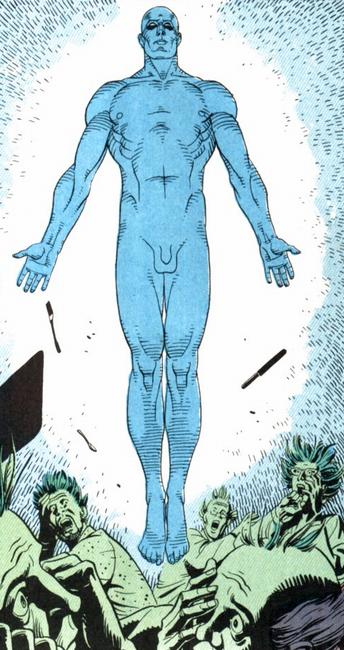
At work, as I stand in a billowing cloud of dust, a haze I suspect of being both physical and epistemological and one that I'm trying my damnedest to see through, one of the many things that I have been thinking incompletely about lately (it's hard to follow any single thought to conclusion inside this cloud of dust... hence, epistemological haze) ever since the release of Watchmen at least, a movie that I can't seem to get out of my head, but not for the right reasons, not because I liked it so much, but because for me, being a fan of the Alan Moore graphic novel, that film highlighted for me in ways that I hadn't quite thought of before the limitations of the cinematic medium, and not just the limitations of an uninspiring director, nope, but of the medium itself, but so anyway, one of the things that I've been thinking about lately is that a terrible clarity exists in film. Film, pictures of any sort really, impose a vision - one might say version - of reality upon us that, at least as far as our visual sense is concerned, should be accepted as reality. Pictures make certain demands upon or awareness of reality. Of course, when it comes to films, most of us, instead of being left to the mercies of clogged doors of perception, appeal to an epistemological structure that does not depend solely on sight, allowing us to discriminate without much hesitation or confusion between reality and fantasy. But I am not talking about artistic irony or suspension of disbelief. No, I'm talking about perception and how it relates to artistic interpretation. The clearer the image, the less room we have to negotiate with what we are seeing. I am talking, you see, about Dr. Manhattan's Penis.*
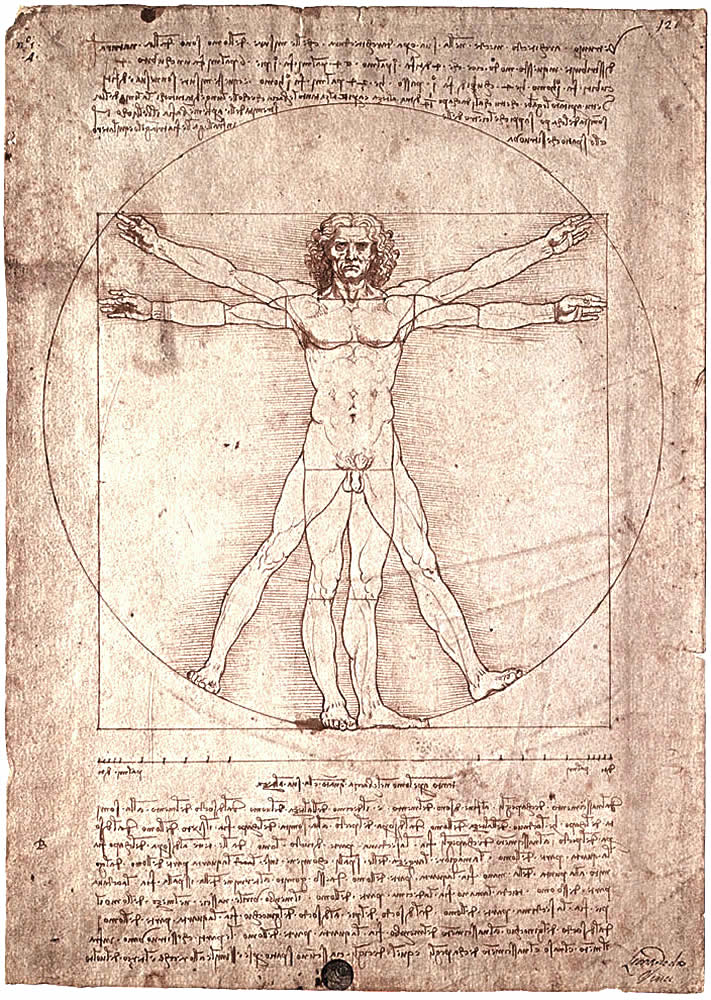
In Watchmen, Dr. Manhattan, previously John Osterman, is a sort of atomic super-being. Having been literally atomized in a laboratory accident, he reconstructed himself, particle by particle, into something else entirely, a being capable of manipulating matter and energy with nothing more than thought and will. As his fellow scientist and friend put it after John's post-accident reappearance: God exists, and he is American. But so, John, now far beyond anything recognizably human, finds himself slowly becoming detached from normal, everyday experience, a withdrawal that plays an important part in the Watchmen narrative. One of those detachments, it seems, is clothing. Though he does wear a sort of loincloth, or even sometimes a suit, when appearing in public, these are really more concessions to public morality than attempts at true modesty. Dr. Manhattan, probably because they have no meaning for him, just doesn't normally wear clothes, and in a novel so concerned with costumes and the way they create or conceal identity, this is likely important. So, for a good deal of Watchmen, you have a giant, blue-glowing man who recalls, more than anything, Da Vinci's Vitruvian man,walking around with no pants on. Just, you know, swinging in the breeze. On paper, in the panels of the novel, this works, partly because on the page the whole thing remains largely conceptual but also because of the way that Dave Gibbons chose to draw him (see above linked image), you do not so much get a penis as the suggestion of a penis.
In Zack Snyder's Watchmen, however, Dr. Manhattan's penis thrusts itself off the page, out of the realm of the conceptual, and into the full monty of visual clarity. There is no negotiating with this penis, no sir. It is there, on the screen. It moves. It possesses a lurid gravity.
Setting aside - setting far, far aside, so far aside, in fact, that you can't even see them, since they really aren't what I want to get into here - questions about the morality of on-screen nudity, it seems to me that something is lost, something perhaps critical, in this transition from concept to image, something I'm only starting to become aware of. The graphic novel is already a bridge between what is strictly textual and strictly visual, but even on the page, in this gentle blending of mediums, wiggle room can be found. A great deal of imagination is required to bring to life the images, either visual or literary. Readers aren't only consumers, they are participants. In film, or at least in most films, however, this type of imagination - which brings to life the art in the reader's mind, which brings the opportunity for self-evaluation and interpretation, which brings moments of insight - is no longer required. Another type may be, but not this one, not normally. Much of the imaginative, and what's worse, much of the hermeneutical work traditionally performed by the consumer of art is now done by the film itself. This is not an insurmountable hurdle, however, but it does require a deft hand and and a bit of trust in the audience. It requires relocating the conceptual, being aware that, though there are a few, there are not many overlaps between the literary and visual mediums. What is preciously ambiguous in one is crudely, vulgarly made obvious and dull in the full light of the other. A picture may be worth a thousand words but make that same picture move and its worth suddenly plummets. Ten words, maybe. Or fifteen. It is analogous, I think, to language. In the fuzzy passages of abstraction and conceptualization, a thought grows and expands, fills cathedrals worth of psychic pages: the thought is infinite. Spoken aloud or written down, that thought is shackled, chained, shoved roughly through Blake's dirty doors of perception. Limited, probably unintentionally, by our fumbling attempts at language.
Recently, Battlestar Galactica came to a triumphant finish. In poking around the various discussions online, however, I came across an interesting species of thought: some fans were actually disappointed in the series' finale because it left so many things "open." This sort of puzzled me because, other than a few narrative threads that simply didn't get treated (and most of these weren't terribly important), the last episodes wrapped up all the big questions. Wrapped up, that is, in that much was suggested, much was implied, much left in appropriate ways to the viewers imagination. But some viewers seemed angered by the endings provided. They apparently wanted everything spelled out. Perhaps they would have been satisfied if Edward James Olmos had turned to the camera and narrated each characters conclusions in detail, perhaps including such pointless things as what each of them ate for breakfast the next day. Maybe then they would have been satisfied. But this sort of petulent demand for absolute clarity is, I think, a consequence of what I am talking about. having grown accustomed to the cinematic medium's ability to provide absolute visual clarity, the viewer/reader's place in the creative process is lost. It goes beyond want... most viewers need everything spelled out to them, just like in a CSI episode.
We have lost the ability to negotiate with art. We are no longer adults, conversing like friends. At the feet of art, we are children. Uncomprehending. Dull. Unable to fully engage.
There are ways for the visual medium to be challenging. In the hands of filmmakers like David Cronenberg, Paul Thomas Anderson, the late Stanley Kubrick, people like this, filmmakers who understood the strenghts and weakness of visual communication, movies possess as much power, as much ambiguity, as much "literariness" as literature. There is no reason to settle for dull art.
So, trapped in my dusty haze, I ponder these things. Incompletely. No single medium is without limitation. And I am growing more and more aware of film's limitations. Watchmen isn't a horrible film. But it does highlight the problem of a medium's versitility. Brought to life, Dr. Manhattan's giant blue member is distracting. But Snyder was, I think, trapped: he could either be "faithful" to the text** (whatever that means) or adapt it to the new medium. Neither is entirely preferrable, so I think Watchmen should have stayed exactly what it was. But Watchmen isn't the problem. It only tugged into the open a question that had been slowing gathering force in my mind. As we hurl ourselves headlong into new technological frontiers, with ever expanding entertainment vistas opening up in front of us, as hi-def technology becomes more readily and easily available, I'm wondering if a clearer, sharper image is really what we need. Maybe the older, fuzzier images nurtered healthier imagintions.
*****
UPDATE: As my friend Life of Turner points out - and I can always trust him to point these things out - I may have come across as a bit too iconoclastic here. I'm not dismissing the medium entirely. As anyone who has met me or reads this site already knows, I have invested a great deal of my time and mental activity into film. I'm not about to abandon it. I think great directors, and sometimes even not so great ones, powerfully employ the medium, twisting it, manipulating it, forcing it to play on our emotions and intellects in ways we may not have been prepared for; they throw back into Marshall McLuhan's face his aphoristic assertion: the medium may be the message, but we can manipulate the medium. However, unless you*** are Lynch or Herzog or Cronenberg or (P. T.) Anderson, or some one of the other very few people out there really making films, and I mean really making them, you are more likely the manipulated in this situation and not, as you may think, the manipulator. And for the self-unaware, mediums are tyrannical masters: they will break your back and take from you everything. The cinematic medium is a savagely literal one. It relies, almost exclusively, on sight, and sight, as my master William Blake taught me, is defective. "We are led to believe a lie / when we see not thro the eye." Years of literal conditioning has left audiences far less jaded and sophisticated than they think. They are often imaginative infants, craddled within the medium's dictatorial arms. What we read, what we watch, what we play - these things shape our minds. So this isn't a dismissal of the medium. It's a desire to see the medium used properly. As long as filmmakers rely on their medium's visual clarity (and those who do almost always couple visual clarity with dialogue so utterly banal and dull as to boggle the mind - a double crime against art), as long as, in other words, we as viewers are meant to turn off our minds and simply accept what we are seeing, film and television will continue encouraging us into a downward spiral that ends in the opposite of enlightenment, in mental darkness.
Too much? Nay, not enough!
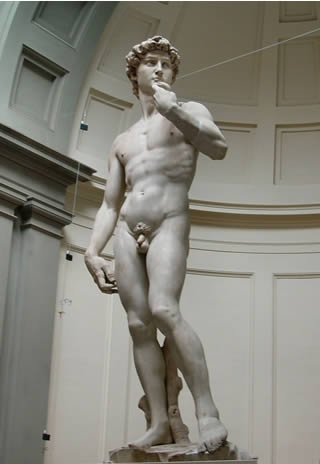
*Interesting side-story. The other day I found and uploaded onto photobucket.com this picture of Dr. Manhattan taken from the Watchmen graphic novel. When I logged back into photobucket, however, I was told that the image, I guess because it includes a picture of a penis, had been moderated. Frustrating. I wonder if an uploaded picture of David would receive the same treatment.
** I think that he, by remaining so visually faithful to the text (in this case image), probably thought he was being "edgy" (whatever that means) by so prominently including the Doc's giant dong. Sorry, Snyder... it just adds another layer of tonal schizophrenia to an already confused film.
*** This is perhaps my most inappropriate use of "you" ever. Really, it doesn't make any sense.
Saturday, March 7, 2009
Review :: Watchmen
When asked how he would make Watchmen, beloved auteur of the bizarre and all things strange Terry Gilliam, who was once attached to direct the film, said that it should be made as a twelve-part mini-series; when asked how he would make Watchmen, series creator and crazy-looking person Alan Moore, who is famously upset because of several movies poorly adapted from his work (among which is the disastrous The League of Extraordinary Gentlemen and the not-so-disastrous but still not very good V for Vendetta), said he wouldn't. Watchmen shouldn't be adapted; it's unfilmable; it would be irreparably damaged in translation. However, cutting into some middle ground between Gilliam's hypothetical twelve plus hour epic and Moore's self-important insistence on zero, director Zack Snyder, convinced of his own directorial abilities, which, let's be honest, does include a powerful if somewhat shallow eye for spectacle and visual invention, has brought Watchmen to the big screen in what I am sure he thinks is all its giant, blue-glowing glory. But does Watchmen survive translation? The graphic novel is, if not the greatest, than at least very high on the list of greatest graphic novels of all time; it is one of those works of art that not only uses its medium to the fullest potential possible but which transcends that medium, elevating it beyond what was thought possible. Though the same can't be said for the film, Watchmen is a serviceable adaptation. Which is to say that it is disappointing.
 Watchmen is the story of the end, or perhaps the beginning, who knows, of the world, and it is set in an alternate universe, one resembling our own but just ever-so-slightly laterally shifted off centre. It is a 1980's-ish universe in which Richard Nixon is serving his third term, America won the Vietnam war, and in which costumed heroes and masked vigilantes, heroes and villains both, are not the stuff of comics and kids stories but of every day life. Or at least they had been until a government act banned "masks" and outlawed costumed heroes. Now, most of these former heroes and villains live ordinary lives, haunted by the deeds and heroics of their past shadow lives. But when, with the doomsday clock sitting at five minutes to midnight and with the Americans and the Russians staring down the barrel of mutually assured nuclear annihilation, one of these former heroes, The Comedian (Jeffrey Dead Morgan), is murdered, the one costumed hero who has refused to give up his vigilante ways, Rorschach (Jackie Earle Haley), suspects that a plot to kill off "masks" has been hatched and sets off to find answers. What ensues is a sprawling, ambitious super hero epic, one that quickly spirals much deeper then one dead former hero into a plan to change the world, entirely, forever.
 Though I love the source material (and I mean really love it, which probably only exacerbates my disappointment), and though there are parts of this film that work, and work really well, Watchmen as a whole doesn't work. I don't know, perhaps no adaptation of it could work. I'm not quite sure how to nail down my criticisms of it, however, since individually all the elements seem to work on their own. The casting, especially Jeffrey Dead Morgan and The Comedian and Jackie Earle Haley as Rorschach, is dead on, and the decision to go with relatively unknown actors (Billy Crudup as Doctor Manhattan and Malin Akerman as Silk Specter II are probably the most recognizable actors here) probably serves the film well since none of the actors bring too much of their filmographic baggage to the show. The effects, and many of the set-pieces, like the prison break scene, also work very well. Zack Snyder, who's last film was the vacuous though visually arresting 300, can obviously direct action and manage CGI. But, though everything looks good on paper, and even looks good on film, and though the film is remarkably faithful to the novel, perhaps even to a fault, something is missing, and I'm not only referring to the cut material. As a fan of the source material, it's impossible for me to separate my expectations for the film from what I already know and love of the novel. And though I can tolerate and even appreciate (when done well) changes or updates when it comes to adaptations, I can't forgive shallowness. Watchmen the film only skims across the surface of Watchmen the novel, never diving deeper into its murkier depths. So while all the important components of the story are present and accounted for, they aren't quite used to their proper effect.
To illustrate all this, especially the film's failings as an adaptation, a comparative digression. As if the darker pages of Marvel or DC had spilled over into reality, allowing costumed heroes to roam about the cities, accepted - even if begrudgingly - as a feature of ordinary life, Alan Moore's Watchmen deconstructed the super hero genre. However, Moore's heroes are not the shiny, wholesome types of heroes we've come to expect from comics.* His heroes, instead, are ones that fight or participate in crime in order to fulfill the needs of some psychological disorder. Costumes don't hide identity; for the characters in Watchmen, they create them. Walter Kovacs is Rorschach's alter-ego; the ordinary man is the vigilante's disguise. So sociopaths, lunatics, and borderline schizophrenics: these are the kinds of people putting on costumes. These are the watchmen guarding society - ethically suspect, viciously violent, teetering on the fine edge between moral certitude and outright insanity. In Zack Snyder's Watchmen, however, these ambiguities and subtleties of character are never explored. They are present, yes, but only in some perfunctory sort of way. An example: a scene, a pivotal one in the Rorschach origin story, is clumsily represented. Instead of letting us feel what Rorschach felt, instead of developing the scene in a way that allows audiences to share in his moral outrage, we are hastily told what Rorschach felt. What should be experience becomes exposition. Another example: the lust and sexuality hidden in both Silk Spectre II and Nite Owl II (Patrick Wilson)** that emerges as the two of them resume their long-repressed costumed ways is present on screen (boy is it ever) but isn't given its proper weight. It comes off more as cinematic titillation and as a strong desire to earn that 18A rating than as a psychological imperative driving these characters. Now both of these examples would be fine (though probably not so graphic) if this were just another Spider-Man movie or X-Men movie or just another of any of the major comic book movies plugging up theatres all over the place, but with is Watchmen, dammit. The film has pretensions beyond this. It deserves to have its themes handled by a steady hand and not by someone more concerned with making them look right. And when the film so obviously wants to be taken seriously and considered portentous, it needs to offer more than Snyder seems capable of delivering.
Since Christopher Nolan re-launched Batman and gave us what were essentially arthouse films disguised as summer blockbusters, comic book movies have been trying to outgrow their ordinarily B-grade britches. Now, here is a story ripe for such a treatment - demanding such a treatment, screaming out for it - but which gets, instead, Zack Snyder. While I have no doubt that he loves Watchmen, I do doubt Snyder's ability to direct anything of real emotional or intellectual substance. When the Watchmen teaser debuted a few months ago (conveniently embedded above), I watched it over and over again, reveling in its visual splendor, salivating over its images and the promise that they offered - an adaptation worthy of its source. Now, having seen the final product that Snyder delivered, I know why I liked that trailer so much and why I am so disappointed in the film. Snyder is a surface director. He can make anything look good. But while Watchmen looks good, it never gets past the make-up and the CGI, never dives into those deeper waters. It's like he pain-stakingly recreated the panels of Watchmen without actually understanding what they meant, giving us a pretty forgery instead of a true adaptation. I want to love this movie. I want Watchmen to be brilliant. Even just watching the trailer again, I wonder if I've got this wrong. But I don't think that I have.
Experto Crede: Though visually stunning and lovingly rendered, Watchmen fails to deliver much more than a shallow recreation of the graphic novel. It's a decent film, sure, but it's not the film the novel deserves.
* This worked better, and packed a heavier punch, I imagine, when the graphic novel was initially published, in the late 80's. Now, sociopathic heroes are all too commonplace.
** Um, just ignore the genealogical numbering. It would take too long to explain. Let's just say I'm too much of a purist to leave them off.
 Watchmen is the story of the end, or perhaps the beginning, who knows, of the world, and it is set in an alternate universe, one resembling our own but just ever-so-slightly laterally shifted off centre. It is a 1980's-ish universe in which Richard Nixon is serving his third term, America won the Vietnam war, and in which costumed heroes and masked vigilantes, heroes and villains both, are not the stuff of comics and kids stories but of every day life. Or at least they had been until a government act banned "masks" and outlawed costumed heroes. Now, most of these former heroes and villains live ordinary lives, haunted by the deeds and heroics of their past shadow lives. But when, with the doomsday clock sitting at five minutes to midnight and with the Americans and the Russians staring down the barrel of mutually assured nuclear annihilation, one of these former heroes, The Comedian (Jeffrey Dead Morgan), is murdered, the one costumed hero who has refused to give up his vigilante ways, Rorschach (Jackie Earle Haley), suspects that a plot to kill off "masks" has been hatched and sets off to find answers. What ensues is a sprawling, ambitious super hero epic, one that quickly spirals much deeper then one dead former hero into a plan to change the world, entirely, forever.
 Though I love the source material (and I mean really love it, which probably only exacerbates my disappointment), and though there are parts of this film that work, and work really well, Watchmen as a whole doesn't work. I don't know, perhaps no adaptation of it could work. I'm not quite sure how to nail down my criticisms of it, however, since individually all the elements seem to work on their own. The casting, especially Jeffrey Dead Morgan and The Comedian and Jackie Earle Haley as Rorschach, is dead on, and the decision to go with relatively unknown actors (Billy Crudup as Doctor Manhattan and Malin Akerman as Silk Specter II are probably the most recognizable actors here) probably serves the film well since none of the actors bring too much of their filmographic baggage to the show. The effects, and many of the set-pieces, like the prison break scene, also work very well. Zack Snyder, who's last film was the vacuous though visually arresting 300, can obviously direct action and manage CGI. But, though everything looks good on paper, and even looks good on film, and though the film is remarkably faithful to the novel, perhaps even to a fault, something is missing, and I'm not only referring to the cut material. As a fan of the source material, it's impossible for me to separate my expectations for the film from what I already know and love of the novel. And though I can tolerate and even appreciate (when done well) changes or updates when it comes to adaptations, I can't forgive shallowness. Watchmen the film only skims across the surface of Watchmen the novel, never diving deeper into its murkier depths. So while all the important components of the story are present and accounted for, they aren't quite used to their proper effect.
To illustrate all this, especially the film's failings as an adaptation, a comparative digression. As if the darker pages of Marvel or DC had spilled over into reality, allowing costumed heroes to roam about the cities, accepted - even if begrudgingly - as a feature of ordinary life, Alan Moore's Watchmen deconstructed the super hero genre. However, Moore's heroes are not the shiny, wholesome types of heroes we've come to expect from comics.* His heroes, instead, are ones that fight or participate in crime in order to fulfill the needs of some psychological disorder. Costumes don't hide identity; for the characters in Watchmen, they create them. Walter Kovacs is Rorschach's alter-ego; the ordinary man is the vigilante's disguise. So sociopaths, lunatics, and borderline schizophrenics: these are the kinds of people putting on costumes. These are the watchmen guarding society - ethically suspect, viciously violent, teetering on the fine edge between moral certitude and outright insanity. In Zack Snyder's Watchmen, however, these ambiguities and subtleties of character are never explored. They are present, yes, but only in some perfunctory sort of way. An example: a scene, a pivotal one in the Rorschach origin story, is clumsily represented. Instead of letting us feel what Rorschach felt, instead of developing the scene in a way that allows audiences to share in his moral outrage, we are hastily told what Rorschach felt. What should be experience becomes exposition. Another example: the lust and sexuality hidden in both Silk Spectre II and Nite Owl II (Patrick Wilson)** that emerges as the two of them resume their long-repressed costumed ways is present on screen (boy is it ever) but isn't given its proper weight. It comes off more as cinematic titillation and as a strong desire to earn that 18A rating than as a psychological imperative driving these characters. Now both of these examples would be fine (though probably not so graphic) if this were just another Spider-Man movie or X-Men movie or just another of any of the major comic book movies plugging up theatres all over the place, but with is Watchmen, dammit. The film has pretensions beyond this. It deserves to have its themes handled by a steady hand and not by someone more concerned with making them look right. And when the film so obviously wants to be taken seriously and considered portentous, it needs to offer more than Snyder seems capable of delivering.
Since Christopher Nolan re-launched Batman and gave us what were essentially arthouse films disguised as summer blockbusters, comic book movies have been trying to outgrow their ordinarily B-grade britches. Now, here is a story ripe for such a treatment - demanding such a treatment, screaming out for it - but which gets, instead, Zack Snyder. While I have no doubt that he loves Watchmen, I do doubt Snyder's ability to direct anything of real emotional or intellectual substance. When the Watchmen teaser debuted a few months ago (conveniently embedded above), I watched it over and over again, reveling in its visual splendor, salivating over its images and the promise that they offered - an adaptation worthy of its source. Now, having seen the final product that Snyder delivered, I know why I liked that trailer so much and why I am so disappointed in the film. Snyder is a surface director. He can make anything look good. But while Watchmen looks good, it never gets past the make-up and the CGI, never dives into those deeper waters. It's like he pain-stakingly recreated the panels of Watchmen without actually understanding what they meant, giving us a pretty forgery instead of a true adaptation. I want to love this movie. I want Watchmen to be brilliant. Even just watching the trailer again, I wonder if I've got this wrong. But I don't think that I have.
Experto Crede: Though visually stunning and lovingly rendered, Watchmen fails to deliver much more than a shallow recreation of the graphic novel. It's a decent film, sure, but it's not the film the novel deserves.
* This worked better, and packed a heavier punch, I imagine, when the graphic novel was initially published, in the late 80's. Now, sociopathic heroes are all too commonplace.
** Um, just ignore the genealogical numbering. It would take too long to explain. Let's just say I'm too much of a purist to leave them off.
UPDATE: Here's a link to an AICN interview between Quint and Zack Snyder. While Quint is polite, and geeks out at the right moments, the whole interview only confirms my suspicions: that Snyder, probably through no fault of his own, I don't know maybe he's too young or something, should not have directed the film.
Saturday, February 28, 2009
Review :: Choke
When it came out in 1999, Fight Club seemed like a big deal. I was only 18 at the time, but after seeing that film, and after veraciously reading the Chuck Palahniuk novel upon which it was based, there came over me a sense that this - this schizo-social satire and savagely sardonic examination of masculinity coming out of the raggedy last breaths of a tormented millennium - was important. The film opened up a new world to me, the world of film as art, a world in which big questions could be asked, and maybe answered, on screen.* So I have a bit of a soft spot for that film. However, it struck me then, and it still strikes me now, that Fight Club, perhaps because of David Fincher's direction, perhaps because of the actors (I still can't see Edward Norton without thinking of Jack's smirking revenge), feels better suited to the cinematic medium than to the printed one. Now, nearly 10 years later, another Palahniuk adaptation, Choke, lurches forth and, having already read the novel, the same question swirls about in my head. Does Choke work as a movie? Well, sort of.
 Choke, directed be one Clark Gregg, is the story of Victor Mancini (Sam Rockwell), a sex-addict and all around self-involved degenerate. His life is depressing: he and his best friend, a fellow sex-addict and chronic masturbater, Denny (Brad William Henke), work as "historical interpreters" in one of those lousy recreations of an early colonial village, which they both, of course, despise, despite being the default posture in this sorts of situations; his mother, Ida (Anjelica Houston), who apparently raised him while mostly on the run from the police, she being one of those anarchist, pseudo-revolutionary types who spend most of their time pulling mean-spirited pranks, has been hospitalized because of a rapidly deteriorating, and drug-fueled, mental condition and she only occasionally recognizes him; he compulsively has meaningless sex with strangers, though he is, well now this is just awkward, apparently unable to perform with people he might actually like, the self-loathing prick; and, just to top it all off, he and Denny, in a nihilistic tour de force, go from restaurant to restaurant staging chokes: Victor will deliberately choke on his food, you see, and then flail about the place, giving a stranger - preferably a wealthy one, wealthy people generally being the self-hating types who will always give away money in an effort to convince themselves that they are not, in fact, wretched people - the opportunity to "save" him. He is, in other words, hopelessly lost.
 Choke, directed be one Clark Gregg, is the story of Victor Mancini (Sam Rockwell), a sex-addict and all around self-involved degenerate. His life is depressing: he and his best friend, a fellow sex-addict and chronic masturbater, Denny (Brad William Henke), work as "historical interpreters" in one of those lousy recreations of an early colonial village, which they both, of course, despise, despite being the default posture in this sorts of situations; his mother, Ida (Anjelica Houston), who apparently raised him while mostly on the run from the police, she being one of those anarchist, pseudo-revolutionary types who spend most of their time pulling mean-spirited pranks, has been hospitalized because of a rapidly deteriorating, and drug-fueled, mental condition and she only occasionally recognizes him; he compulsively has meaningless sex with strangers, though he is, well now this is just awkward, apparently unable to perform with people he might actually like, the self-loathing prick; and, just to top it all off, he and Denny, in a nihilistic tour de force, go from restaurant to restaurant staging chokes: Victor will deliberately choke on his food, you see, and then flail about the place, giving a stranger - preferably a wealthy one, wealthy people generally being the self-hating types who will always give away money in an effort to convince themselves that they are not, in fact, wretched people - the opportunity to "save" him. He is, in other words, hopelessly lost.
 If this all sounds a bit overdone, if it sounds a bit like a Slothropian spiral into pointless deviance, that's because it is. Unlike Fight Club, in which deviance was used to treat the societal disease, the deviance being often more tolerable and appealing than the plastic and manufactured norm of a soulless and largely homogenized society, Choke uses deviance as an end unto itself, so that, as with Victor's friend's self-pleasuring addiction, the result is basically potency without creation. All the elements of a satiric roll in the cultural hay are here but none of them feel genuine, as if both Palahniuk and the filmmakers just decided to sit down and manufacture of sort of Thomas Pynchon-lite experience, one that on the surface seems meaningful and important but which is ultimately not much more than a hollow recitation of moral horrors and empty obscenities. If I may make a comparison, the appeal of the Tyler Durden character lay in his refusal to participate in, and his willingness to viciously exploit, the casual shallowness of post-modern society. Fight Club felt like a mythic restructuring of culture at the hands of cultural deviants, and it all appeared teleological - Durden was burning down society but in order to create another one. His actions had an end, a goal. Victor, on the other hand, is a character with no power (even though Rockwell is a powerful actor). He is neither the rallying, messianic figure of a post-modern cultural revolution nor is he an audience surrogate, a stand-in for some sort of shared cultural experiece. If this is some half-addled attempt at satire, it is lost on me because satire requires at least a few points of affinity, some touchstones with which we can say Yes, that's me or Yup, that's true. But there are no touchstones here. It seems too disconnected from ordinary experiance, too outrageous in its pruriance to be meaningful satire.
And yet, even after this heavy mountain of criticism, I'd be lying if I said that there's nothing here to like. Sam Rockwell, for instance, is fantastic. It always seems to me as if he is on the very edge of greatness but always fails to get the recognition he deserves. Also, tonally speaking, this movie is dramatically different than Fight Club, which I appreciated, and which is probably a good thing, both for director Clark Gregg and Palahniuk. (I keep bringing up Fight Club, and I feel bad about that, but that film/book really does cast quite a long and deep shadow over the rest of Palahniuk's work and over all other, but at this point largely hypothetical, Palahniuk adaptations (Edit: oh, I just checked IMDb and I guess another Palahniuk adaptation is on the way)... anyway, but so Fight Club had this iconoclastically epic feel to it, which was appropriate for a film about cultural apocalypse. Here, Gregg wisely steers the project into a much more subdued, and dare I say intimate, direction.) Though, returning to my earlier criticisms, I do think that an unintended, or probably unintended, consequence of this direction is that the film's subversive elements, if there are any here, are undercut by a sense of stylistic mediocrity, as if the movie's style and theme don't quite cooperate with each other.
And yet, even after this heavy mountain of criticism, I'd be lying if I said that there's nothing here to like. Sam Rockwell, for instance, is fantastic. It always seems to me as if he is on the very edge of greatness but always fails to get the recognition he deserves. Also, tonally speaking, this movie is dramatically different than Fight Club, which I appreciated, and which is probably a good thing, both for director Clark Gregg and Palahniuk. (I keep bringing up Fight Club, and I feel bad about that, but that film/book really does cast quite a long and deep shadow over the rest of Palahniuk's work and over all other, but at this point largely hypothetical, Palahniuk adaptations (Edit: oh, I just checked IMDb and I guess another Palahniuk adaptation is on the way)... anyway, but so Fight Club had this iconoclastically epic feel to it, which was appropriate for a film about cultural apocalypse. Here, Gregg wisely steers the project into a much more subdued, and dare I say intimate, direction.) Though, returning to my earlier criticisms, I do think that an unintended, or probably unintended, consequence of this direction is that the film's subversive elements, if there are any here, are undercut by a sense of stylistic mediocrity, as if the movie's style and theme don't quite cooperate with each other.
So out of all of this can I pull a recommendation? Sure. It's not a bad movie. It just isn't great. But coming from Palahniuk, the man who gave us Fight Club, I want greatness, or at least I want meaningfulness. This just feels small, and not in a good way, but as if both he and this film are retreading already well-worn paths, and not treading them nearly as well as others, or as in Chuck's case, as well as he himself, have done in the past. It's satire unhinged, aimed at nothing, and in the end more nihilistic than useful.
Experto Crede: Choke isn't all bad. It's just not all that good either. If you are counter-cultural, or if like me you just enjoy every once in a while adopting a counter-cultural posture, you might like this. You just as likely won't, though.
* This has more to do with my own biography than with any innovation on Fight Club's part. I simply hadn't seen many "important" films at that time in my life.
Subscribe to:
Posts (Atom)